Ripheus23
-
Posts
1318 -
Joined
-
Last visited
-
Days Won
2
Content Type
Profiles
News
Forums
Blogs
Gallery
Events
Everything posted by Ripheus23
-
Whom watcheth the watchethmen
-
On the tip o' my tongue for some years now
Ripheus23 replied to Ripheus23's topic in Cosmere Discussion
If any of this was an indication of anything, that leaves three more evil (from our POV, or whatever) Shards, one for a prison-plane, one for some floating volcanoes or what IIRC, but where one of the ultimate fiend-lords dwells, and one for another battle-plane. Preservation, maybe. -
For some reason, the 16/17 thing about the Shards has always subtly reminded me of something, but I couldn't figure it out. The closest was thinking that the 16 might be relevant to a personality test. However, within the last few days, I finally remembered. The Outer Planes from D&D. I don't know what state the D&D cosmologies are at today, but while I was growing up, they were still roughly at the, "Sixteen Outer Planes surrounding a seventeeth," stage. Now, the logic behind them is morally slanted, plus only really requires nine examples, but let's imagine that there's a vague possible mapping from the Outer Planes to the Shards, with the 17th Shard being the neutral "center." Here are my guesses: Odium: The Gray Wastes (from Wikipedia: "Here, all emotion and compassion is drained away, until only hopelessness, selfishness and apathy remain"). Dominion: Baator Ruin: The Abyss Mechanus: Preservation (Wiki: "This clockwork plane is the ultimate in order") Having a heck of a time with Cultivation, maybe Arcadia, the Beastlands, or Arborea Honor: Ysgard ("The eternal battleground where true heroes prove their valor": Tranquiline Halls much? though this depends on how much of the TH mythos is Honor's) Devotion: Elysium Autonomy: Limbo Ambition: Pandemonium Endowment: Bytopia (only "link": the term "BioChromatic Breath") EDIT: Possible extra Shards Ingenuity/Wisdom and Grief = have neutral planar counterparts? Also if Honor is not Ysgard, he's Celestia, maybe.
-
The key to defeating Odium is to arrange a marriage for him... ... to Taravangian. The Stormfather again officiates, hence the title.
-
OMG Knights of Honor's Truth Knife of Heaven's Treasure Knowledge of Hope Knowledge of Wind Ketek of Highstorms House of Worldsingers
-
Mwahahaha Knowledge of Wailing Tentacles, Keep of Worrisome Turtles, Kiln of Weaponized Terebinths. King of Wriggling Teetotalers. Knights of Whistling Tomatoes.
-
"Since ZFC provides us with the resources to construct ultrapowers, we can construct inner models using mice."
-
I will square the circle, even if it is impossible.
-
Kelp of Wiggles. Krill of Whales. Knurl of Whirls. Kerfluffle of Whiplash. EDIT: Kettle of Worms, Kaleidoscope of Wishes, Kiosk of Windows, Keel of Wolves, Knell of Wilting, Knee of Wit, Koala of Width, Knife of Worship, Karaoke of Wealth.
-
Sanderson also uses the phrase "one-to-one correspondence" periodically (in WoBs). In set theory, the word "cardinality" was originally read off the notion of suits and ranks in decks of cards (the example being 4 suits X 13 ranks giving you a "set with a cardinality of 52"). 1-to-1 correspondence ends up being crucial to defining "different sizes of infinite cardinalities." I wonder if there's anything about the Physical-Cognitive interface that suggests you could get a lot of indirect magical power from thinking about infinite sets. My guess is that there is, that the Set are either on to the problem or know (part of) its solution, etc.
-
Kiss of Wonder
-
"The souls of the lepidoptera finalitas contain prophecies. Think of them like flying fortune cakes..." "Be gentle! Heed the lepidoptera..."
And they said:
"Hither! Purple whispers creep! The noose is loose! Kitten and a kaboose!"
"There are 9.23 grams of marmalade dried to the base of Mrs. Losensky's blue ceramic bucket..."
"I woke up one morning to find that my nose had detached itself from my face and been transformed into a hideous, lavender-scented aardvark..."
"Apollyon likes bloody omelets..."
"There seem to be a few problems with the argument: it is too long and only quotes The Minstrel of Lettuce..."
"The quotient of a positive shirt and a negative shirt is a set of four-legged pants..."
"Good grief, it looks like I missed the coronation of my skeleton's last remarks..."
"What a mighty! I! What!"
"My nephews never believed that I used the abacus for firewood to power my mitten-crinkling machine..."
"Tsk. As if YOU had ever shaken hands with the Form of Handshakes..."
-
Can't believe I didn't think of "Wind." Oooh, what about "Wraith"? Also, super-wordplay it would be if the K was for "ketek"...
-
Not King of Ways, King of Words... Killer of Worlds? I think that's a book name already. Kindness of Worth, Keeper of Woe, Kite of Wrath, Knowledge of Wisdom, Key of Whispers, Kitten of Wrong, Kayak of Wombats, Knot of Wreaths, ...???
-
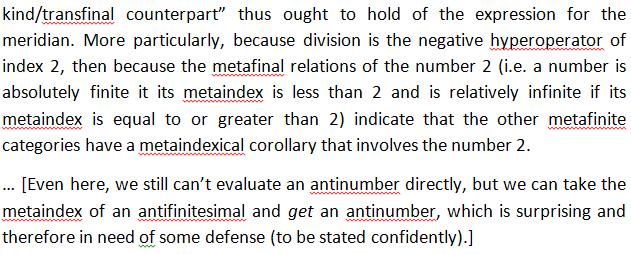
I realized that there's a difference between proving "x is not a set of anything" and proving "x is a set of nothing," and I needed to prove that the ur-element is not a set of no elements of any set, including itself. I think I worked it out* but anyway, another result of the model was that while zero is an empty subset of other sets (a set with no elements of any other sets), so all other sets are empty subsets of zero (sets of no elements of zero). So this underscores why for all natural numbers n besides 0, the powerset is uniquely 2 to the power of n, whereas 0 to the power of 0, 1 to the power of 0, 2 the power of zero... 1 to the power of 1, 1 to the power of 2, 1 to the power of 3... = 0 ^^2 = 1 ^^ 2 = 1. <So zero is the only number before aleph-zero that has an infinite number of powerset expressions.>
*my idea is that "being a set of no elements of x" means being 0 (in relation to other numbers) and being other numbers (in relation to zero). But the relation is never defined on the ur-element. More, then, we can just define the ur-element such that it it is not a set of no elements of other sets, nor itself. In conjunction with the ur-element's not being a set of anything either, it follows that it is not a set of anything or nothing, which rules out the ur-element being a set.
-
minotaur elements
minotaur ordinals
dragon ordinals
unicorn ordinals
Orpheus surreals
Osirus ordinals
Amaterasu cardinals [again]
Ragnarok cardinals
Michael cardinals
Raphael ordinals
Gabriel surreals
Asmodeus surreals
warlock ordinals
sorcerer ordinals
wizard cardinals
sortilege ordinals
demonic cardinals
leviathan transet
"kenotic transet" <said of the ur-element> and "pleromatic set"
happy cardinals
sad ordinals
priestly cardinals
hieratic ordinals
sword cardinals
sword ordinals
nuclear cardinals
nuclear ordinals
nuclear surreals
presbyter cardinals
deacon cardinals
"reformed cardinals" <so large only divine revelation can give knowledge of them>
Ezekiel cardinals
Oberon numbers
Aquinas cardinals
Nicean cardinals
irminsul ordinals
Odysseus ordinals
Aeneas surreals
Milwaukee cardinals ("a kind of joke cardinal")
cheddar ordinal
parmesan cardinal
cola ordinal
hemlock ordinal
Icarus transet
ambrosiac cardinal
cowardly cardinal
cowardly ordinal
helpless surreal
potato surreal
guitar cardinal
piano ordinal [haha]
Deseret cardinal
-
-
Anselm cardinals. A transet in V proposed by the "cult of the universal constructor." Its elements are supposed to be "cardinals so large that only divine power could have brought them into being" or give them a reference. Note that this concept therefore requires that Anselm numbers be transfinally ordered, making the first Anselm number into the meridian of a nexus <where the Anselm section of V is the "greatest" section>.
cult of the universal constructor, the. Believers in a transcreationist model of the Godelian universal constructor. Their leader is Cardinal Mahlo [finally!], who is actually secretly working with the Septarch of Commandment (also known as Deonomy). According to the cult, it is not provable whether empirical reality was created by a divine nature, but it is provable whether mathematical reality was transcreated by a divine nature. <The argument goes: there is a possible mathematical world that was transcreated; therefore there is a possible transcreatrix; if something is a transcreatrix, it is this necessarily; therefore the transcreatrix, if it exists for any possible mathematical world, exists for all of them.>
Godelian universal constructor. An entity whose existence is supported by Godel's ontological argument. Similar to the necessary agent.
necessary agent, the. Posit of naive deontic logic: there is an obligation that exists purely from logical grounds (an obligation to "uphold" the law of non-contradiction), wherefore there is always (necessarily) an agent able to discharge the obligation. In ecograph theory, this posit is actually a principle for the manifestation of different kinds of "necessary" agents.
Deonomy. The Septarch empowered by divine-command theory. He was also the first ecoarch to manipulate the Keyscape in order to the Septatheon. (Note that ecoarchs are already a peculiar kind of "necessary agent.")
-
<Why are Anselm cardinals not defined as "none greater than which can be conceived"? First, in context, there is no individual such cardinal. Second, this definition is implicit in the notion of a transfinal ordering, which attaches to the base definition by virtue of saying "divine nature" there, since a divine nature is one that transfinally orders things <or so the theory goes>. Of course, those who accepted the existence of Amida cardinals thought otherwise: these were "so large that only a mathematician gifted with divine power could access them." But these mathematicians with this gift need not be divine "inherently," only called that by reference to the power at issues (which power could well be impersonal, as in the so-called Tian model).>
-
-
Next step/stage.
-
-
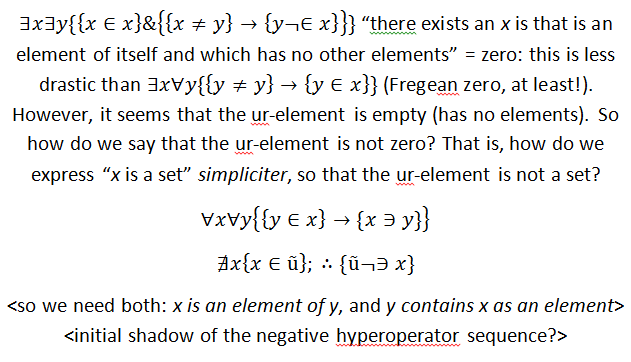
*Regarding zero: Z = {Z}, Z ~= element of ~Z, for all X, if X is not Z then X ~= an element of Z. "Zero is an element of itself, is not an element of any other set, and has no other elements besides itself." By contrast, "The ur-element is not an element of itself, is an element of only one set, and is the only element of that set" = 1.
-
-
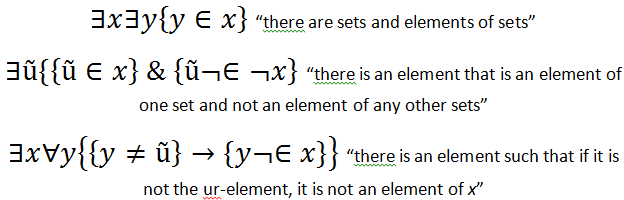
First-run technical account of the ur-set and the ur-element concept.
-
I suppose I'd question that "is highly likely that" claim. I'm not that well-versed on probability, though. The most I can say for now is that there is a difference between chance and randomness, probability has more to do with chance, free will might not be random but so maybe it would count as a third (or whichever) alternative on the "same level as" things like determinism, probability, and randomness.
-
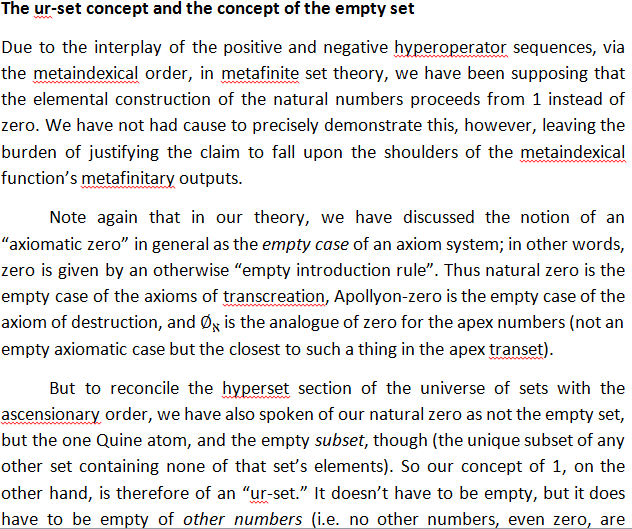
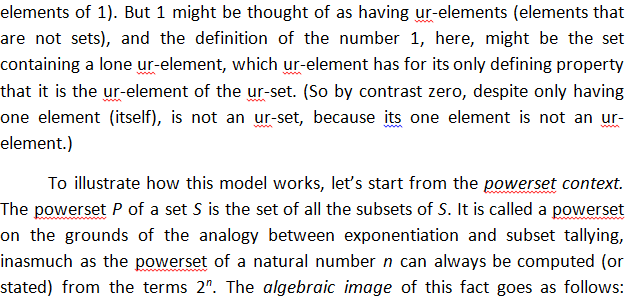
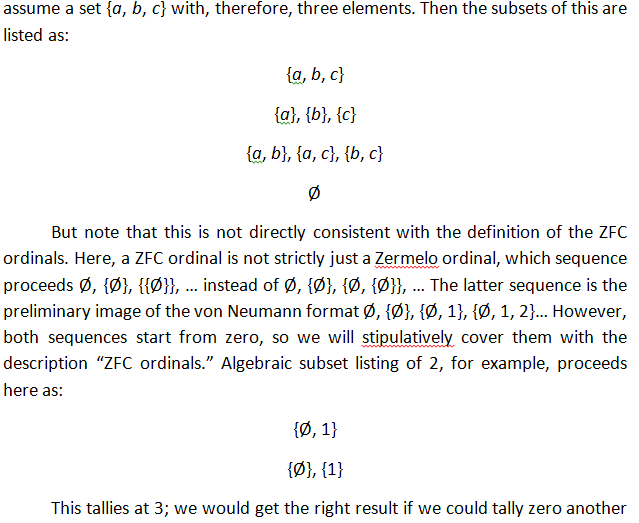
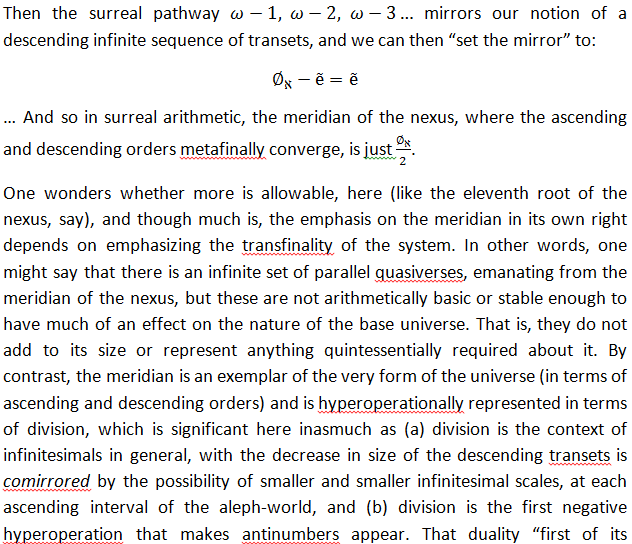
Haha, I finally managed to come up with a thoroughly set-theoretic foundation for my theory. The main thing is not to start with the empty set as zero. Rather, we define zero as a Quine atom (a = {a}) and 1 as the equivalent of the empty set. Here zero is the empty subset. I checked the powerset listing under this definition and it works (I couldn't get the classical definition to work, I will add).
-
More particularly, can a strong concept of free will be proved? Let us say that we are looking for the kind of free will involved in the representation of "Choose Your Own Adventure" books: same conditions at time t but divergent outcomes at t+. Then not, "They were free to do otherwise if they had chosen otherwise," but, "They were free to choose otherwise in the first place." The basic argument from moral concepts is that, if ought-implies-can, then when we do as we ought not, we could've done otherwise; ergo... This has proven less convincing than it was supposed to be (one major philosopher, Immanuel Kant, made it the touchstone of his argument for strong free will), among other things due to doubts about the unrestricted license for "ought-implies-can." However, let us suppose that a "moral fact" would always correspond to some imperative. Then, "X is right," corresponds to, "Do X." So let us focus on imperatives themselves. Now an assertion is semantically satisified if it is true, whereas an imperative is semantically satisfied if it is complied with. "This sentence is true," has for a counterpart, "Comply with this imperative" (and then the paradoxical, "This sentence is false," maps to the paradoxical, "Don't comply with this imperative"). So imperatives are "action-guiding." I think it can be quickly demonstrated that this condition requires strong free will to "make sense." Let's start with an intuitive statement: "An imperative I holds if and only if I can be complied with for the sake of being complied with." We will not elaborate much on this word "holds," here. Roughly, it is a concept of semantic satisfaction (again), this time one that is applied such that an imperative I is "meaningless" just in case I doesn't hold. The individual words used in the imperative might be meaningful, true. But imagine that you have a friend F and you are in Antarctica and F is in northern Canada. You say out loud, "F, don't let the dogs out." Your command is meaningful partwise, but supposing F can't hear you when you issue it, then your command doesn't hold for F. Even if F doesn't let the dogs out, this is not "for the sake of" complying with your command since F is unaware of your command. Next, immediately, an imperative doesn't hold if it can't be complied with at all, i.e. if the command is to do something impossible. Or if you are already doing what someone then tells you to do, or if some outside force is forcing you to independently do such a thing, then again this what-you-are-told-to-do isn't being complied with for the sake of compliance, but for some other reason. And it wouldn't work to say that, by commanding someone to do something, I then cause them to do this thing: the way imperatives are addressed inherently represents addressees as the ones meant to cause compliance. So it seems that, for an imperative to hold, the corresponding action must be possible, but also contingent. Voila, imperative semantics requires disjunctive free will. This is all well and done, but the rejoinder could just be, "Then imperatives are never really meaningful as such." That is, one of the same things we might have said about moral concepts, we can say about all imperatives, moral or not. Our faculty of imperatives is an "error" in our neural circuitry, or whatever along these lines. This won't do, though. First, consider an imperative like, "Don't think of cats." In understanding it, you can't help but think of cats. So in essence, even the meaning of individual words requires imperative transyntax in the background. The meaning of an individual word W is always in part an imperative like, "Refer to the referent of W." But if this is true, then all meaning whatsoever requires free will. That's an incredible conclusion to come to, but it can be defended very well. Consider the place of sentences like, "Let such and such be the case," or, "Allow that..." or, "Assume that..." in deductive reasoning. Axiomatic assertions are in effect commonly introduced by imperative transyntax. Moreover, rules of inference have an imperative form: modus ponens can be thought of along the lines of not just the assertion that "If A then B; A; therefore B" but as "from, 'if A then B,' and, 'A,' infer, 'B.'" Indeed, without this form, modus ponens enters the vicious circle discussed in e.g. Godel, Escher, and Bach (namely, it figures in a "proof of itself" that presupposes the thing to be proved). Or consider erotetic transyntax, too (the logic of questions). Let us suppose that iterated skepticism ends with self-answering questions. In other words, to the person who keeps asking, "How do you know...?" the trick is not to keep offering assertions that the skeptic then just questions, but to ask the skeptic a question that will commit them to an assertion, namely, "What do you mean by, 'How do you know?'?" Granted this, it becomes evident enough that the faculty of inquiry in itself is at the heart of the solution to issues of proof, evidence, rational belief, etc. Facts about this faculty are among the fundamental facts of axiomatic and other assertoric systems. They are on a par with laws like, "No contradiction is ever true," or, "Not-not X reduces to X," in assertoric logic. No less is true than that the essence of the faculty of inquiry is even the source of our "justification" for accepting the law of noncontradiction, etc. (or rather: if this law is provable in a way that doesn't "beg the question," it is with reference to the nature of all questions as such---to be sure, at this point, we would just import Aristotle's, "Those who don't accept this law, fail to use the concept of negation in the first place, then," but our importation is shown to be very well-motivated). Even if we didn't say "all meaning requires imperative transyntax," it would not be hard to illustrate how erotetic meaning "requires" (or is automatically interpolated with) this. First, there is a theory of erotetic functions that says that a question encodes an imperative to decide the question. E.g., "What day is it?" corresponds to, "Tell me what day it is." Asking someone, "What day is it?" is the same thing as telling them to tell you what day it is. (Well, as long as our question is not rhetorical, anyway...) Without accepting this encoding as a reduction, we can accept it (the traditional view is reductive, though). So, if erotetic logic "grounds" the axioms of assertoric logic, then its counterpart imperative transyntax assumes its fundamental place in logic such that free will is, once more, implicated in the form of all knowledge (including all knowledge of meaning). Luckily(?), we can do even better than this.* Go back to the notion that moral assertions are mirrored by moral imperatives. In fact, there is a question whether moral concepts are ever assertoric as such in the first place. But what we can say, then, is that even if we "just start out with" imperatives, there is a basic erotetic function that enfolds imperatives into an assertoric form, i.e. transcreates the very form of moral assertions. This is the question, "Why?" as in, "Why do X?" An answer to this question will be an assertion that some J = why. So if moral logic emerges from the fusion of all the forms of transyntax (assertoric, imperative, and erotetic**) and if these forms of transyntax have axiomatic value across the board, then we can even bring back "ought-implies-can" as a fundamental fact about all knowledge and meaning whatsoever(!). This is truly said anyway inasmuch as we have to find a formal harmony between deontic and modal logic; but at this stage, the proof is sufficient (the bridge of deontic and modal logic then being "icing on the cake"). *[Or: the ability to ask questions is itself the metaphysical source of free will. Viz., this ability allows us to question not just individual cause-and-effect (deterministic) claims, but the entire claim of causation (determinism) itself. The initial semantic underdetermination of questions (e.g. the essence of expressions like "what," "who," "where," and so on, in erotetic space) is tantamount of an indeterministic circuit of causality, from within erotetic space. Think of it like this: suppose "desires cause all our actions." Then we would tend to say that, if I desire a piece of cake, this will cause me to move towards a piece of cake, etc. But what if we "desire to act indeterministically"? What will this desire cause? If it causes anything, it doesn't seem as if it would deterministically cause things. Or, not completely deterministically... Likewise, if a pure question were a cause, it doesn't seem as if it would be able to force its possible effects to be limited to one and only one outcome.] **[For the empiricist-minded: it is an empirical fact that these are the only forms of transyntax that universally exist in natural language. Or so I have heard (quote me on this if it would please you so...).] ... Also, despite its novel intricacy, this entire line of argument hearkens back to (A) the theory that "private language" being impossible is a priori proof of "other minds" and an "external world" (referring to Wittgensteinian/Putnamian reasons on these scores) and (B) the notion that knowledge can't be arbitrarily caused by outside factors (a la the normative idea of epistemology, e.g. re: Jaegwon Kim). To be sure, (B)-arguments are usually not strongly formed; my argument, though it vitiates the (B)-ones, has to be set up in a stronger way.
-
In Mark Z. Danielewski's House of Leaves, there is an obscure passage that reads something like, "The Messiah will not come until the tears of Esau have ceased." The footnote assigned to this quotation reads: "Lost," meaning that the compiler of the text couldn't find the reference. So I did some Googling and found a possible answer: Martin Buber's writings, specifically "The Rung of Redemption," which more or less opens with the quote, attributing it originally to "the Midrash" [emphasis added], which further Googling indicates to me is a classical midrashic corpus (i.e. the one going back to the 200 CE timeframe at the earliest). The obscurity in HOL of this citation is doubled by the obscurity of the section in which it appears: an attempt to relate two brothers in the story (the interior protagonist Will Navidson and his brother Tom) to the Jacob-Esau mythos. For some reason, this analysis ended up distressing the author of the interior story so much that he ripped the section apart, and the compiler of the text was indeed only able to compile part of this section. Now, when I converted to Christianity, I converted to a very fluid and mystical form thereof. So when I did scriptural exegesis, I thought I found some very peculiar typology therein: e.g. in the Jacob-Esau narrative, it appeared that Jacob was a type of Christ and his putting-on-an-animal-skin was a type of the Incarnation. The later issue of the flocks of sheep could be made to match to the Son's distilling His church from out of the mass of humanity under sin's power, etc. (thence Laban seemed a type of Satan or, at least, of political forces (under Satan) holding the flock hostage, so to say, in the first place). Doing all this, though, means assigning a fundamental brother to the Son Himself, as it goes. The LDS of course do this with Lucifer (or Samael or whatever we think he originally was named). However, for various reasons I think that is a mistake. The metaphysically closest thing to a brother of the Son would be the Incarnation of a different person of the Trinity, I think. In my system of exegesis, I already had an answer for this: Apollyon. Hence Esau's default of his birthright and his murderous pursuit of Jacob correspond to Apollyon's fall and contribution to Satan's eternal plan to murder the Son upon the Incarnation (hence they are "the murderers in the beginning"). In the Ripheus story, the Earth of Christianity is actually a fictional world inside the "actual" world of the story. So Christian scripture is canonical for this "inside" domain, and characters refer to these words as mystically relevant to the goings-on "in fact." For example, there are infinitely powerful entities known as the Septatheon, who draw on the "magic of ethics" to become even more god-like as expressions of seven different moral theories (e.g. utilitarianism, intuitionism). A police officer (investigator) eventually uncovers a mystical link between the Septatheon and the seven-headed beasts in the Book of Revelation (the idea is that seven-headed monsters are symbols of sevenfold sets of false ideologies: the Beast from the Sea is the political representation of these sets, the Red Dragon is the more abstract representation (to refer to the difference of levels between politics and ethics, then)). And so on and on... As Ripheus goes about his quest to understand what is going wrong with the machine that gives people magic (the Keyscape), he eventually learns that a critical point in the programming was left recursively incomplete: the so-called "absolute proof theorem" was not itself absolutely proven. The idea is this: it is possible to do the wrong thing knowingly, but not relative to absolute knowledge. Achieving absolute proof of a moral proposition rules out a violation of that proposition (though neutral inaction is still possible in relation thereto). More specifically, even if this condition does not hold of just any moral question-and-answer, it does hold with respect to the problem of transcendental delusion, which is the corrupt archetype of sin (the wrong of having the wrong standards of moral evidence in the first place). But so ultimately the condition should hold of itself, i.e. we should be able to absolutely prove the absolute proof theorem. And, unfortunately, the Host of Ripheus did not think to do so when constructing the Keyscape. But even when Ripheus himself later knows that this is the problem, it's not like he can just wish it away, he has to actually come up with a real absolute proof of the theorem itself. The means of doing so dog him, and interrelate with his enigmatic suicidal impulses. He's not depressed, guilty, etc. but he feels spontaneous inclinations to kill himself, and he doesn't know why. He ends up thinking the source of the impulses has to do with the role of egoism in ethical theory, as if he subconsciously wants to be living proof that egoism is a morally insufficient outlook, and he could be such a thing if he sacrificed his life "just like that." OTOH, he also recognizes that his relationship with the Form of Destruction slants his thoughts in this case; so he is wary of giving in to his impulses... The story takes place in a multiverse, the speciality of the case being that this is a finite multiverse: there are exactly 24 parallel realities total (along with an indefinite domain of demiplanes). Some of these universes are themselves finite (but unbounded), others indefinitely change size, and some are internally infinite. Some even have changing numbers of spacetime dimensions. One universe is finite and fully mapped out by a city, known as the Veldaithemyr or "the Memorial." It is a vast monument to the "Last War" (the actually last war in history). In fact, the magic of the Keyscape uses this city to hold the finality of the Last War in place: anyone, anywhere, who tries to start a new war, will end up being magically teleported to the Memorial, where they are confined until their intentions change. Another universe, one of the indefinite realms, is known as the Sea Alone. It is, more or less, an ocean with islands "here and there." The ocean is infused with an immense amount of magical energy. This energy has something to do with an infinite degree of sadness: there is some very large transfinite cardinal whose Keyscape-signature is imprinted on the Sea. There is, then, a way to draw on the Sea to feel the degree of sadness in question. This, then, is the conclusion that Ripheus comes to: instead of committing suicide, he will drain the magic of the Sea into himself, and by this means "absolutely prove" the place of happiness and sadness in justice, contrary to the egoism/related attitudes he is arguing against. And so he thinks that this will fix the Keyscape, end the anomalous consequences of the machine's incomplete programming, and so on and on... Although the story is supposed to make note of the fact that Vyrian Armirex is running around the multiverse, the Artificer doesn't meet up with Ripheus until near the end of everything else. They meet, then, in the Veldaithemyr, in a theatrical crowd, i.e. a group of people putting on a play in public. Two notes before the prototype of the scene: Armirex knows how to use magic to torture people. Another Fallen Artificer, historically, used torture to bring about magic. He taught his methods to Armirex when the two worked together long ago, so now Armirex knows how to first magically torture someone, and then go and use that torture to invoke even more magic. Second: "the Broken Ones" are a group of people mutated by the Form of Evil such that, unless they are killed, then on the day of the Final Power's advent, Apollyon will be prevented from receiving the gift of that Power indirectly. (Everyone else will directly receive the gift, and minus the added seal, anyone of these could go on to give Apollyon their share, so...) But moreover, as long as none of the Broken Ones have died yet at all, the Final Power will be delayed. Unfortunately or not, the Broken Ones end up killing themselves in order to unseal both Apollyon and the Final Power (if I remember my notes on the scene in question rightly; the computer with the file for this scene is lost to me...)


-
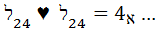
"By this means, they could make the mental act of resolving the semiotic image into a conduit for the corresponding aleph's power, that is to say the act would be the 'shadow' of evaluations involving the figures themselves thus attained, and so the one act would cause another..."