Ammanas
-
Posts
1987 -
Joined
-
Last visited
-
Days Won
1
Content Type
Profiles
News
Forums
Blogs
Gallery
Events
Everything posted by Ammanas
-
I'm interested in how much of the contradictions are by design or not. He has mentioned in past interviews that he is interested in exploring about the idea of how history changes and is lost as time passes. He has also mentioned how unconcerned he is about keeping timelines and other details straight; I can't remember the interview, but he said that doing that would zap the joy from writing and he is more concerned about getting across specific themes to the reader.
-
I plan on rereading them if (when?) the third Kharkanus, Walk in Shadow, is released. I think the earliest we can hope for is at least five years; he has talked about how difficult it is for him to write them plus the three Karsa books that are to come first. I joke around that the Early Empire books were written by the "third malazan author". I say that because ICE completely changed his prose and I feel it was a huge success! I really hope that Tor contracts him for more in the Early Empire series...there is still so much for him to explore and his current contract is for three.
-
Before Oathbringer came out there were a lot of sharp eyed readers that noticed the thrill was unnatural and probably atrached to Odium. I must admit I dismissed these conclusions and thought the "Thrill" was simply a result of the human condition that was described by Karen Armstrong (apologies for the length): "Here again the limbic system comes into play. The prospect of killing may stir our empathy, but in the very acts of hunting, raiding, and battling, this same seat of emotions is awash in serotonin, the neurotransmitter responsible for the sensation of ecstasy that we associate with some forms of spiritual experience. So it happened that these violent pursuits came to be perceived as sacred activities, however bizarre that may seem to our understanding of religion. People, especially men, experienced a strong bond with their fellow warriors, a heady feeling of altruism at putting their lives at risk for others and of being more fully alive. This response to violence persists in our nature. The New York Times war correspondent Chris Hedges has aptly described war as “a force that gives us meaning”: War makes the world understandable, a black and white tableau of them and us. It suspends thought, especially self-critical thought. All bow before the supreme effort. We are one. Most of us willingly accept war as long as we can fold it into a belief system that paints the ensuing suffering as necessary for a higher good, for human beings seek not only happiness but meaning. And tragically war is sometimes the most powerful way in human society to achieve meaning. It may be too that as they give free rein to the aggressive impulses from the deepest region of their brains, warriors feel in tune with the most elemental and inexorable dynamics of existence, those of life and death. Put another way, war is a means of surrender to reptilian ruthlessness, one of the strongest of human drives, without being troubled by the self-critical nudges of the neocortex. The warrior, therefore, experiences in battle the transcendence that others find in ritual, sometimes to pathological effect. Psychiatrists who treat war veterans for post-traumatic stress disorder (PTSD) have noted that in the destruction of other people, soldiers can experience a self-affirmation that is almost erotic. Yet afterward, as they struggle to disentangle their emotions of pity and ruthlessness, PTSD sufferers may find themselves unable to function as coherent human beings. One Vietnam veteran described a photograph of himself holding two severed heads by the hair; the war, he said, was “hell,” a place where “crazy was natural” and everything “out of control,” but, he concluded: The worst thing I can say about myself is that while I was there I was so alive. I loved it the way you can like an adrenaline high, the way you can love your friends, your tight buddies. So unreal and the realest thing that ever happened.… And maybe the worst thing for me now is living in peacetime without a possibility of that high again. I hate what that high was about but I loved that high." So my question is what clues were those sharders working off of and how did they know to differentiate it from the previously quoted part that is just common to the evolution of humans?
-
Back to RotCG! I guess I never noticed on previous reads the Sayings of the Fool and how many there are throughout the series. I think my favorite one is found in this book, "While travelling I met a man dressed in rags, his feet and shoulders bare. Take this coin, I offered him, yet he refused my hand. You see me poor, hungry, and cold, he said -- yet I am rich in dreams." I also like the one in Deadhouse Gates which provides some nice foreshadowing for events in House of Chains: He swam at my feet, Powerful arms in broad strokes Sweeping the sand. So I asked this man, What seas do you swim? And to this he answered, 'I have seen shells and the like On this desert floor, So I swim this land's memory Thus honouring its past,' Is the journey far, queried I. 'I cannot say,' he replied, 'For I shall drown long before I am done.' There are a few others too: http://malazan.wikia.com/wiki/Sayings_of_the_Fool On a different note how awesome is Braven Tooth? Everyone, including the empress, just assumed he died a long time ago, but he's still training soldiers and will play a bigger role later on in the book. The very definition of, "Old soldiers never die; they just fade away"
-
 All religions, in Brandons books and the real world, come down an act of faith; to believe in something perhaps rationality tells you cannot be. I personally have taken that act of faith to believe and worship, but do not fault anyone who disagrees. Apologies if my previous post came across as agressive in any way.
 -
People talk about "Mormon Doctrine" but there are very few things in the church that qualifies for that. A lot of what people consider doctrine are just influential members ideas that catch on and become popular; some stick and some don't. "Doctrine" that tried to be implemented, but failed over time include Blood Atonement and The Adam-God theory plus many others. Even staples of the religion has undergone a metamorphosis like the Words of Wisdom which was only thought of to be good advice for a long time. It wasn't until after the move to Utah that it became categorized, strictly enforced and a temple interview question. Much of what Joseph Smith taught on exaltation is contained in the King Follet Sermon. It is important to remember that this came about in the Nauvoo era of his ministry and he was killed before he could really elaborate on a lot of his beliefs. Other prophets, and influential members agree with idea and "carry the torch" so to speak. Here is the most relevant bit concerning exaltation: "God himself was once as we are now, and is an exalted man, and sits enthroned in yonder heavens! That is the great secret. If the veil were rent today, and the great God who holds this world in its orbit, and who upholds all worlds and all things by His power, was to make himself visible—I say, if you were to see him today, you would see him like a man in form—like yourselves in all the person, image, and very form as a man; for Adam was created in the very fashion, image and likeness of God, and received instruction from, and walked, talked and conversed with Him, as one man talks and communes with another. In order to understand the subject of the dead, for consolation of those who mourn for the loss of their friends, it is necessary we should understand the character and being of God and how He came to be so; for I am going to tell you how God came to be God. We have imagined and supposed that God was God from all eternity. I will refute that idea, and take away the veil, so that you may see. These ideas are incomprehensible to some, but they are simple. It is the first principle of the gospel to know for a certainty the character of God, and to know that we may converse with Him as one man converses with another, and that He was once a man like us; yea, that God himself, the Father of us all, dwelt on an earth, the same as Jesus Christ Himself did; and I will show it from the Bible. Eternal Life to Know God and Jesus Christ I wish I was in a suitable place to tell it, and that I had the trump of an archangel, so that I could tell the story in such a manner that persecution would cease forever. What did Jesus say? (Mark it, Elder Rigdon!) The scriptures inform us that Jesus said, as the Father hath power in himself, even so hath the Son power—to do what? Why, what the Father did. The answer is obvious—in a manner to lay down his body and take it up again. Jesus, what are you going to do? To lay down my life as my Father did, and take it up again. Do you believe it? If you do not believe it you do not believe the Bible. The scriptures say it, and I defy all the learning and wisdom and all the combined powers of earth and hell together to refute it. Here, then, is eternal life—to know the only wise and true God; and you have got to learn how to be gods yourselves, and to be kings and priests to God, the same as all gods have done before you, namely, by going from one small degree to another, and from a small capacity to a great one; from grace to grace, from exaltation to exaltation, until you attain to the resurrectionof the dead, and are able to dwell in everlasting burnings, and to sit in glory, as do those who sit enthroned in everlasting power. And I want you to know that God, in the last days, while certain individuals are proclaiming His name, is not trifling with you or me." https://www.lds.org/ensign/1971/04/the-king-follett-sermon?lang=eng
-
Watching paint dry is more entertaining than Crossroads of the Twilight I'm reading book 2 of Otherland called River of Blue Fire. Classic Tad Williams style. It's all about the journey rather than the destination; it's a lot of fun
-
I pretty sure that Resuthenal is only mentioned in RotCG and was just a common aquaintance, they both knew, and were making small talk over.
-
Hah well the prose is a little different and its really unique how he switches between the macro and the micro storytelling methods. He will zoom out and describe a entire persons life in just a few pages and zoom in to tell what's happening presently in the story. I think he was trying to tell these ancient chinese history and stories, but in a different way to a wider audience.
-
One of my all-time favorite books! Definitely not for everyone, but I've already read it three times!
-
The Good News Thread: I'm So Excited! And I Just Can't Hide It!
Ammanas replied to traceria's topic in General Discussion
The conclusion to Lighbringer ended up being delayed a year, but at least they have a cover now and it looks great! Really looking forward to how it all turns out! https://www.orbitbooks.net/2018/08/02/cover-launch-the-burning-white-by-brent-weeks/ -
Its a literary equivalent of a asymptote hah!
-
A couple of my audiobooks came through on my library app. That means I will have to pause RotCG (which I own) and get back to it later. Am I destined to be the next Briar King? Forever trying to finish this book, but never reaching the end haha!
-
You Know You're a Sanderfan When...
Ammanas replied to Shardbearer's topic in General Brandon Discussion
I was never able to go, but I still listen to the music sometimes. I feel like the EFY songs are more spiritual than the hymns we sing at church (just my opinion though) But to keep this thread in track: you know you are a Sanderson fan when you adopt a Nin expression as one of your life mottos, "One cannot live life making decisions at every juncture". You have a game plan, or made tough decision just stick with it. -
I think Brent Weeks writes about religion in a similar way to Brandon. I talked about it more in depth elsewhere on the shard, but will copy and paste it in case anyone is curious: "I have found Brent Weeks books to be deeply spiritual. I know that a person without a belief in God can read them completely different than I did, but I think the subtlety and my own personal interpretation makes it all the more powerful. There is a lot of fakers and abusers of religion in his books including: the Prism, the God King and Kali's real identity. There is also a lot of sorrow and unhappiness because of religion. But there is also a sense of Providence that runs throughout his books and how everything seems to be guided almost miraculously to work out for the best. I think that despite everything there is a ton of evidence that The "One God" and Orhalem exist (in his worlds) and take a interest in human affairs. There is a lot of themes throughout his books redemption, sacrifice, and forgiveness as well. One moment that comes to mind is Ironfist, upon witnessing a miraculous shot, regains his belief in God and cries about how he is forgiven despite his mistakes. Another is Irene seeing a vision of how she would save the world despit how imposdible it looked in book one. Also Count Drakes conversion story. A lot of readers could shrug these occurences off to coincidence, but I love how Weeks leaves it open to interpretation."
-
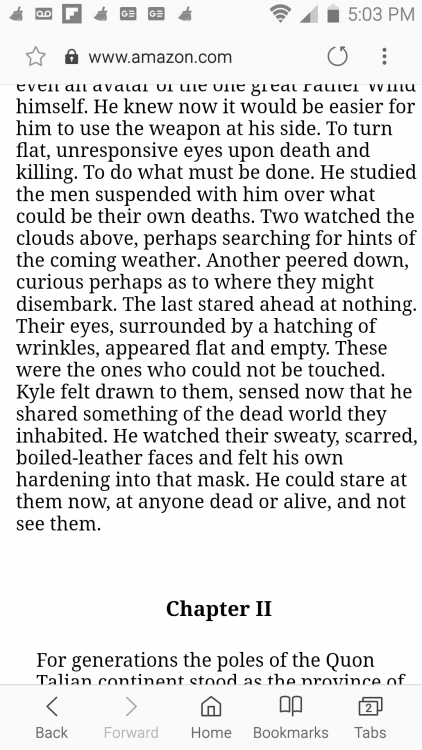
The Ghelel arc was alright for me. I think its kind of interesting how Esslemont gives us a macro and micro view of the rebellion. The audience can see a lot of the big effects of these actions, but perhaps the audience is asking, "how do they go about getting new rulers, in the various provinces and how do they adapt to having so much power thrust upon them?" The Ghelel arc answers both of these questions, but I feel like he has about thirty plot lines so its not a surprise that not every one works for everybody. While we are on the topic of RotCG I though I would share a brief exerpt from the beginning in the attachment. I thought Esslemont did a really good job showing the loss of innocence of Kyle and what happens to every soldier. A nice bit of writing.
-
B.k I say either finish RotCG or just admit defeat and say the book just isn't for you. I do love the Expanse, but that one (Babylons Ashes) is best read while events from the previous books are fresh on your mind...it draws on characters and past events from all five earlier books and really acts as a closing of a major arc in the series. Dresden is always light and a lot of fun as well!
-
@Ascended I've got a question that is somewhat related. Hopefully this question doesn't come across as snarky but what sort of job does one get with religious studies in a church with no payed clergy (unless you are a apostle or a few other exceptions)?
-
Read it wrong, Thanks! I just have Otherland on the brain!
-
-
About 75% done with the first one and am liking it so far! Tad Williams always seem to have a very helpful synopsis in his books (after the first installment) so you could probably be able to figure it out. You have also got to read Shadowheart! I think the fourth book was the best in that series!
-
Don't forget about Dragnipur arrows! I got such a huge kick out of that! Simon Vance would be great! Nick Podehl has some great voices, but I wonder how he would do narrating so many grizzled veterans? The Red Knight series...I have tried reading that about five times. It looks great, everyone tells me its great, but some reason or another I can't get past the first 150 pages. I tried the hoopla audiobook, but the app was having problems so that was probably a factor (I can't remember being particularly impressed with that Wolf narrator either, but cant recall any details). I will probably try again someday and will definitely be trying out the first in Miles Cameron's new series (Cold Iron) when it is released in the United States on October.
-
Going through RotCG again. First of all John Banks is quickly becoming one of my favorite narrators. I am shocked when I read criticisms of his on audible because I believe he reads at a perfect speed, has a great neutral voice, and does a good job changing it up to fit characters of both genders. He also does a great job of Bancroft's Books of Babel series (a very different series from Malazan books, but is unique and a lot of fun). It's too bad Banks hasn't been chosen for Eriksons books. It's amazing how much, in my opinion, both Erikson and Esslemont improve between their first two books. Although the publication date does not reflect it, both Night of Knives and Gardens were written ten year or so before the next installment. For all of Esslemont's strengths there is always something a little dissapointing with his endings (although he is improving with that in his early empire series) but I really like his beginnings and middle sections. His endings are not necessarily bad but I keep hoping for more from him. The worst ending of his was probably Blood and Bone which is a shame because I really liked the jungle setting and the Apocalypse Now/heart of Darkness vibe. Blood and Bone also includes some of the best horror scenes in the series imo.
-
I was originally delighted that Apocalypse Guard had been shelved thinking, in my naivete, that he would immediately start working on the next mistborn and then Stormlight 4. Unfortunately my wait is now longer...I am not complaining about Brandons decisions, but it is a little deflating for me.
-
You have got to read, who I believe, started all this modern grimdark books...Glen Cook! I will not lie, but the narrators are not very good but his books are awesome! He has a ton of books, but The Black Company series is the best place to start (the narrator for that series is ok...better than his other audiobooks but not is the same league as the Simon Vance and Kramers of the world). Glen Cook has been such a huge influence on Erikson that I will just let Steven explain how much he has meant to him