Harakeke
-
Posts
260 -
Joined
-
Last visited
-
Days Won
2
Content Type
Profiles
News
Forums
Blogs
Gallery
Events
Everything posted by Harakeke
-
I'm afraid to venture into the Typos thread, but my copy finaaaalllly got delivered, and I noticed the map at the end of the book is upside-down. Is it supposed to be like that?
-
I now have a new cipher-cracking scheme! 1. Learn obscure foreign language 2. Open publishing house and acquire rights to translate WoR 3. ??? 4. Profit
-
Aha! I got it! The cipher is actually a syllabic code derived from Elantrian Aons! If you split the number into triads, and assume that Aon Aon is already drawn, then the three numbers in the triad tell you how to add additional lines, starting in the upper left and working clockwise. Primes are straight lines, and nonprimes are curves. Then you mirror that shape along the diagonal axis (which makes sense, since Rosharians have such a thing for symmatry), and you wind up shapes that match the known Aons. Each Aon stands for a syllable, and if you write down the sequence and sound it out phonetically, you get:
-
-
Well, I'm signing off for the night. Good luck Pattern! Some general thoughts after today: It's most likely English, not Alethi. Alethi doesn't make sense for a variety of reasons. I don't think it uses a keyword (a la Vigenere etc.). Nothing in the context of the other epigraphs jumps out as being a keyword, and I just get the feeling (both in and out of character) that this code is supposed to be self-contained. It might be a two-step code that combines a substitution cipher and an every-other-letter transposition cipher. Which adds another wrinkle to looking for patterns (double letters, etc.) in the ciphertext. I'm partial toward the parsing of "11 18 25 10 11 12 71 24 91 51 21 01 01 11 41 02 15 11 71 12 10 11 12 17 13 44 83 11 10 71 51 42 54 14 34 10 91 61 49 14 93 41 21 22 54 10 10 12 51 27 10 15 19 10 11 12 34 12 55 11 52 51 21 57 55 11 12 34 10 11 12 91 51 21 06 15 34" This is a simple "split the whole thing into pairs of 2" organization. It's straightforward for the encoder and unambiguous for the decoder. On the other hand, it isn't great statistically. The strings of numbers >26, such as "71 51 42 54" are problematic even if you only take every other letter. But it might work in a Numbered Key Cipher with redundant cells. There's a handy tool for working on those at: http://home.comcast.net/~acabion/numb_pairs_extended.html , though I haven't found a key that works. Might be worth trying out with some of the other proposed parsings. Another thought is that it could be a polyphonic cipher that just uses the numbers 1-10. But I think that would be just too nasty.
-
I'm inclined to think the code uses English letters. Pattern pointed out that the other epigraphs use English letters that aren't in Alethi (e.g. c, x, q), and that they reference some unknown heiroglyphics that the Diagram *actually* used. This code (much like Navani's notes) is most likely transliterated into English to give us English readers the "feel" of what it it was like for native Rosharians. I also played around a trying to decode the numbers into Alethi, and nothing came up.
-
Righhhht - 5 days per week, not 50. *facepalm* Okay, new theory - death quotes correspond with highstorm occurrences! Though I did notice something while playing around with the dates - numbers <10 are always preceded by a 0 in the concatenated form. I'll play around with parsing the cipher numbers with that in mind. edit: 11 18 25 10 11 12 71 24 91 51 21 01 01 11 41 02 15 11 71 12 10 11 12 17 13 44 83 11 10 71 51 42 54 14 34 10 91 61 49 14 93 41 21 22 54 10 10 12 51 27 10 15 19 10 11 12 34 12 55 11 52 51 21 57 55 11 12 34 10 11 12 91 51 21 06 15 34 Maybe numbers >26 represent capitals?
-
AhoyMatey speculated earlier that they might be the dates of highstorms, but I just calculated the intervals between the dates (56, 50, 50, 3, 51, 50, 96, 102, 101), and they seem to spread out for that, since highstorms come every few days. They remind me more of the dates for the deathrattle quotes in WoK. edit: Ah. The last death quote in WoK is dated Tanatanev 1173, which would be 1173090204. The list from WoR picks up not long after that with 1173090605 (Tanatashah? 1173). edit2: And just for the heck of it, here are the WoK dates rendered in North Wall Coda format: 1173010304, 1173030202, 1173040204, 1173040503, 1173050101, 1173050402, 1173050804, 1173060202, 1173060704, 1173070201, 1173070202, 1173080204, 1173080405, 1173080605, 1173080801, 1173080903, 1173090103, 1173090201, 1173090204 edit3: counting is hard =P
-
That's good to know. I'm still waiting for Amazon to deliver my copy, so I'm just going by the information in this thread for now. I agree that the Alethi women's script probably isn't the way to go. I'll play around more using the Latin alphabet when I get a chance. I like your theory that it's a two-level substitution/transposition cipher. (I tried brute-forcing various substitution solutions this morning, but nothing popped up.) In that case, what we'll need to do to crack this is: 1. Determine the proper parsing of the original number string 2. Determine the substitution key for translating the cipher text 3. Determine the ordering of the transposition cipher (likely solved)
-
I've been playing around with the way Pattern split up the numbers into 1-2 digits in post #13, trying to find keys in English and Alethi, but nothing's panned out. Here's the spreadsheet I've been using, if that's helpful to anyone: https://drive.google.com/file/d/0B19mpDUN_8rSYjhsZGhlNFQwN1U/edit?usp=sharing
-
Alethi has 25 letters, which can be arranged in 5 groups of 5.
-
 Well, the first thing I did was sort out all the possible Alethi graphemes (written letters) and give them labels. They come in three sizes: small, middle and long; and 6 shapes: left, right, hatch, swoosh, diamond, and fancy (plus the special "sentence start" symbol). I wrote them all out individually so I had a blank key to work with. The single line symbols: swoosh(vowels) and hatch (the second half of Th, Ch, etc.) were particularly tricky to decipher, because I lumped them all together at first. I played around a bit at first with a numeric notation to try and quickly correlate the emotion bracelet labels with information from the Ars Arcana, thinking that maybe they were gemstone names. Things like 2D 113 2 1R = Ruby? , 2D 113 2 1R = Chach? etc. But that didn't work (turns out it actually says "fear"), so I had to brute-force it. I went through the illustrations and copied out all the words that were only 2 or 3 letters long that repeated multiple times in the text. There are only so many words that are that short (the, is, of, etc.) so I played around with assigning English letters to the various Alethi graphemes, going back and forth between my key and the list of short words. I'd pick a short word and say, "Okay, let's assume this word is "AND". So then the first shape is an A, that one's an N, and that one's an D. Which means that this similar two-letter word must be AN. And then this one ends with the same letter, so it must be ON or IN." And so forth. In practice it wasn't nearly so elegant, and I did a lot of erasing. The vowels and the graphemes for Alethi letters that don't exist in English (such as "Th") threw me for a bit of a loop. I had this klugy system where all the -h graphemes were split in two, and F was written as PH. But eventually I worked out a partial key based on the short words that was self-consistent (T, H, E, I, S, N), and could start attacking the longer words. The first word I was able to translate properly was "spren". When I got that, I knew I was on the right track! Things accelerated quickly from there, and once I could start to get information from a word's context, it was just a matter of filling in the blank spots in the key. e.g.: "Okay, this part here says "[long diamond]AIN KNIFE" Rain knife? Main knife? Pain knife! Yeah! So [long diamond] must be P!" And so forth. It was really fun!
 -
Aren't the various gems associated with numbers 1-10 in the table in the Ars Arcanum? Maybe the number of prongs are an indication of which gem goes in each setting.
-
Ah, thanks.
-
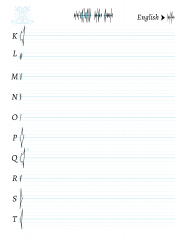
If you want to write English words in Alethi script (like in the WoK illustrations), I've thrown together a bit of a guide: And this is one for Alethi to English: edit: adjusted the practice page as per Peter Ahlstrom's comment below.
-
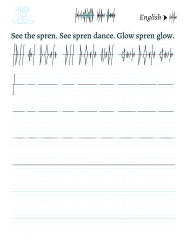 For practicing writing.
 -
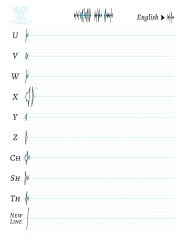 edit: corrected Ch, Sh, U, W, and Th
 -
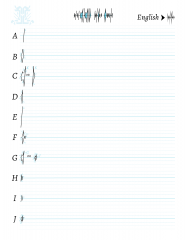 edit: corrected F
 -
No -- great question! It's a rather straightforward substitution ciper in which English letters are replaced with Alethi symbols. The Way of Kings contained several illustrations with captions in Alethi script, so it was just a matter of cracking the code. For more information, see: http://stormlightarchive.wikia.com/wiki/Alethi_Script
-
Thanks! I'm trying to keep the key really minimalistic, so I'm glad that makes sense. I went back and took another look at the original script in the Way of Kings illustrations, and realized my graphemes for Ch, Sh, Th, F, and U were too tall. Fixed it in the bookmark - and added it to the to-do list for the primer pages. I'm also not thrilled with the direction arrows. I may have to do a bit more writing by hand to get a better feel for how the strokes flow. On a related note, is there a way to delete images from my Content Collection Gallery? I poked around a bit but didn't see an obvious button. edit: Fixed the errors on the phonics primer pages and reworked the direction arrows so that they follow a continuous stroke. Also added a sentence-writing worksheet.
-
 Corrected height of Ch, Sh, Th, F, U
 -
Version 2
-
Apparently Navani just has quirky handwriting. There was a post somewhere that vowels shouldn't have upstrokes.
-
-