



sheep
-
Posts
268 -
Joined
-
Last visited
-
Days Won
17
Content Type
Profiles
News
Forums
Blogs
Gallery
Events
Everything posted by sheep
-
At least you live on the same continent. I looked it up and the last time Brandon came to my city was in 2012. I only started reading Mistborn and Way of Kings in ~2013. People don't ask character questions because most of them enjoy the books for the expanded universe and want to know more about that, but I personally have never cared about Adonalsium theories. Character questions do get asked, like which arm Lopen is missing and how he eat non-chouta foods. I remember the artist Botanica asking about and getting a really in-depth answer with input from Ben (the interior artist) about the havah and Alethi clothing. If you get self-conscious, simple solution - go in costume, preferably with a mask. People will pay attention to the costume and not the perv questions. :lol: I don't think there's any description of Dalinar's facial hair in WoK. After I read it, I imagined him with one because it seemed to fit. I still think of Elhokar as bearded even though he's described as canonically clean shaven in WoK...but then again WoK says he has yellow eyes which are changed to green in WoR. If Dalinar has a shirtless scene, the real question is if Brandon will actually describe it instead of giving a broad strokes description as he usually does when things could veer off the G-rating. Adolin is mentioned to like bathing, he bathes after training because the new upgraded arena has prep rooms with baths - but we get no shirtless scenes!!! :ph34r: Disappointing!!! Maybe if it is because if Shallan saw Adolin shirtless it would kill the love triangle just as quickly as Shallarin died when she called him a creep. Maybe I should use this smiley more. :ph34r: :ph34r: If Renarin + criticism is the magic spell for summoning Feather Adolin + is a beeping pager for maxal. I think it's a waste if you have a character who can draw, but you don't include drawings. I read a novel recently with a musical main character, and the book included original sheet music excerpts with lyrics, to fit with the setting, like "Dad's lullaby" and "Organ music at the pier". I can't read scales but I thought it was a wonderful idea - you get a better sense of a character than if the author just said "btw Charlie is also a rockstar". Same with another novel that had a MC who wanted to be an illustrator - the book had full page comic strips in between text chapters. A character just feels more than two-dimensional when you mix media and show that they have legitimate skills, not just informed ones. If you've ever read "The Book Thief", art interludes can really have impact. Well, critique is good for self-improvement. And I want to get better at writing. Does anyone find it jarring or thrown out of the story when I mix modern writing with Bronte-ish prose? These sorts of colloquialisms happen because I can't think of a translation of my thoughts into concise "old timey speak" and the slang phrase is more direct and unambiguous, but still anachronistic. So what this story really is, rather than a true Regency romance, is my contemporary voice being stapled onto a Regency setting, in some places more crudely than others, and I'm wondering if readers see this patchiness as ruining or cheapening the experience. I also feel bad about info-dumping in the Author's Notes section. I hate over-exposition or explaining jokes in the main text, so I leave it off there, but I feel like my writing would be better if it were clearer, so a reader could understand the reference straight off. I write things that I would understand, and feel like that characters in-universe would too, but sometimes I forget about you valuable reader people. For instance, a "clyster" is an old timey way to talk about an enema, which is something that Kaladin would know about since he's a doctor in this AU. So my dialogue isn't funny until you bother to Google, and by that time the moment has passed because explaining the joke killed it. Just my thoughts. I am the only one proof-reading so everything is clear to me but I have no idea what other people's impressions are. EDIT: I'm pretty sure the solution to obscure references is not to avoid them, but to make it so if a reader doesn't understand, nothing relevant story-wise is lost. And if they do get it, it's an Easter egg. I'm not even sure if I'm skilled enough to pull it off...
-
If you have the opportunity to ask Brandon about "other hair" at a signing, you should also also ask if Alethi even grow chest hair, and if the answer is some do, some don't just like Earth humans, then you have to ask if Dalinar has it. Many people imagined Dalinar had a beard until a WoB confirmed he was clean shaven most of the time. And Dalinar's head hair is mixed colours, black and grey as well.... You don't need to give your real name at a signing. Ask without embarrassment, because no one will ever know. :ph34r: You sure do like that smiley, don't you. :ph34r: :ph34r: :ph34r: :ph34r: :ph34r:
-
The Stormlight Archives Regency Romance SHALLAN'S SKETCHBOOK PART 4
-
The Stormlight Archives Regency Romance SHALLAN'S SKETCHBOOK PART 3
-
The Stormlight Archives Regency Romance PART SIX The Duke did not wait for a footman to show Shallan to her seat; instead, he pushed in her chair himself before finding his own, to her right. Doctor Kaladin did not oblige Jasnah equal courtesy; he found his own seat opposite theirs silently. Jasnah did not appear to notice Kaladin’s show of tactlessness, and she did not seem to care. Even so, one had to wonder if it was caused by an excess of gross insolence or gross ignorance; either option marked any character as unpleasant - which was, of course, perfectly applicable as a description of the Doctor. As they were unfolding their napkins and settling into their seats – Shallan inconspicuously toeing her sketchbooks and satchels under the table, the Duke and the Doctor folding their coats over the backs of the seats – the butler, carrying boxes, approached the table. He approached the seated Duke, bowed, and offered him the first, smaller, box. There was a ring inside it. It was a heavy gold seal ring with an oval face, with a design carved deeply in reverse. The Duke slipped it onto his left hand, the hand nearest Shallan; she saw that it was of a crown over a tower, surrounded by an engraved linked chain that curved all the way around the bezel as a border. The empty box was handed back to the butler, and the second, a flat square box, was offered to Kaladin. Kaladin waved it away, she heard him mutter “afterwards”, and the butler withdrew with both boxes. The first course – a clear broth – was served and a white wine was uncorked, tasted, and poured for all but Kaladin. A servant took away his wineglass and replaced it with a short glass of watery smallbeer. How was it that Kaladin could do everything different from everyone else, yet there were no comments on the ungraciousness contrariness of his manner? As a retainer to the Duke, should he not have more respect for the guests of his employer? It was by the benevolence of his superiors – and their indulgent condescension – that he was seated at this very table, eating their food; it was incredibly galling to Shallan that he seemed not to care either way. She, at her father’s estate, struggled to find suitable companionship her social equal; there was no-one within a day’s travel higher than the daughters of farmers who owned their holdings outright. Even her governess, the well-educated daughter of a diplomatic attaché, was no more than middle class. Madame Tyn had been born and raised abroad, and yet she was easily Kaladin’s superior in social decorum. She was intent on dissecting the evidence of Kaladin’s ambiguous status – was he really middle class? He was a confirmed physician; Jasnah had accepted his credentials as genuine. Was he a natural-born son of someone important? He could not possibly be the Duke’s brother – they shared no resemblance – a reveal of illegitimacy, or even a claim of it, would have been scandalous enough gossip to reach even the most distant of country estates in the frigid northern highlands. Thus she was surprised when her half-finished bowl of broth was gently slid out from under her raised spoon and replaced by what appeared to be the second, third and fourth removes simultaneously. Shallan’s senses returned to her. The Duke and Kaladin were intent on eating; footmen were continuously circulating with trays and tongs to refresh their plates. On the side table with the samovar, the butler was furiously carving a whole poached chicken into even white slices; behind him, two more chickens were awaiting the knife. Jasnah was tapping Shallan’s feet under the table with her own, and wiggling her eyebrows in a meaningful way. It occurred to her that no-one had said anything since the luncheon’s start. “Your Grace–,” she finally managed to say. The Duke winced and, rather reluctantly, put down his fork. “Please. I notice that you and Jasnah have dispensed with proper address; although decency would disapprove: so recent was our introduction – you may do so with me. Such formality is unnecessary, for now, whilst we are here among friends.” “Of course, m—Adolin,” she said, floundering for something to talk about. She had not expected to be chastised this early, however gently. “Um. Your hair is nice.” Blessed Heralds. As soon as she returned to the House, she would have to have a bath drawn and then she would see if she could fit her foot into her mouth. The Duke – Adolin – blinked. He glanced at Kaladin, who shrugged and continued eating. Jasnah was intently studying something on the ceiling of the pavilion. Maybe it was the carved vine leaves. The footman pouring a thick peppery gravy onto Adolin’s sliced chicken had his eyes downcast, but he was smirking. “My hair?” Almighty, save me. “Yes,” said Shallan desperately, “blond hair and stripes are rarely seen in the north.” “You know,” said Adolin, returning to his food. It seemed that very little could dampen his appetite, not even pathetically awkward – verging on rude – personal comments. “Some people would say it is a mark of my bloodline being impure.” “Everyone must come from somewhere, sir,” said Shallan. Manners, ground in from years of instruction, objected to the thought of addressing so fresh an acquaintance by his Vorin name. Her mind cast about for something to say that would offend no-one. “Back home we consider you Anglethi to be the foreigners.” …Storms. “Really,” said Kaladin. He was inspecting an asparagus spear impaled on his knife. “We Scots,” she began, “have been on these fair isles years before anyone from the East Continent ever beached a hull here. My former governess made a study of languages; she once told me that the word ‘Anglethi’ originated from a tribe from a northern peninsula in the East.” Adolin smiled. “Were you aware that my mother came from the East Continent?” “Then your blood is as pure - more pure - than those who seek to tell you otherwise. In any case,” she paused; her eyes met Kaladin’s for one brief moment. “The fact that I am here shows that wealth speaks a language anyone can understand.” “Yes, I suppose you're right. That is not something any woman has ever had the temerity to admit.” He was agreeing instead of bewildered now. It was a change that Shallan could work with; she thought she was starting to get the hang of talking to gentlemen. “And in my experience – limited as it is – a nobleman who boasts of his purity appeals to his pedigree,” Shallan said, “because if it was merely wealth that elevates a man, then every common man should have the potential in him to be noble. So what makes a man noble?” Shallan glanced across the table. Jasnah was nodding, a faint smile on her face. “Some would say it is ultimately granted to us by the Almighty,” remarked Adolin. It was the typical response one learned at church; Adolin said it rather flatly - it sounded like something that had been memorised and recited countless times in the past, and now could be regurgitated on command. “Ah, the inherent dignity; that is a topic on which Jasnah is fiercely keen on lecturing,” she said. Jasnah sighed loudly. Shallan continued: “It has always urged me to wonder, if some men are elevated over others, and they above other men, by the Almighty's grace, how would we tell? ” – here her eyes flicked across the table. Adolin looked blank, Kaladin was eyeing her over the rim of his glass with his darkly inscrutable gaze – “Does His grace exist in some tangible form? If it were so, then I daresay we should be using the King's clysters to cure cholera.” There was a gagging sound. Kaladin had apparently – somehow – managed to spray his smallbeer out through his nose and was now coughing vigorously. Adolin, who had been smiling, burst into laughter, and slapped the table. He had not the type of laugh that could ever be considered pretty, or delicate, as ones cultivated by governesses everywhere; it could be described as a sort of happy guffaw that Shallan would have liked to hear again and again. “Blasphemy and lèse majesté in one go! Impressive – I quite like it!” Shallan reddened slightly, pleased. “This conversation was begun by your insisting on familiarity, sir." “It's remarkably refreshing, in honesty,” said Adolin, looking at her directly. He seemed more disposed towards friendliness now than before – compared to previously, which perhaps in hindsight seemed mere charitable condescension; it was as if a dam of cautious reservation had broken at last and now something in him could no longer recognise her as either a threat or a stranger. “I should enjoy growing used to this. Now I see why Cousin Jasnah has become so fond of you – and it is rare of her to willingly suffer the company of others.” “Dear Cousin,” said Jasnah, smiling. “You wound me! Should I remind you of your own companions, or lack thereof?” “Kal is right here, you know,” Adolin said. “Thank you for noticing.” Kaladin had wiped his face with a napkin. Shallan thought the twenty or so undignified seconds where he was gasping for breath and choking on his drink something she would remember for years. “Your father and your aunt my mother would find him neither suitable nor capable for their purposes ... in a manner of speaking,” Jasnah said. Kaladin cleared his throat loudly at that, then muttered something unintelligible under his breath. “Nevertheless, if ever you find yourself disinterested in maintaining an acquaintanceship with Lady Shallan, I should be pleased to take her back to Ivory Lane with me. I am to return there shortly.” “She is a strange woman indeed, but here I find myself rather … pleasantly intrigued. What are your plans, Cousin?” “I am for the The City to-morrow,” Jasnah replied, “there are some things I must see to at the Palace and I think it best that I stop to visit my own house. I shall be back within four days.” “Lady Jasnah, will you go unaccompanied?” asked Shallan. “Your scholarship must continue even while I am absent. There are tasks I will expect you to have seen to when I return.” “Of course. Adolin, when we were at the village yesterday, I spied a church there that I am most eager to visit. Would it not be possible to borrow a carriage to pay a call?” “I am expected in the village to-morrow to approve some tenancy contracts. The good Doctor was to accompany me, but I am delighted if you were to join us. We must make it an event: have luncheon with me. If you are to stay here - and I dare hope you may - you must at least familiarise yourself with the village of Courtlea,” said Adolin. He patted his lips with his napkin, then tossed it onto the table. “Of course, it would be my pleasure,” Shallan said. She untwisted her own napkin from where her nervous fingers had knotted it during her earlier blundering attempt at conversation. There were grey marks on the white linen where charcoal had rubbed off. The servants were clearing the dishes now, so she stood. Adolin rose too, followed by Jasnah. Kaladin remained sitting. He didn’t rise for a lady, and he didn’t rise for the highest in precedence at the table, that storming man. But he rose for the chicken. A footman was reaching over the table for an empty ribcage on a tray. There was a forlorn drumstick on the side; Kaladin stood and plucked it off. He ate it while Shallan glared at him. He looked rather smug, which was something he could somehow do, without smiling or giving the impression that anything made him happy. Well, I know what you look like shooting beer out of your nose, she thought to herself. It was a cheering thought. Author’s Notes: Any resemblance to the scenes in WoR where Shallan and Adolin met for the first and second times is not accidental. Adolin has a personal seal because spanreeds don't exist and people still write letters. Kaladin’s box had a gun in it. He doesn’t put it on at the table not because he doesn’t want to be rude and frighten the ladies, but because he is sneaky and doesn’t want Shallan to know he has one. He is a part-time bodyguard which is why he gets invited to things even though people don’t want him to be there. Every Regency romance has to have baseless assumptions and conclusions being drawn out of nowhere for drama reasons, when they could have easily been cleared up just by characters talking to each other. I can’t write funny so I wrote cringe comedy. If you felt second-hand shame on Shallan’s behalf while reading this chapter, I did it right. The original Anglo-Saxons came from Angeln, which is somewhere around modern Denmark/Northern Germany The subtext: Kaladin thinks Shallan is high-handed and he’s right. She snarks on the divine right of kings, but is elitist and very socially conscious and isn’t really aware of it. She forgets that there are servants around when they’re right in the room, which is why she says things that could be construed as treason. The East Continent is Europe. Adolin’s mother in this universe is ethnically German and probably Prussian. Adolin doesn’t speak German; he doesn’t even like reading Anglish. “Wealth speaks a language” - Shallan is trying to tell Kaladin that she’s a gold digger, not a spy. Medieval medicine is weird. They used to think things that were shaped like noses could cure sneezing, and that sacred body parts like saints' knucklebones were miracle cures. Magical holy clysters for cholera is Shallan referencing this. Kaladin gets the joke faster than Adolin. “Neither suitable nor capable” is Jasnah commenting that Kaladin can’t produce an heir, and that Adolin should be looking for a companion who can. Everyone snarks better than Adolin. I’m nearing the end of how far I’ve plotted. I have enough notes and drafts to write one more chapter before I run out of material. I never thought I’d properly write out the story so I never thought of an ending apart from the obligatory “they do”.
-
To not freak him out, it would be better to specify the "other hair" as chest hair or leg hair, at first. There are other people in line behind you, and they are listening on. You wouldn't want them to think that you're some kind of crazy perv, would you? If he does want to know the real reason why you ask, the best answer is the refuge in audacity. I would say that I needed the information to make a "Roshar Fundraising Swimsuit Calendar" , because the Knight Radiants need Stormlight and what better way than to sell calendar folios for spheres.
-
What's the point of reading a romance if it's G-rated? I think the best way to get a confirmation on "other hair" is to ask Brandon if weird Roshar hair genetics extends to armpits. What if Natans had fluffy underarms???
-

Can't believe I just made this connection
sheep replied to Sand Master's topic in Stormlight Archive
In Ender's Game, they were squatting while "flying" in zero gravity. They were looking and shooting from between their legs. It sounds like a practical solution, but it looks really, really stupid. -
The Stormlight Archives Regency Romance SHALLAN'S SKETCHBOOK PART 2
-
The Stormlight Archives Regency Romance SHALLAN'S SKETCHBOOK PART 1
-
The Stormlight Archives Regency Romance PART FIVE The morning constitutionals – if that was what they were – were still ongoing when they had arrived at the North Courtyard. Jasnah, after eyeing the butler directing the footmen in raising a large white tent outside their viewing pavilion, summoned a servant to run back to their rooms to collect some personal items for their diversion. Shallan now had her satchel of sketchbooks and pen boxes, and Jasnah a few books. The North Courtyard was a sunny area screened from the drive by a row of ornamental topiary. It was paved with large square tiles of smoothly pebbled concrete; unlike the courtyard and entryway at her father’s house in Scotland, this Courtyard had no cracks from which persistent weeds crawled out of the ground. A hemi-circular colonnaded pavilion jutted from a wing of the House, and was furnished with an oval table and cast iron chairs that servants had cushioned before allowing them to be seated. Aproned servants were now setting up a smaller table by wall, snapping out crisp white cloths and pushing trolleys clattering with porcelain settings. Shallan was now sketching the capitals – the elaborate twining reliefs on either end of the sandstone columns. They were stylised grapevines and leaves; it was a novel drawing exercise for her – she was an amateur scholar of natural history, dabbling now and then into botany, but she had few specimens on which to practise her taxonomic skills. The estate around her home, she thought rather wistfully, had thistle and heather, hare and dogs and deer. There was a considerable amount of each, but the lack of variety was – one might admit – not particularly rewarding. After turning to a new page in her sketchbook and scraping a fresh point onto her charcoal with a folded paper sleeve of emery, Shallan noticed a sharp clack, clack, clack-ing had risen above the general murmur and hubbub of servants at work. It was something that one got used to, after a time - the sounds of servants were like creaking cicadas. They eventually faded into the background and you forgot they existed until you needed something - at that point they were nowhere to be found. She supposed that was why the best butlers and ladies’ maids were habitually poached from one Grand House to another: everyone found valuable in a servant the rare talent of having at hand what you needed before you had even realised it yourself. On the courtyard, two men were whacking one another with sticks. They were not plain peasant sticks, as one could find on the ground or in a stack of firewood, but polished and weighted sticks three feet long, with round leather guards to cover the hands. The men were wearing thick white quilted jackets and peculiar hood-like head coverings with stiff wire netting over the face; flat muslin pockets of coloured chalk were pinned to cover the tops of their heads and half their foreheads. One man had pink chalk, the other had blue. Smears of chalk were evident on their chests and shoulders. She had seen the middies and cabin boys of the Wind’s Pleasure being taught to hit each other with sticks in a similar fashion by a sailor. Shallan had been told that it was a way for the boys to strengthen their arms and reflexes in order that they be prepared for the day when they might bear cutlasses to repel unwelcome boarders. She could scarcely enjoy watching people willingly – or not – be hit by sticks for sport when the idea of it made something in her chest quail with uncharacteristic panic. She turned her thoughts away from that dark path, and picked up her charcoal to continue her sketching - this time of the tall and strangely shaped kettle device that the servants had set up in the corner. It looked like a teapot perched on an urn; it was enamelled with an elaborately colourful flower design where its gold plating didn’t peek through. “It’s a samovar,” said Jasnah. “A wedding gift from the family of my late aunt the Duchess. It is rather convenient – you can make chocolate and tea at the same time, and it stays warm for hours, which unfortunately has the effect of encouraging guests to linger when–,” she paused, “–it seems now is the time to tread the boards.” Shallan looked up, startled, then hurriedly swept her pencils into their wooden box; she rose to her feet. Two men were approaching the pavilion, followed by servants. One was the tall and uncomfortably familiar figure of Doctor Kaladin – she felt her ears going red in humiliation – and the second was only slightly shorter but more solidly built; he walked with the carelessly confident poise of the high nobility: was this –? “Jasnah!” he called, waving an arm at her. He jogged up. He wore a loose shirt with collar unbuttoned under a blue waistcoast, and he had no neckcloth; a darker blue coat was slung over an arm. On the courtyard, the tent was being efficiently dismantled. Behind Shallan, Jasnah sighed and stepped forward. “Cousin Adolin.” She closed her eyes and inclined her head for the requisite kiss. The Duke did not have to bend to kiss her on both cheeks; her dressed hair with its carved hairsticks gave her the impression of equal height although she was a few inches shorter. “May I present my new ward?” “Yes, of course, one ought to do things properly,” said the Duke. Doctor Kaladin had caught up with the servants; they exchanged meaningful glances and turned towards Shallan. Shallan’s breath felt as if it were rising up to choke her; she thought that if she coughed, she would not be surprised if it fell in curd-like chunks from her lips. “Adolin, this is Shallan Davar, daughter of Lin, Laird – Baron by our measure – of Loch Davar, of the Clan McValam. She has been my travelling companion and ward these last six months.” Shallan drew up her skirts and dipped into the low curtsey one made as a social inferior in a formal setting. When was the last time she had properly practised it? Before her mother’s unfortunate death? The last time she could recall needing to curtsey perfectly with straight back and shoulders and bent knees was when she was thirteen years old, pledging herself as kinswoman in front of The McValam for the one time necessary to confirm her entry to the clan. She held the position for two beats and stood upright; when she straightened, she saw she was eye level with the Duke’s chin. He really had the most remarkable hair: she had thought it blond with stripes in the firelight last evening, but the stripes were actually individual strands of black upon closer inspection. His brows were the same mottled colour. Upon gazing at his chin – she hadn’t met his eyes, and hadn’t wanted to – she found herself curiously contemplating the colour of his beard; he was clean shaven now, but if he grew it out, would it match his hair? … Would his – other – hair be like that as well? Her ears remained unbecomingly warm at the brazenness; she was suddenly pathetically grateful that her own hair was red and that she had worn it down to-day. “Shallan, I present my cousin, His Grace the Duke Kholinar, Adolin Kholin. Major–“ “–Lieutenant Colonel.” “–Lieutenant Colonel,” Jasnah corrected smoothly, “of His Majesty’s Home Regiments.” He gave a courtly full bow – more appropriate for someone his own social equal, like Jasnah – and took her right hand with his left. She looked down at their hands: hers was slim and freckled with grey smudges of charcoal over the knuckle and down the wrist where she had brushed against her sketched pages; he had larger squared fingers with callused palms, and blue chalk dust was caught under a few of the nails. He held her hand unexpectedly gently and raised it to his lips. She met his eyes. She had always thought that blue eyes were neither rare nor special – everyone in her family had them – and she was satisfied in this confirmation: his eyes were not a particularly unique shade of blue. They didn’t glow or twinkle or sparkle or appear mysterious in any way like the novels said they should. They were not mysterious at all; rather, they were friendly and open, but in the whole, quite ordinary. It was a pleasant contrast to Kaladin; his looked like he was thinking about all things you were doing wrong, even if you just happened to be walking past minding your own affairs. His kissed the air above her hand. Of course that was correct and proper for a bachelor greeting an unwed lady for the first time, but Shallan couldn’t help but feel a twinge of disappointment. She quashed the thought. She was supposed to feel heartsick at leaving her beloved highland home, and becoming Jasnah’s ward was a hard-won childhood dream that she had desired ever since she had found and read that very first essay. To put a halt to her research, to throw it away, all for the sake of a handsome man – even at Jasnah’s behest – that felt like weakness and wrongness. It was to be borne – or rather, suffered, however uncomfortably – as the necessary price of so advantageous a connection. If Shallan were to do it, to become a sorrowful but willing sacrifice on the altar of matrimony, aching regret ought to be the very least of her emotions. He winked, then released her hand. The disappointment could not be suppressed. “Now,” Jasnah said, clapping her hands. “That’s done with. Shall we to luncheon?” Author's Notes: The exercise they are doing is the traditional British stick fighting sport, singlesticks. It is used as practice for swordfighting, because I thought that foil fencing was too "continental" for Adolin and too fancy for Kaladin. The tent that was being set up is a changing room, in case you were wondering. And yes, in this universe, Kaladin is aware of what colour Adolin's "other hair" is. I'm only writing from Shallan's perspective because romance novels are mostly all written from the girl's PoV. And I think she's the only one I can write while keeping consistently on-character. Post feedback if you like - I haven't done fiction writing in years and keeping to the Bronte/Regency tone is a real struggle. If you're reading closely, you can tell when I'm lapsing in and out of it, ugh. We are nearing the end of my plot skeleton and drafted notes, sadly.
-
The loansharks traditionally demand a pound of flesh as payment.
-
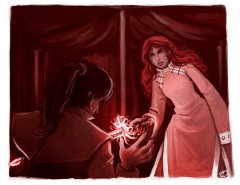 I normally draw her in blue too, since it's the colour she's most commonly mentioned in-canon to wear. I was planning on drawing her in blue for this picture, but I decided to colour with red lighting and blue somehow felt a bit off, too normal. So I made pinkShallan to show that this is her crazy side, the repressed killer who is the opposite of happy blueShallan. The alternative view is that she is wearing blue, but the glowing red light from her Patternsword washes it out.
 -
The Stormlight Archives Regency Romance PART FOUR Shallan was woken by a housemaid at quarter-to-nine, when the curtains around the bed were dragged open with no warning. Bright sunlight and fresh, wholesome country air streamed in; it was probably what doctors all round the country ordered for curing the feminine hysterics – she would not be the least surprised if it was a cure that particular Doctor was fond of recommending. Shallan, completely gracelessly, rolled onto her stomach and heaved the blanket over her head. “Lady Shallan! If you don’t rise now, your bath shall get cold – and Her Ladyship has requested your presence in the Teal Drawing Room at half-past-nine for breakfast.” Oh. Lady Jasnah. Things to do to-day. Doing things, what an absolutely dreadful concept. Shallan groaned and stirred; waking up – rather, being woken up – never failed to make her feel cross and fatigued. It took minutes to regain her faculties, and in the meantime her limbs hung leaden and clumsy. That was why when she kicked the blanket off, the cold bed-warmer fell from the bed onto the parquet with a loud clank, spraying a cloud of ash down the side of the linens that settled slowly onto the floor. This is what came of bothering to get out of bed in the morning. Numbly, Shallan allowed the maid to drape a dressing gown over her nightdress, and lead her lethargically down the hall towards the bathing chamber and the waiting bath. The chamber’s floor was of alternating tiles in blue and white, and the walls were painted white and scattered with framed pictures of artistically stylised towers. She undressed while staring at the wall with no particular interest; her eyes were unfocused and her mind was still dully contemplating the dream she was having when she was so rudely awoken. It was something about beads, endless beads under an endless black sky ... strange, wasn’t it, how quickly dreams fled from the mind in the light of day. When she stepped into the lukewarm water of the tub, the events of the previous evening hit her with humiliating clarity; she shuddered with the desperate cringing embarrassment of hindsight and slid her face underwater. No one heard her screams: there came only the sound of occasional splashing; merry bubbles rose gently to the surface. After the bath, Shallan felt much better. *** Shallan arrived at the Teal Drawing Room three minutes past the half-hour. True to its name, it was tastefully papered in delicate shades of teal and pastel turquoise; the moulding on the ceilings was white and resembled frozen tidal waves. Jasnah was seated already, looking perfectly refreshed for the morning - there was a cup of tea by her left hand and a rack of news sheets hanging from a wooden dolly on the floor by her right. Her hair was fashionably done up with carved bone sticks, and her lips were painted a deep red. A footman with a tray drew next to Shallan’s elbow and started unloading plates. Toasted bread rolls in a basket, fruit preserves, a small bowl of bland but healthful broth, miniature scones with butter and cream, fresh fruits peeled and sliced with a small jar of powdered white sugar on the side. The cutlery was silver today; the shields in relief on the handle were enamelled in white. She felt a pang when the footman retreated and she saw that there was no oatmeal; nothing on the table was made with oats. “You look well this morning,” commented Jasnah. She took a sip of tea. Her lips left no red smear on fine white porcelain. How did she do it? “I’m as well as could be expected,” said Shallan. She loaded her plate and started eating. How convenient it was that the Kholins had servants that made sure all their bread was buttered, whether they were going to eat it or not. “You should present a more amiable temperament, Shallan, if you want the gentlemen more favourably disposed towards you. Especially in the morning.” “By the time they find out what I’m like in the morning, it will be too late,” replied Shallan through a mouthful of bread and jam. Strawberry jam; that was a delight. She had not tasted jam this nice in years. The inns’ guest breakfasts served cheap jam made with more aspic than sugar, which left an unpleasant lingering aftertaste: after a disappointing try at the first inn, she had eaten her bread plain for the rest of the journey. “Nevertheless,” sighed Jasnah, “we want you to make a positive impression. If one cannot be congenial, one should always defer to courtesy. However, if all goes well and Cousin Adolin is pleased to make your acquaintance, we shall have an official presentation for the Family next week, before my uncle returns to the front. ‘’I have confidence that, if this suit proves successful, we should remain firm allies. There is much work to be done, and a mutual co-operation would be ... beneficial. The queen dowager, my mother, has influence but no power. My sister-in-law, the queen, has no interest. You understand, Shallan.” There was truth in that, an unexpectedly tentative truth, but it was still there, feebly revealing itself to her. Jasnah, in a roundabout fashion – was she even aware of it? – was showing Shallan something of her own vulnerability, as brief a view as it was. She had helped Jasnah bathe and had seen her undressed; Jasnah had not lied yet to Shallan nor ever had any reason to – but suddenly this last sentence outstripped the level of intimacy to which she had previously been privy. Shallan was queerly gratified to know that the confident Jasnah could feel she might falter from the weight of bearing her burdens alone. Shallan took a gulp of tea to wash the bread down. It was very hot tea. “I am grateful,” she gasped, clearing her throat. “For the opportunity. Of course. But would you not have accomplished your objectives sooner with a girl more biddable?” “A compliant girl would be next to useless at court; she would not be able to hold my cousin's overeager attentions: I have tried that before.” “And … have you not tried for an advantageous match of your own?” asked Shallan. This was very forward, but Shallan was no Anglethi, after all. She had been curious, and there never had been an opportunity – before this – to know; inquiries to others on the subject would have felt a duplicitous intrusion, as most information from second- or third-hand sources was likely to be no more valuable than common gossip. Jasnah, as a historian and scholar, was naturally disdainful of anything that wasn’t primary. Even that, sometimes, required wary scepticism. Jasnah looked at Shallan. Shallan sensed that Jasnah was looking in her direction, but wasn’t looking at her. Their eyes didn’t meet, but rather wavered to and fro; no doubt each woman was gazing intently at the other’s nose without making it obvious that she was. A pervasive tension hummed in the air; she felt that Jasnah was as likely to share another truth as she was to tell her to stop asking prying questions and finish her breakfast. Jasnah finally spoke: “There are certain – responsibilities – involved in marriage that I find I cannot accept. I will admit to this: I rank as Countess rather than Princess not because of relegation, no matter the rumour, but by my own choice. “I am grateful – though I cannot say I am approving – that you willingly make yourself beholden to a man, even if society judges him to be a good one and a smart match. If ever the responsibilities become ... unpalatable ... to you, you must inform me while there is still time. “But never mind, the day passes; we must get on.” Jasnah plucked the napkin off her lap and dropped it on her plate; as if on cue, the footman on duty at the door was by her side to pull out her chair. The newspaper rack was carried away and the settings were cleared as Shallan finished her last bite. Jasnah, standing now, said, “My cousin was expected to arrive after dinner last evening; we meant to make the first introduction then. He was delayed, so we might as well do it now. They are in the North Courtyard for their morning constitutionals – shall we join them?” Authors Notes: This is the scene that I wish had been the first chapter of WoR. Jasnah proves she has a heart! A shrivelled, dusty heart with a few dings in it, but it’s still there and she wants to protect Shallan while still using her at the same time. I write Shallan as snarky but not non-stop puns because 1) it doesn’t fit the genre 2) I am not funny 3) I found it kind of annoying after a while. I also don’t write Kaladin as the 100% angry jerk some people expect him to be, because here his character has already developed since he became friends with Adolin earlier than the original timeline. He has already figured out that not all noblemen are trash and to replay an AU version of the notoriously polarising WoR Prison Scene would be make me go blaaarrgghhh. YMMV, etc. The subtext: The Davar kids traded the aluminium necklace for oats. Oatmeal now gives Shallan homesickness. She would probably throw up if she had to eat plain oats boiled in water again, but it’s still nostalgia. Jasnah is sour about Amaram, who is Viscount Meridas in this universe. She is obliquely referring to him (“even if society judges him to be a good one and a smart match”) while Shallan thinks she is talking about Adolin. And saucy details: a Countess (female Earl) can refuse a suit from a Viscount without scandal, and as a landowning peer cannot be easily married off to a foreigner by the King as a Princess might. I know entailment and inheritance didn’t work that way historically, so I will wave my hands and say that because Elhokar is King and Jasnah is the older daughter, Gavilar indulged her and made sure she was provided with an income, especially since they started liking each other more before his death.
-
On Alethkar and banking: I would personally say that the use of printing presses and modern banking is part of the set-up conditions of transitioning an economy (and society maybe) into proto-industrialism. But printing can only work effectively if writers and publishers are free to print whatever instead of being censored, and if banking can only work effectively if it has a framework of legitimate accountability and "fair play" that gives investors a reason to trust it. If there is no appearance of accountability or regulation, people would rather hide their money in their sock drawer or in the mattress rather than depositing to the bank, if they are afraid the manager will take the money and run, or invest it in really terrible companies (ie, dog wedding party supplies) owned by friends. Managers can be getting away with dubious things with investor capital, but what matters is that the financial institutions give the appearance of being trustworthy. When your banks earn themselves a terrible reputation and confidence falls, this is what happens to society: Bank runs - everyone dogpiles the ATM and withdraws as much as they can before the bank closes People stop depositing, new investment capital dries up Entrepreneurs and innovators who had good ideas get no funding People are afraid and can only keep their money in their undie drawer (loses value after inflation) or invest in very safe companies (government bonds, necessary public companies like water treatment plant, energy) which have small but steady gains and won't risk folding. Large companies stay large, new companies and innovators close as they have large set-up costs before they can produce dividends, but the seed capital has dried up Market stagnation happens - duopolies, oligopolies, monopolies, all those good Greek words that make you want to hit Go and collect $200 So image and appearance, regardless of what is going on in reality, is important to the function and existence of banking. Pyschology in general is important in the study of economics, but we won't dig that deep. And this is why I do not think banks - crucial to the development of a industrial society - exist in Alethkar. I won't say that small credit unions, or money pot lending between the noble families and crafts/trades guilds don't exist. They probably do, and they rely on connections to get loans. But central banks and federal fiscal policy don't, and neither does "fair play" investment and lending. Chapter 4, "The Shattered Plains", WoK Chapter 6, "Bridge Four", WoK From what we have seen of Alethkar, they have a primitive understanding of finance. Debt is portrayed as a burden, not an investment. They do not have regulation. Debts and interest are calculated arbitrarily, because there is no governing authority for bureaucratic oversight. And, of course, Alethi income and wealth distribution make it so most people are really poor and have no assets, capital, or collateral to store in banks. They only have their bodies. Chapter 30, "Darkness Unseen", WoK WHY DOES EVERYONE DECIDE TO GET LOANS FROM THE DODGIEST PEOPLE OMG AHHHH Chapter 1, "Santhid", WoR If only banks existed - then people would have an alternative loans without putting the lives of their children as collateral. I know Lin Davar never liked Jushu, but Shallan was his favourite and a debt collector wouldn't care which child he took. In fact, a creditor might just take all of them. Chapter 24, "Tyn", WoR Shallan could have been one of them! And this is the lack of "fair play" that I meant. Without a fair play atmosphere in finance, people are discouraged from taking loans because they don't want to risk having their families sold if their business idea fails. There are little or no restrictions on lenders reclaiming assets. It's shocking that they can even take light-eyed children as slaves. So there are no laws, or the law is vague on it, or Vorinism accepts it as normal since the only legal authority we have seen to actually do stuff is the Ardents, who write and approve marriage and betrothal contracts. So people are encouraged to hold onto their broams, to not buy things, to not open up a consumer friendly market. They are encouraged to do things safely, to farm instead of open a business, to keep to their rung of the social ladder instead of expanding into the middle class. In this kind of environment, I cannot see how banks exist. I know most of you agree with me on the primitive state of Alethi finances, but I just wanted to elaborate and clarify. But here is one silver lining! Elhokar, being a big baby as usual, can't decide to fund a waterpark in the Shattered Plains by printing more money. Since spheres can't be clipped (cutting metal shavings off coin edges to sell) and you can't "water down" the money by mixing it with cheaper copper or tin, as was done in the old days, Elhokar won't be able to cause accidental Zimbabwe-tier hyper-inflation. None of the highprinces would be able to destabilise Alethkar either. Which is good for now, but what happens in the future when the population is high enough that the money supply is so small that it's starting to limit the economy? Maybe they'll do away with gem standard like we did away with gold.
-
If Different Authors Wrote the Stormlight Archive
sheep replied to TwiLyghtSansSparkles's topic in Sanderson Fan Works
I made a new thread so I could stop hijacking this one with mega-long walls of text. Here you go. Thanks! The bad thing about alternate universe fics is that the more you write, the more you diverge from the canonical source. Roshar is a great place, it feels kind of bad that I'm using a Regency England setting when it is nowhere near as original. I made a new thread because I am clogging this one up. You have to do endless scrolling to get anywhere. -
The Stormlight Archives Regency Romance PART THREE The door of the retiring room opened, there was the heavy tread of feet, and then the door closed with a snap. Shallan awoke. Her body was held in peaceful paralysis; her mind was soft and dazed with the stupor of nameless interrupted dreams; the book lay with pages down on her chest. She was on her back on the three-seater sofa and there was someone in the room with her. No, she thought, as her befuddled mind swum slowly back out of the serene depths and into consciousness - there was more than one person in the room. “…You’re late; they’ve all gone to bed by now. We were expecting you hours ago.” That was Doctor Kaladin. No one else had that – she fumbled for the appropriate description – annoyingly derisive tone in their speech, as if somehow he knew and flaunted the secret that exempted him from the unspoken rules of social conduct that held the rest of the civilised world in their sway. “I was delayed, you see,” she heard. This was an unfamiliar voice that spoke with the refined enunciation of the properly educated. Although this man’s manner of speech was gentlemanly and his delivery confident, she could hear no sign of Jasnah’s aristocratic imperiousness in it. “You should have sent word.” Very curiously, Kaladin had managed to sound more concerned than irritated. “I was on my way here but my royal aunt intercepted me with a summons to view her new Shardcannons,” came the voice again. “Apparently they're some sort of shrapnel artillery device, very useful for repulsing infantry, with some interesting naval applications as well. But I had to detour to a rather remote paddock at Kholinshire Park where they had them set up for testing. “Would you pour me a drink? The Tokaj – no, not that one. The yellow one in the round bottle with the wolf’s head stopper. Good man; have some yourself.” There was a clink of glasses, then a glug as the wine was poured, and a tap as a glass was placed on a table. There was a step, step, step as Kaladin started pacing near the drinks cabinet and side bar; Shallan could see his feet move back and forth from under the legs of the sofa. Should she announce her presence? Was it better to lay quietly and wait for them to leave? They need never know she was here: the sofa’s back faced the door and hid the tea tray on the low table. She was, however, curious about the voice. She slowly bunched up her skirts and tucked them between her thighs to prevent a rustle from giving her away, and sat up, peering over the edge of sofa. Doctor Kaladin paced by the wall. The second man was sitting in a winged armchair by the fire, in waistcoat and shirtsleeves, his coat draped over the chair’s back. He was more sprawling than sitting, his legs hooked over the leather upholstered arm of the chair. Such a posture, especially in the presence of company, would have been deemed shockingly indecent in the north – both men and women in Shallan’s homeland wore skirts. But this was a well-proportioned Anglethi man; he wore trousers, and his rolled up sleeves revealed tanned arms firm with muscle. He had a handsome, open countenance, his features were pleasant and symmetrical; he was fairer of skin and appeared to lack the acerbic temperament with which Doctor Kaladin was chronically afflicted. His hair was a queer blond colour - somehow striped, and much too short to tie up in a tail that was the fashion for modern gentlemen. It was not short enough, either, to be mistaken for a soldier’s or worker’s crop; it tumbled softly halfway down his forehead and was trimmed tightly in the back, leaving his neck bare. “…Anyways, Parliament won't support Father - Ruthar has roused the Opposition and deadlocked us. The other Dukes refuse to say yea or nay whilst the Crown – as usual - has yet to make up its mind…” Shallan carefully adjusted her position on the sofa, pulling her legs up. She was not careful enough. The sofa, with its antique wooden frame, creaked. Storms. “…Father was depending on Lord Torol to back us ... but Father is Father and he expects more of people than they are ever likely to–“ “What was that?” said Kaladin. Shallan quickly yanked her skirts out from under her legs from where they were pinned, and lay back. She closed her eyes, threw an arm over her face; as an afterthought, she placed her book open on her chest. There were footsteps, drawing near. Not a moment too soon. She didn’t dare to try and peek through her lashes; their nervous flutter would give her away. “It’s the girl.” That was Kaladin. "ls it her? Storms, it is! Pretty, but rather fragile looking, she is. Wouldn't you say she's delightfully delicate? Should we wake her?” “Delightful? Delicate? She is anything but! I struggle to find words to describe her other than "utterly unsuitable". I trust your judgment to be sounder on the matter of horseflesh than maidenflesh: the former, at least, would give you a ride without a throw; look at her - she is skinny and speckled like a frog.” “These days, I am under the impression my dearest father would accept a frog as a daughter-in-law without complaint,” the blond man replied. “Would you accept one?” said Kaladin, charming as ever. “If a kiss could prove a Scottish frog a princess, I would have no cause for regret. Summon a servant for her, then, Kal. I am going up.” She heard the clink as he placed the wine glass on the tea tray. There were footsteps drawing farther away, then the sound of the door opening and closing with a final click. “I know you’re not asleep,” said Kaladin. “Sleeping people don’t hold their breath like that.” Shallan didn’t move. The wine glass was picked up, she heard a gulp, and it was set back down again. “Go to bed. I’m sure you’ve done enough sneaking about to easily find your own room from here.” Author's Notes: Backstory in context - though you probably have already guessed at some of it, Prince Dalinar is fighting a war against the marshpeople in Ireland. There are rebels, rebel sympathisers, and anti-Anglethi factions, all very mysterious, and Laird Davar and Helaran Davar were part of them. Laird Davar caused the family's bankruptcy lending money to the wrong group, and Helaran ran away from home for ideological reasons. Kaladin has not had good experiences with red-haired foreigners and suspects most of them are spies or terrorists. However, the Scots/Vedens have been part of the Anglethi Kingdom for hundreds of years and although they aren't Anglethi, they are still loyal subjects in the eyes of the ruling class. FEEL FREE TO POST COMMENTS/FEEDBACK, GUYS! ALL INPUT IS APPRECIATED SINCE I ONLY WROTE A PLOT SKELETON UP TO A CERTAIN POINT.
-
The Stormlight Archives Regency Romance PART TWO The carriage had arrived and the luggage brought up to the House - it would be a disservice to call Kholinar Court, with its long curving drive, cultivated gardens, fancifully mismatched architecture, and parade of servants waiting outside the front door to greet them, a mere house. It was a House, a Grand House, one of the ten in this country; Shallan hadn't the fortune to see any other for herself, but she could not imagine a House grander; Dun McValam was a quaint folly in comparison. She had, with the help of a housemaid, changed from her hard-wearing travelling clothes in muslin and wool to the best she had for now - a blue silk dress from home she had, on a bit of whimsy, embroidered on the skirt and hem with mathematically inspired designs. The current Duke and his younger brother were bachelors; the House had not seen a feminine touch since the death of the Duke's mother ten years before: the Prince their father had not seen fit to remarry, and thus the House had gone without lady-in-waiting or lady's maid for a decade now. Shallan was used to dressing herself and the housemaid unused to dressing another. She had crouched down on the floor in front of the mirror to lace herself up as she did at home; she'd found that it was easier to settle the layered underskirts in place whilst lying on her back, but a timid false-cough from the maid had reminded her that she would now have to rely on others - one habit with which she was haltingly unfamiliar. The dress was cut simply and more suitable for a burgher's wife than a noble lady; it was designed so that one could dress and dress alone. Shallan decided then that she would gleefully welcome the label of "eccentric" if it meant not having strangers' cold fingers wandering over the bare skin of her back. *** Shallan had not attended many formal dinners before, but she could not say that this one had been a success. The servants had made an effort, yes - that could not be disregarded. There must have been an intense debate downstairs over how to arrange the seating; everyone who aspired to call themselves well-bred and had read a manual on etiquette knew that in hosting mixed company - which they were, and none of the three of them wed - you alternated gentlemen between the ladies and made up the difference with obligation-invitations when you found your number woefully uneven. But Countess Jasnah, though the rank of her peerage was the lesser of her cousins, was Family, and with the Duke currently absent, the highest in precedence at the table. So Jasnah had been seated at the head of the table but not on the Duke's personal chair, with Shallan on her left and Doctor Kaladin at her right. This made his seat directly opposite Shallan's, and implied that his status was not just of trusted Family or personal retainer, but an associate considered almost socially equal. How very puzzling. She had observed that they seemed to use more elaborate settings than perhaps Doctor Kaladin was used to; they were also, though it wouldn't do to point it out, more elaborate than what she herself was accustomed. She watched Doctor Kaladin heft the cutlery in his hands as the first course was brought in and served from the left elbow; neither she nor Jasnah addressed the servants but Kaladin murmured his thanks. "They're aluminium plated, you know," said Kaladin. "They're lighter than the silver set and do not polish up to so high a shine." Shallan looked at the fork in her hand. The handle had been cast with the shape of a shield at the end, with the tower-and-crown embossed in relief. "I know," she said. She did not use her exaggerated country milkmaid's accent this time. "I once had a necklace made of aluminium links. It was very light for its size." "Had? What happened to it?" "We sold it. It was quite pretty, but after using this aluminium fork, I am glad we did. Aluminium appears to have no taste so I cannot regret that we chose food over it." Shallan met his eyes and smiled politely, trying to look as nonchalant about it as she wished she really was. It seemed to work; Kaladin looked away and stabbed the filet of sole with his aluminium fork. Ah, she thought, now I see: when that man is kept off-balance he cannot sustain the ill-humour necessary for his outward unpleasantness. Countess Jasnah, noticing a lull, cleared her throat, then engaged him in a conversation over the use of indentured labour that the civilians of the losing side were fated to when they were conquered by the Anglethi. Jasnah was of the opinion that the vast numbers of the indentured would lead to some sort of a rebellion or uprising in the near future; Doctor Kaladin believed that the labour they provided lessened the burdens on the native Anglethi working class. Shallan did not have an opinion. These indentured "marshpeople" were relatively uncommon in her northern homeland. Their contracts were bought and sold and her father, Laird Davar, had a few of them: she could not remember that they had been differently or worse treated than any other menial. They were not family retainers, of course, nor could they claim the rank of servant, who were obliged the few rights a patron-employer was law-bound to respect. Their contracts had later been auctioned off with most of the other Davar liquid assets. The discussion grew heated, and Shallan did not volunteer a remark, nor were any inquiries on her opinion offered. Shallan observed that Countess Jasnah and Doctor Kaladin had lapsed with their formal address; from what she had learned of Jasnah over the months they had worked and travelled together, she could see that the countess was pleased to finally have a conversational partner her equal in intellect. Jasnah had attempted to debate with Shallan in the past - to while away the days on the Wind's Pleasure - but Shallan was non-confrontational in her temperament; her disinterest in assertive argumentation drove Jasnah to seek stimulus, unsuccessfully, elsewhere. Though Kaladin's view of the marshpeople was what Jasnah considered banally populist, he was undoubtedly widely-read and well-spoken; that almost excused his disagreeable sympathies with the lower classes. It was with grateful appreciation that Shallan accepted an escort to the retiring room when the last course had been served. Countess Jasnah and Kaladin had elected to stay at table, and the servants, unwilling to interrupt their debate, had continued pouring drinks and refreshing the platter of cheeses and dried figs. She was certain they were listening avidly to the debate and the main points would be parroted downstairs later; they would, assuredly, support Doctor Kaladin's sentiments that the foreigner marshpeople working in mines prevented the same fate being forced onto good honest Anglethis. The retiring room was decidedly masculine in its furnishings. Glassy-eyed hunting trophies decorated the wall - buffalo and crocodile and peculiar crab-things were more common than deer; even as it lacked the tartan lap rugs or carved bog monsters of home, the wooden panelling and warm yellow lamps reminded Shallan comfortingly of her father’s house, with the added benefit of her father not being there. “Shall I bring you some tea, my lady?” asked the footman who had shown her in. He was now throwing another log into the fireplace. “The ladies’ parlour was ordered mothballed after…ahem …and we were never given any orders to the otherwise. The butler said we daren’t risk it with the Duke away, but we should make you feel comfortable as best we can. If there’s anything at all, my lady.” “Can you bring me the book I left on the nightstand in my room?” said Shallan. Jasnah had given her a list of readings that she had forced herself to plough through on the journey, and if she had the opportunity now to indulge in some pleasure reading without the countess impatient at her shoulder, she should not hesitate to take it. “Very good, my lady,” came the reply. If only all of the Duke’s creatures were as amenable. And thus Shallan found herself in a corner of the room, reclining with a book while a pot tea sat snugly in its cosy on the low table. It was quite comfortable; solitude without the constant rattle and shake of carriages was a novelty that she was eager to reacquaint herself with – preferably with good company that lacked the ability to speak. It was to the turning of pages, the warmth and stillness, and the soft, rhythmic ticking of the wall clock that she drowsed and finally lapsed into the contented ease of sleep. Author's Notes: I've been trying to keep the character personalities "on canon" while also making sure they meld with the alternate universe 1800's England-ish setting. Alternate universe would probably be the best way to describe it. The classism may seem weird to you but some things I think are best kept realistic to retain the flavour of the Regency era. Some backstory for you: in this universe, the Anglethi united Ireland (Irenatan?) into one Kingdom. They did not like it, and King Gavilar I was assassinated by rebels. There was a Vengeance Pact, etc etc. Kaladin studied to become a physician in Kharbranth. Tien was a carpenter's apprentice at home and when the war happened, he volunteered out of patriotism. Lirin already had his prized surgeon son by then so didn't do a good job of stopping him. Kaladin joined the army as a combat medic when he found out, but Tien still died. Tien has to die in every universe, like Batman's parents.
-
UPDATE: This whole story can be found broken into cohesive chapters on Archive of Our Own. It is a more up-to-date and better proofread version with proper formatting, without all the random comments from other people scattered in between. Feel free to comment or leave a review here or in the comments section on AO3. There is also an option to download the story in EPUB or PDF format to read on your eReader or mobile phone. This was originally posted as part of this thread, but since it was a multiple part entry I decided to post it here where it would be more visible and easier to find. The original idea started here and I decided to extend it. The author I was stylistically trying to emulate was Charlotte Bronte, but if you read through you can tell that there are more modern influences in my writing style. The Stormlight Archives Regency Romance PART ONE "That ship, you may have noticed, had two very fine cabins that I hired out for us at no small expense," said Countess Jasnah, with a sigh of dignified resignation. "It is rather a shame that I cannot say likewise for the quality of these...lodgings. And it seems my dearest cousin shan't be gracing us with his presence – he has engaged a proxy to escort us to the Court." Shallan hadn't thought the journey tedious - not at all: it was one thousand nautical miles from Kharbranth to the great port of Varikev in Roionshire, most of it spent splendidly barefoot and scandalously clad only in her chemise and petticoats. The days on the road since had been less pleasant, of course: fifty miles a day by carriage, a night spent in a common coaching house, fifty miles the next. It was only a wonder that the constant rhythmic rattle and clop of the horses hadn't been drummed permanently into her head. But now they had arrived at the very last coaching house, curiously named "The Black Thorn Inn". The idea of her marrying still seemed strange to Shallan, though it hadn't necessarily been one she was dreading. Day by day the journey had shortened ahead of her, and though she was glad of it, she had mused on what few joys she had left. Kholinar Court, the hereditary seat of the Kholin dukes, was the destination - the terminal, one could say, and Shallan was briefly solemn as she was reminded that it could very well be the place where her body was interred. It was not her home; it could never be - it was not a place where friends awaited her arrival with fond welcome. Shallan and Countess Jasnah stood under the shaded eaves of the inn, porters scurrying around them to pile up their numerous steamer trunks, travel valises and awkwardly shaped hatboxes. As they watched, a cloud of dust slowly drifted over the horizon to soften the sharp blue of the sky with a fringe of golden mist. A line of carts - that was it - clattering down the road, gaily painted in Kholin blue, preceded by a carriage with the Duke's arms in white upon the doors. "Hallo!" cried the man sitting on the high driver's seat next to the coachman. He was a lanky man whose long legs bumped up against the coachman's on the narrow shelf of a seat. With unexpected grace, he swung himself to the ground, and Shallan noticed that his shoulder-length hair had not been tied into a tail as current fashion dictated. He had on a plain gentleman's suit - no sign of ducal livery - the wool worn shiny on knees and elbows. "There you are. We must make haste-" "If it pleases you...sir," said Countess Jasnah, rather coldly. "Might I have the pleasure of an introduction? Cousin Adolin promised a trusted proxy to receive us, but I am afraid I do not recognise you." She did not hold out her hand for a kiss. He did not bow. "Doctor Kaladin," said he, pulling a leather wallet from the inside of his coat. "The Duke's personal physician. My letter of introduction, addendum by the Prince Dalinar and reference from the Duke's brother the Marquess of Kholinshire." He held it out to Countess Jasnah, who stared at it for a second, then took it stiffly. "You must be the girl, then. A Scot," Doctor Kaladin said, as he turned to Shallan, looking her up and down, then added, "though I can hardly imagine that you would be any more of a nuisance than the Duke's, ah, previous matches." Shallan felt unpleasant emotions rise up in her throat; she was scarcely aware of what exactly they were, though she was certain they were neither becoming nor ladylike. She did know, however, that impertinence answered by impudence was fair and just, and that Jasnah was out of earshot directing the porters to load the carts with their luggage. If this stranger, this Doctor Kaladin, had been properly courteous - or even good-humoured in the least, in his manner - Shallan would have felt no inclination to respond with insolence. But he had not the air of an elegant gentleman; that surely would have made her shy instinctively towards girlish hesitance. Doctor Kaladin had instead a dark face with heavy brow furrowed in irritation; though he was young - not much older than her, on inspection - his face had none of the softness or gentleness of youth; his lips were set into a stern line. This Kaladin creature spoke with the cultured tones of gentle breeding; despite this, he seemed set on being disagreeable from the start: Shallan had always thought herself sympathetic with those of lesser station, but here, she could feel nothing but antipathy. "Aye, ye be addressing the Lady Shallan," said Shallan, exaggerating her rural accent to one fitting of the servants back home. Her former governess, Madame Tyn, made a study of regional accents and dialects, and had taught her on the condition to never speak like that in front of distinguished company. That would hardly apply to Kaladin. "Pledged clanswoman and shieldbearer to The McValam." "You don't sound like a lady," remarked Kaladin bluntly. She gave him shallow curtsey, no more than a mere dip of the knees, and with a curt toss of her head, circled around him. "Ye dinna look like any doctor I ken," Shallan said. "A real surgeon would ha' better hair than yers, I reckon. Do ye keep it for emergency bandages?" Kaladin sputtered. "Emergency bandages-" "Too stringy fer tha', maybe. Emergency sutures, more like." Kaladin's brows gathered together, and his mouth twisted down with ire. "You do not seem like any lady, would I not be mistaken if I judge you an opportunistic impostor who has managed to deceive herself into Lady Jasnah's good graces? And I, Miss, am no leech-peddling barber surgeon." "E'en tha' job's got folks looking foward to yer comin', aye," said Shallan, "I'd think ye'd be better suited fer bailiff...or hangman. Ye would'na need a rope when yer breath would work faster." Kaladin's face reddened pleasantly, or so Shallan thought, and his body stiffened. He took a breath, then stepped closer to her, hands clenched in tense fists by his side. "Look, you-," he began. "Lady Shallan, the carriage awaits," called Countess Jasnah. The last trunk had been loaded onto the last cart; the first had already departed and was now a merry puff of golden dust on the road ahead. "Doctor, your credentials are in order. My uncle the prince recommends you warmly, I am most astonished to see." "Yes," Kaladin said, and after a pause, "thank you." He turned finally away from Shallan, and took the offered wallet from Jasnah's hands. He did not offer the wallet to Shallan; instead he tucked it into his coat's inner pocket. Lady Jasnah nodded; a footman bowed as he held open the carriage door painted with the tower-and-crown in white with gold details. The folding steps had already been pulled out. "A Kharbranth Academy scholar, I was naturally impressed to see that," said Jasnah, holding her skirts, as she ducked into the soft curtained dimness. "Will you be joining us for the ride to the house, Doctor?" Doctor Kaladin's eyes flicked sideways at Shallan. He had composed himself by now, and she observed that when he wasn't dis-tempered, he made a well-formed figure of a man - taller than most, with handsome breadth of shoulders, and graceful hands etched here and there with pale white scars over tanned fingers and knuckles. His face, though it lacked in beauty or elegance, had its own decisive character made more distinguished by darkly perceptive eyes. Shallan tore herself away and took the footman's guiding arm into the carriage. She did not look back. "I shall ride with the coachman, if it pleases you, Lady Jasnah," said Kaladin after a few moments. "I would not want the road dust from my journey here to soil your clothes nor the upholstery - my Duke had it cleaned for your arrival. He comes from The City to-night and expects Lady Shallan's informal presentation for this evening after supper." There were a few clinks and creaks as footmen found their places, and the horses shuffled impatiently in their traces, then the carriage started moving. Shallan twitched aside the pale blue lace curtains on the window and watched the warm green countryside trundle by, dotted and dashed with the occasional hayrick or wind-breaking treeline. She now felt a thrill; elation gently warmed in her chest: the world suddenly seemed to blossom around her when not very long ago she had imagined that it was like a box folding inwards and unstoppably inwards. She had dealt with that Doctor Kaladin, unpleasant as he was, with remarkable ease; no doubt this unfamiliar southern land would be filled with many such as he, but she could - yes she would - crest over such trifling difficulties and find herself comfortably settled as a lady Duchess that all of Anglethi society would look to. Author's Notes: The last time I wrote short stories or fanfiction was 4 or 5 years ago, so I'm a little rusty with my prose. For stylistic influences in this work, though I'm copying the writing style of classic period romances in general (not the modern paperback bodice-rippers), I would name Charlotte Bronte as the main inspiration to fit with the thread topic. Of course there's some Austen in there as well, mixed with more modern authors for the dialogue lines because I feel using old-style for that sounds too stiff and lacks emotional impact. A few hundred years ago, barbers and surgeons were the same thing. Physicians diagnosed illnesses, but it was barber-surgeons who did the actual surgery and amputations. Their razors could cut skin and give a close shave. Shallan is joking Kaladin on his unfashionable and messy hair. A bailiff in medieval times collected taxes as part of their job. I also referenced the scene in the hallway of Elhokar's palace when Shallan meets Kaladin for the second time in Words of Radiance. If you're wondering why I made Shallan Scottish, it's a reference to the post from a similar thread here, and since all those classic romances took place in England, I tried to make a weird fusion for humourous reasons.
-
If Different Authors Wrote the Stormlight Archive
sheep replied to TwiLyghtSansSparkles's topic in Sanderson Fan Works
The Stormlight Archives Regency Romance PART THREE The carriage had arrived and the luggage brought up to the House - it would be a disservice to call Kholinar Court, with its long curving drive, cultivated gardens, fancifully mismatched architecture, and parade of servants waiting outside the front door to greet them, a mere house. It was a House, a Grand House, one of the ten in this country; Shallan hadn't the fortune to see any other for herself, but she could not imagine a House grander; Dun McValam was a quaint folly in comparison. She had, with the help of a housemaid, changed from her hard-wearing travelling clothes in muslin and wool to the best she had for now - a blue silk dress from home she had, on a bit of whimsy, embroidered on the skirt and hem with mathematically inspired designs. The current Duke and his younger brother were bachelors; the House had not seen a feminine touch since the death of the Duke's mother ten years before: the Prince their father had not seen fit to remarry, and thus the House had gone without lady-in-waiting or lady's maid for a decade now. Shallan was used to dressing herself and the housemaid unused to dressing another. She had crouched down on the floor in front of the mirror to lace herself up as she did at home; she'd found that it was easier to settle the layered underskirts in place whilst lying on her back, but a timid false-cough from the maid had reminded her that she would now have to rely on others - one habit with which she was haltingly unfamiliar. The dress was cut simply and more suitable for a burgher's wife than a noble lady; it was designed so that one could dress and dress alone. Shallan decided then that she would gleefully welcome the label of "eccentric" if it meant not having strangers' cold fingers wandering over the bare skin of her back. *** Shallan had not attended many formal dinners before, but she could not say that this one had been a success. The servants had made an effort, yes - that could not be disregarded. There must have been an intense debate downstairs over how to arrange the seating; everyone who aspired to call themselves well-bred and had read a manual on etiquette knew that in hosting mixed company - which they were, and none of the three of them wed - you alternated gentlemen between the ladies and made up the difference with obligation-invitations when you found your number woefully uneven. But Countess Jasnah, though the rank of her peerage was the lesser of her cousins, was Family, and with the Duke currently absent, the highest in precedence at the table. So Jasnah had been seated at the head of the table but not on the Duke's personal chair, with Shallan on her left and Doctor Kaladin at her right. This made his seat directly opposite Shallan's, and implied that his status was not just of trusted Family or personal retainer, but an associate considered almost socially equal. How very puzzling. She had observed that they seemed to use more elaborate settings than perhaps Doctor Kaladin was used to; they were also, though it wouldn't do to point it out, more elaborate than what she herself was accustomed. She watched Doctor Kaladin heft the cutlery in his hands as the first course was brought in and served from the left elbow; neither she nor Jasnah addressed the servants but Kaladin murmured his thanks. "They're aluminium plated, you know," said Kaladin. "They're lighter than the silver set and do not polish up to so high a shine." Shallan looked at the fork in her hand. The handle had been cast with the shape of a shield at the end, with the tower-and-crown embossed in relief. "I know," she said. She did not use her exaggerated country milkmaid's accent this time. "I once had a necklace made of aluminium links. It was very light for its size." "Had? What happened to it?" "We sold it. It was quite pretty, but after using this aluminium fork, I am glad we did. Aluminium appears to have no taste so I cannot regret that we chose food over it." Shallan met his eyes and smiled politely, trying to look as nonchalant about it as she wished she really was. It seemed to work; Kaladin looked away and stabbed the filet of sole with his aluminium fork. Ah, she thought, now I see: when that man is kept off-balance he cannot sustain the ill-humour necessary for his outward unpleasantness. Countess Jasnah, noticing a lull, cleared her throat, then engaged him in a conversation over the use of indentured labour that the civilians of the losing side were fated to when they were conquered by the Anglethi. Jasnah was of the opinion that the vast numbers of the indentured would lead to some sort of a rebellion or uprising in the near future; Doctor Kaladin believed that the labour they provided lessened the burdens on the native Anglethi working class. Shallan did not have an opinion. These indentured "marshpeople" were relatively uncommon in her northern homeland. Their contracts were bought and sold and her father, Laird Davar, had a few of them: she could not remember that they had been differently or worse treated than any other menial. They were not family retainers, of course, nor could they claim the rank of servant, who were obliged the few rights a patron-employer was law-bound to respect. Their contracts had later been auctioned off with most of the other Davar liquid assets. The discussion grew heated, and Shallan did not volunteer a remark, nor were any inquiries on her opinion offered. Shallan observed that Countess Jasnah and Doctor Kaladin had lapsed with their formal address; from what she had learned of Jasnah over the months they had worked and travelled together, she could see that the countess was pleased to finally have a conversational partner her equal in intellect. Jasnah had attempted to debate with Shallan in the past - to while away the days on the Wind's Pleasure - but Shallan was non-confrontational in her temperament; her disinterest in assertive argumentation drove Jasnah to seek stimulus, unsuccessfully, elsewhere. Though Kaladin's view of the marshpeople was what Jasnah considered banally populist, he was undoubtedly widely-read and well-spoken; that almost excused his disagreeable sympathies with the lower classes. It was with grateful appreciation that Shallan accepted an escort to the retiring room when the last course had been served. Countess Jasnah and Kaladin had elected to stay at table, and the servants, unwilling to interrupt their debate, had continued pouring drinks and refreshing the platter of cheeses and dried figs. She was certain they were listening avidly to the debate and the main points would be parroted downstairs later; they would, assuredly, support Doctor Kaladin's sentiments that the foreigner marshpeople working in mines prevented the same fate being forced onto good honest Anglethis. The retiring room was decidedly masculine in its furnishings. Glassy-eyed hunting trophies decorated the wall - buffalo and crocodile and peculiar crab-things were more common than deer; even as it lacked the tartan lap rugs or carved bog monsters of home, the wooden panelling and warm yellow lamps reminded Shallan comfortingly of her father’s house, with the added benefit of her father not being there. “Shall I bring you some tea, my lady?” asked the footman who had shown her in. He was now throwing another log into the fireplace. “The ladies’ parlour was ordered mothballed after…ahem …and we were never given any orders to the otherwise. The butler said we daren’t risk it with the Duke away, but we should make you feel comfortable as best we can. If there’s anything at all, my lady.” “Can you bring me the book I left on the nightstand in my room?” said Shallan. Jasnah had given her a list of readings that she had forced herself to plough through on the journey, and if she had the opportunity now to indulge in some pleasure reading without the countess impatient at her shoulder, she should not hesitate to take it. “Very good, my lady,” came the reply. If only all of the Duke’s creatures were as amenable. And thus Shallan found herself in a corner of the room, reclining with a book while a pot tea sat snugly in its cosy on the low table. It was quite comfortable; solitude without the constant rattle and shake of carriages was a novelty that she was eager to reacquaint herself with – preferably with good company that lacked the ability to speak. It was to the turning of pages, the warmth and stillness, and the soft, rhythmic ticking of the wall clock that she drowsed and finally lapsed into the contented ease of sleep. THE END. If you were waiting on a certain character appear in this episode, you were disappointed. Author's Notes: This is getting to be pretty long. No one else here has written multi-post entries, so should I start a new thread for the story instead of hijacking this one? I listed the major plot points in that other "if X wrote SA" thread and wrote a skeleton outline with a few notes that I never posted there; so far I'm just elaborating and proofreading on what I've got. I've been trying to keep the character personalities "on canon" while also making sure they meld with the alternate universe 1800's England-ish setting. Alternate universe would probably be the best way to describe it. The classism may seem weird to you but some things I think are best kept realistic to retain the flavour of the Regency era. Some backstory for you: in this universe, the Anglethi united Ireland (Irenatan?) into one Kingdom. They did not like it, and King Gavilar I was assassinated by rebels. There was a Vengeance Pact, etc etc. Kaladin studied to become a physician in Kharbranth. Tien was a carpenter's apprentice at home and when the war happened, he volunteered out of patriotism. Lirin already had his prized surgeon son by then so didn't do a good job of stopping him. Kaladin joined the army as a combat medic when he found out, but Tien still died. Tien has to die in every universe, like Batman's parents. -
If Different Authors Wrote the Stormlight Archive
sheep replied to TwiLyghtSansSparkles's topic in Sanderson Fan Works
Stormlight Archives Regency Romance PART TWO If this stranger, this Doctor Kaladin, had been properly courteous - or even good-humoured in the least, in his manner - Shallan would have felt no inclination to respond with insolence. But he had not the air of an elegant gentleman; that surely would have made her shy instinctively towards girlish hesitance. Doctor Kaladin had instead a dark face with heavy brow furrowed in irritation; though he was young - not much older than her, on inspection - his face had none of the softness or gentleness of youth; his lips were set into a stern line. This Kaladin creature spoke with the cultured tones of gentle breeding; despite this, he seemed set on being disagreeable from the start: Shallan had always thought herself sympathetic with those of lesser station, but here, she could feel nothing but antipathy. "Aye, ye be addressing the Lady Shallan," said Shallan, exaggerating her rural accent to one fitting of the servants back home. Her former governess, Madame Tyn, made a study of regional accents and dialects, and had taught her on the condition to never speak like that in front of distinguished company. That would hardly apply to Kaladin. "Pledged clanswoman and shieldbearer to The McValam." "You don't sound like a lady," remarked Kaladin bluntly. She gave him shallow curtsey, no more than a mere dip of the knees, and with a curt toss of her head, circled around him. "Ye dinna look like any doctor I ken," Shallan said. "A real surgeon would ha' better hair than yers, I reckon. Do ye keep it for emergency bandages?" Kaladin sputtered. "Emergency bandages-" "Too stringy fer tha', maybe. Emergency sutures, more like." Kaladin's brows gathered together, and his mouth twisted down with ire. "You do not seem like any lady, would I not be mistaken if I judge you an opportunistic impostor who has managed to deceive herself into Lady Jasnah's good graces? And I, Miss, am no leech-peddling barber surgeon." "E'en tha' job's got folks looking foward to yer comin', aye," said Shallan, "I'd think ye'd be better suited fer bailiff...or hangman. Ye would'na need a rope when yer breath would work faster." Kaladin's face reddened pleasantly, or so Shallan thought, and his body stiffened. He took a breath, then stepped closer to her, hands clenched in tense fists by his side. "Look, you-," he began. "Lady Shallan, the carriage awaits," called Countess Jasnah. The last trunk had been loaded onto the last cart; the first had already departed and was now a merry puff of golden dust on the road ahead. "Doctor, your credentials are in order. My uncle the prince recommends you warmly, I am most astonished to see." "Yes," Kaladin said, and after a pause, "thank you." He turned finally away from Shallan, and took the offered wallet from Jasnah's hands. He did not offer the wallet to Shallan; instead he tucked it into his coat's inner pocket. Lady Jasnah nodded; a footman bowed as he held open the carriage door painted with the tower-and-crown in white with gold details. The folding steps had already been pulled out. "A Kharbranth Academy scholar, I was naturally impressed to see that," said Jasnah, holding her skirts, as she ducked into the soft curtained dimness. "Will you be joining us for the ride to the house, Doctor?" Doctor Kaladin's eyes flicked sideways at Shallan. He had composed himself by now, and she observed that when he wasn't dis-tempered, he made a well-formed figure of a man - taller than most, with handsome breadth of shoulders, and graceful hands etched here and there with pale white scars over tanned fingers and knuckles. His face, though it lacked in beauty or elegance, had its own decisive character made more distinguished by darkly perceptive eyes. Shallan tore herself away and took the footman's guiding arm into the carriage. She did not look back. "I shall ride with the coachman, if it pleases you, Lady Jasnah," said Kaladin after a few moments. "I would not want the road dust from my journey here to soil your clothes nor the upholstery - my Duke had it cleaned for your arrival. He comes from The City to-night and expects Lady Shallan's informal presentation for this evening after supper." There were a few clinks and creaks as footmen found their places, and the horses shuffled impatiently in their traces, then the carriage started moving. Shallan twitched aside the pale blue lace curtains on the window and watched the warm green countryside trundle by, dotted and dashed with the occasional hayrick or wind-breaking treeline. She now felt a thrill; elation gently warmed in her chest: the world suddenly seemed to blossom around her when not very long ago she had imagined that it was like a box folding inwards and unstoppably inwards. She had dealt with that Doctor Kaladin, unpleasant as he was, with remarkable ease; no doubt this unfamiliar southern land would be filled with many such as he, but she could - yes she would - crest over such trifling difficulties and find herself comfortably settled as a lady Duchess that all of Anglethi society would look to. THE END. Now imagine a Purelake Interlude here. I skip that one every time I re-read. Author's Notes: The last time I wrote short stories or fanfiction was 4 or 5 years ago, so I'm a little rusty with my prose. For stylistic influences in this work, though I'm copying the writing style of classic period romances in general (not the modern paperback bodice-rippers), I would name Charlotte Bronte as the main inspiration to fit with the thread topic. Of course there's some Austen in there as well, mixed with more modern authors for the dialogue lines because I feel using old-style for that sounds too stiff and lacks emotional impact. A few hundred years ago, barbers and surgeons were the same thing. Physicians diagnosed illnesses, but it was barber-surgeons who did the actual surgery and amputations. Their razors could cut skin and give a close shave. Shallan is joking Kaladin on his unfashionable and messy hair. A bailiff in medieval times collected taxes as part of their job. I also referenced the scene in the hallway of Elhokar's palace when Shallan meets Kaladin for the second time in Words of Radiance. If you're wondering why I made Shallan Scottish, it's a reference to the post from a similar thread here, and since all those classic romances took place in England, I tried to make a weird fusion for humourous reasons. -
If Different Authors Wrote the Stormlight Archive
sheep replied to TwiLyghtSansSparkles's topic in Sanderson Fan Works
Because it's my pet genre, let's have Stormlight Archives, Regency Romance edition! "That ship, you may have noticed, had two very fine cabins that I hired out for us at no small expense," said Countess Jasnah, with a sigh of dignified resignation. "It is rather a shame that I cannot say likewise for the quality of these...lodgings. And it seems my cousin dearest shan't be gracing us with his presence and has engaged a proxy to escort us to the Court." Shallan hadn't thought the journey tedious - not at all: it was one thousand nautical miles from Kharbranth to the great port of Varikev in Roionshire, most of it spent splendidly barefoot and scandalously clad only in her chemise and petticoats. The days on the road since had been less pleasant, of course: fifty miles a day by carriage, a night spent in a common coaching house, fifty miles the next. It was only a wonder that the constant rhythmic rattle and clop of the horses hadn't been drummed permanently into her head. But now they had arrived at the very last coaching house, curiously named "The Black Thorn Inn". The idea of her marrying still seemed strange to Shallan, though it hadn't necessarily been one she was dreading. Day by day the journey had shortened ahead of her, and though she was glad of it, she had mused on what few joys she had left. Kholinar Court, the hereditary seat of the Kholin dukes, was the destination - the terminal, one could say, and Shallan was briefly solemn as she was reminded that it could very well be place where her body was interred. It was not her home; it could never be - it was not a place where friends awaited her arrival with fond welcome. Shallan and Countess Jasnah stood under the shaded eaves of the inn, porters scurrying around them to pile up their numerous steamer trunks, travel valises and awkwardly shaped hatboxes. As they watched, a cloud of dust slowly drifted over the horizon to soften the sharp blue of the sky with a fringe of golden mist. A line of carts - that was it - clattering down the road, gaily painted in Kholin blue, preceded by a carriage with the Duke's arms in white upon the doors. "Hallo!" cried the man sitting on the high driver's seat next to the coachman. He was a lanky man whose long legs bumped up against the coachman's on the narrow shelf of a seat. With unexpected grace, he swung himself to the ground, and Shallan noticed that his shoulder-length hair had not been tied into a tail as current fashion dictated. He had on a plain gentleman's suit - no sign of ducal livery - the wool worn shiny on knees and elbows. "There you are. We must make haste-" "If it pleases you...sir," said Countess Jasnah, rather coldly. "Might I have the pleasure of an introduction? Cousin Adolin promised a trusted proxy to receive us, but I am afraid I do not recognise you." She did not hold out her hand for a kiss. He did not bow. "Doctor Kaladin," said he, pulling a leather wallet from the inside of his coat. "The Duke's personal physician. My letter of introduction, addendum by the Prince Dalinar and reference from the Duke's brother the Marquess of Kholinshire." He held it out to Countess Jasnah, who stared at it for a second, then took it stiffly. "You must be the girl, then. A Scot," Doctor Kaladin said, as he turned to Shallan, looking her up and down, then added, "though I can hardly imagine that you would be any more of a nuisance than the Duke's, ah, previous matches." Shallan felt unpleasant emotions rise up in her throat; she was scarcely aware of what exactly they were, though she was certain they were neither becoming nor ladylike. She did know, however, that impertinence answered by impudence was fair and just, and that Jasnah was out of earshot directing the porters to load the carts with their luggage. THE END. now you remember how much you hated when a PoV chapter ends and a Lift interlude starts. -
Borrowing money from an individual and relying on them not to kill you because their investment is lost is gambling with the Sunk Cost Fallacy, that if they keep throwing good money after bad, the ship won't sink. At some point, an experienced moneylender or usurer would know when to recognise a loss instead of continuing to help. In a situation between borrowing from a bank with your estate as collateral and a dodgy individual with your life as collateral, then most would choose the bank - unless there are no banks. Or you're planning to do something illegal and dangerous. In a perfect capitalist world, Lin Davar would have taken the Soulcaster and used the marble to buy a partnership in a masonry company. Then he would use the increased stock value of the masonry company as collateral with the bank to pay back the lenders of the Soulcaster, while collecting dividends from the sale of marble mantelpieces and tiles. But sadly, Alethkar doesn't seem to have invented publicly traded joint-stock companies. Effectiveness of a collusion based oligopoly depends on distance between competitors, and ease of transport of goods, and ease of communication. It works on the Shattered Plains since Dalinar controls the Soulcasters, and Sadeas owns the trees, the only source of wood available within reasonable distance. I looked on the map, and Vamah's princedom is northwest, near the Veden border. Vamah has no choice because it would be cheaper to pay for Soulcasting than it would be to ship trees from his home province. Within large cities and towns in Alethkar, I would say local collusion is a fact of life, especially if you count guild charters signed by local Citylords. Few people would risk a highstorm and travel 3 days to the next town to save a few spheres on wagon wheels. From what we've seen, the princedoms are pretty much autonomous, down to local level. Sadeas doesn't really get involved with what Amaram does, and Amaram tries to stay out of petty politicking that Roshone does. And from historical precedent, it wouldn't be surprising at all for a local mayor, in a medieval economy, to endorse guild charters for his mates. As for what Roshone did, he reported Moash's family on "some charge or another". Probably breaking some minor long-forgotten rule on the level of "Roof eaves must be at 45 degree angles and cleaned of crem no less than three times per year", but a rule nonetheless. Since they were, we presume, business owning darkeyes of relatively high nahn, they had the right of inquest. The charge was valid and what Roshone did, though morally ambiguous, was not illegal. He attempted the same rules lawyering with the Stormblessed family, but he had no proof of Lirin's accused crime of stealing spheres, so he got Tien instead. With the production demand of war - I would say that the ramped up productivity only applies to the localised area of the Shattered Plains. Interlude 1-12, Words of Radiance. The wealth and investment in the Shattered Plains stays in the Plains. There's a net increase in per capita income and productivity over the 6 years of the Vengeance Pact as 100 000 soldiers and an equal amount of civvie service workers filter in, but from the little we know of Kholinar and Hearthstone, it hasn't spread its golden tentacles outwards. Sebarial knows that the gemhearts will keep the princes camping the spawnpoints, which is why he sets up farms and factories. So the economy there will become self-sustaining and perhaps become a new princedom - if the Desolation doesn't wipe everyone out. But it will take years before the rest of the kingdom catches up. On fabrial technology - it's described as all relatively new. Grandbows and Halfshards, spanreeds and dehumidifiers, most of them pioneered by Navani and her scholars. The problem with fabrials is that they're limited by the amount of gems they have, and due to the expense of gems and their method of collection by the Highprinces, the wealth and innovation will stay with the wealthy, filter slowly and slightly into the middle class, and probably won't even reach the lower. Using spheres for light, the simplest of fabrial technology, is relatively common. But even now, the poorest people still rely on lanterns and candles for their light. If the industrial revolution does take place, darkeyed peasants will barely see a change in their quality of life for a decade or two. Though comparing to real life historical precedent, that's not so surprising. This is a really interesting discussion to have. Hopefully I explained my conclusions well enough to that people don't think that my interpretations on the Alethi economy wasn't just pulled out of my chull.
-
Is Alethi society closer to medieval or proto-industrial? Let's analyse this from an economics perspective. I will use "proto-industrial" as it's the better fitting term, because medieval times technically are pre-industrial. Proto-industrial in this context means the set-up of conditions that transition a society from a primary sector agricultural economy to "value added" production based economies. Ignore this if you don't care thought reading fiction was supposed to be fun, or if you think I'm boring, sorry guys. So after skimming WoK/WoR and wavering back and forth - if we use the history of Western Europe as a measuring stick - I conclude that the Alethi economy is closer to medieval levels. This is only one aspect of Alethkar, and I'm not saying it applies for all of Roshar, nor that their technology/culture/etc is medieval. Chapter 15, "The Decoy", WoK This is collusion and an oligopoly in the making. A consumer-based industrial society requires a basic framework of fair-play guarantees. The regulatory framework doesn't necessarily have to come from a government, but its existence ensures that consumers are protected from conflicts of interest, insider trading, and price fixing. Why is this important? Because entrepreneurial innovation is incentivised by profit, and a stagnant oligopoly without market regulations can effectively block out anything it doesn't want. Long-term economic efficiency, consumer welfare, and "the big market picture" is modern economic philosophy. Maximising profit through collusion was normal practice way past the medieval age, and was not considered immoral nor illegal. Using your insider knowledge was considered perks of the job, and a part of accepted life just like nepotism or under-reporting taxes. I don't condemn what Dalinar and Sadeas did as wrong, as it's presumed to be accepted behaviour for a time when there are no regulatory laws. They don't even have a regulatory authority since Elhokar hasn't appointed a Highprince of Commerce. Chapter 44, "One Form of Justice", WoR Classic medieval guild behaviour right here, good job Roshone. "Rent-seeking" is the economic term for increasing your profit by introducing or manipulating restrictive policies. Here's an example of rent-seeking in action: Tailors' Guild sells shirts for $5 They hold a charter (AKA contract of monopoly) from sucking up to Mayor Elhokar, saying that only shirts produced by Guild tailors are allowed to be sold in town A seamstress from neighbouring town tries to sell shirts for $4 The Tailors beat her up and burn her shirts The seamstress has two options: leave town or join the Tailors' Guild, which involves signing up for 10 years of unpaid apprenticeship and paying 20% dues for the rest of her life after becoming a full Guild Tailor Of course, this is a primitive and inefficient way to deal with market competition, but very traditionally medieval. If this was an industrial or otherwise more sophisticated economy, Roshone would have gotten mechanical buffing wheels and steam hammers and outcompeted Moash's family, then bought out their shops. The fact that he relied on connections instead says that economy slants toward the medieval side. Chapter 29, "Errorgance", WoK This scene shows that the Davars are living off their capital (the Soulcast marble quarries) and once they're gone, they're back to square one. I'm making a few presumptions here, but the fact that they are doing this, has a few implications: There are no existing means, or they are not aware of any, to invest the capital to provide long-term revenue. No mention of investment opportunities means few large businesses and no chartered companies exist. Which suggests that most of Alethkar is on subsistence level production and there is not enough production surplus, evenly distributed wealth, nor demand to create a profitable consumer market. In comparison, the Dutch East India Company was founded in 1602. They owe individual creditors directly, instead of going the less violent path, through a bank. That means there are no banks or equivalent financial organisations. Again, a sign of medieval lack of regulatory structure and legal authority. I think anyone would rather mortgage their mansion to a bank, if it existed, than accept a Soulcaster from a dubious secret society that asks for unknown "favours" as payment... Chapter 40, "Palona", WoR This is only section in the entire series that gives me any hope at all that Alethkar isn't just another stasis-mired crem-farm in terms of economy. Almighty bless Sebarial! He sees the light of innovation, yea, verily he does! Sebarial understands supply chain, he sees long-term competitive viability, he knows where to target the market. The fact that he has built manufactories (probably sweatshops) means that he understands efficiency comes from assembly lines and bit-production. In the old fashioned medieval guild settings, one shoemaker would spend 6-12 years apprenticing, learning how to make every part of the shoe from the last, the sole, the tongue, the toebox, etc, and have his work inspected at each stage before he can pass to the next. A factory means workers are trained to make one part only, which they can put their full attention to. This churns out shoes faster and cheaper per worker compared to the guild model. Good thing he is a Highprince, because the Guild of Shoemakers and Cobblers would be tempted to burn down his factory before long. So based on an economic analysis, Alethkar is mostly medieval in economy, but slowly, slowly tipping towards a more capitalist society. The seeds of proto-industrialism are there, but we will have to see if the Desolation kills it off. One thing that I'd like to know more about is the Alethi middle class, the first and second nahn of citizen darkeyes, and the tenners to the sixth dahn of lighteyes, who make up society's trained professionals and bureaucrats. They are the largest segment of consumers with the expendable wealth to buy luxuries, yet they are also the group that could make best use of market regulation and legal protection. tl;dr - Alethkar economy is mostly medieval, but this doesn't mean they will be like that forever. Probably. Disclaimer: I am not an economist, nor do I make claims to be one.
-
Long answer: Maybe the Smokestone is kept in a small cage inside the big cage that is held by small wound strings like bobbins in a sewing machine. And it is kept synced to a MegaClock in Kholinar that uses a gemheart and mechanical gears, like how spanreeds are linked. Because how else would you set your time when you take the stone out to recharge during a storm and there are no other clocks in town to check with. Short answer: It's magic.
