



VirtuousTraveller
-
Posts
362 -
Joined
-
Last visited
-
Days Won
1
Content Type
Profiles
News
Forums
Blogs
Gallery
Events
Posts posted by VirtuousTraveller
-
-
15 hours ago, Aeshdan said:
I think it's interesting that you see it this way, because one of my major problems with RoW and WaT is that it feels to me like they have switched emphasis from morality to therapy. One of my favorite things about the first three Stormlight books was that they were books where Honor and morality played a major part in the world and plotline, where the protagonists drew power from doing the right thing even when difficult and where we got to see moral lessons played out in a practical fashion. But with the more recent two books, it feels to me like Sanderson has shifted his focus away from Honor and morality to instead focus on mental health and therapy.
What a great observation @Aeshdan - and one I agree with pretty full-heartedly. I think a lot of it comes down to vocabulary, but even beyond words and syntax, the author's intent especially in WaT was "hey guys LOOK it's MENTAL HEALTH stuff DID YOU SEE."
(I felt that same presence of the "author's intent" in The Lost Metal with all the cosmere crossover stuff - "hey guys LOOK it's a character FROM A DIFFERENT BOOK did you see")
Even though I can hear someone saying "Szeth faced a lot of moral dilemmas in WaT," I would also argue that the lens through which we as the audience are supposed to be experiencing these dilemmas is rooted in mental health instead. The author's intent was we would experience the mental health stuff, and by golly that's what came across (cringing remembering the Book Quartermaster scene).
Mental health and morality are obviously intertwined in real life, and they should be intertwined effectively in quality literature. Mental health adds rich context to moral dilemmas, but depth felt pretty shallow in the execution of WaT. I feel like that mixture felt more organic in the first three books of The Stormlight Archive.
0 -
2 hours ago, Kenji said:
Yes, it sounds like good advice to me. Is this not supposed to work? Is it just more complicated than this? I'm sure it is...but is this concept wrong? Again I feel like I've been told to do this exact thing. I'm confused as to whether this is just too on the nose for a fantasy novel or if it's actually wrong therapy. Can we decide whether we want things to be too accurate or risk being too abstracted from the real world concepts to be correct?
My preference would be for a storyline involving a wounded warrior turned healer learning to help others to be written that way, not as a gimmicky "the Herald of Second Chances you've invented therapy the world's first therapist" experience. I don't disagree with most of the statements Kaladin says (and the idea of reframing and becoming aware of one's thoughts are concepts I frequently use when working with people) - in the book, they just read as a gimmick, written so the reader understands "HEY LOOK Kaladin is doing counseling DID YOU SEE IT" rather than something legitimate.
For comparison, Kaladin's journey at the start of Rhythm of War learning to help people locked away in the sanitarium came across FAR more genuine and in line with Kaladin's previous story and characterization and the universe the story takes place in. I say that to say, I don't think it's impossible to include these kind of stories in fantasy worlds - it just can't break the immersion of the story.
To me, Kaladin's efforts with Szeth, Nale, and Ishar broke the immersion. That doesn't discount the potential effectiveness of the strategies/vocabulary touched on in Kaladin's dialogue. Some of these moments were less poorly written than others, but in general I felt the tone of the book was consistently immersion-breaking for me.
1 -
1 hour ago, therunner said:
That is because Kaladin is in those moments intentionally trying to act like Wit did to him...and it does not really work.
That does line up with their exchange early in Wind and Truth:
Quote"Congratulations. You've practiced music, you've listened to a self-important rant, and you've delivered quips at awkward points. I dub you graduated from Wit's school of practical impracticality."
"Wait," Kaladin said. "Does that make me...your apprentice?"
Wit belted out a loud, full belly laugh, long enough to be uncomfortable. "Kal," he said, gasping for breath, "you're still far, far too useful a human being to be an apprentice of mine. You'd end up actually helping people! No, I've already had one bridgeboy as an apprentice, and graduated or not, he's incompetent enough to hold on to the position."
"I'll have you know," Kaladin said, "that Sig is doing a fine job leading the Windrunners."
"You've been corrupting him," Wit said. "No, you're not my apprentice, but that doesn't mean you can't learn a thing or two. A kind of...cross-training in uselessness."
-Wind and Truth (Chapter 4)
Granted, all this comes right before the "just you becoming your world's first therapist" line, which does support your statement. It just seems odd that Kaladin would have experienced some success with the men in his group in Rhythm of War using his own vocabulary and life experience, only for him to decide he has to start acting like Wit when he tries to help Szeth (and Nale, and Ishar).
2 -
4 hours ago, Schneeente said:
You might want to consider if the problem is really that Kaladin can only do "surface level" stuff (and doesn't even have a PHD in either medicine or psychology) or if maybe the problem is that you seem to expect a nonfiction book for students.
I wouldn't say that's what I expected - Kaladin had already been set up as "being a surgeon for the mind" in RoW. But as much as I felt RoW was a step down in writing atmosphere/tone from the first three books of the series, none of Kaladin's RoW scenes felt as shallow as WaT. In fact, they felt more authentic to his character in both the vocabulary he used and the continuity of the story.
Quote"Can...can I keep my oaths without fighting?" Kaladin asked. "I need to protect."
"There are many ways to protect," Dalinar said. "Not all Radiants went into battle in the old days. I have found many ways to serve this war without swinging a Blade on the front lines."
"You won't be the first celebrated soldier who has moved to a support position after seeing one too many friends die," Dalinar said to Kaladin.
-Rhythm of War (Chapter 10)-------------
There was more than one way to protect.
Kaladin had always known this, but he hadn't felt it. Feeling and knowing seemed to be the same to his father, but not to Kaladin. Listening to descriptions from books was never good enough for him. He had to try something to understand it.
He threw himself into this new challenge: finding a way to help Noril and the others in the sanitarium.
-Rhythm of War (Chapter 33)
Kaladin had to learn how to help other people without being on the battlefield. He found his calling in helping people in the sanitarium, because he related to the struggles they experienced. When Kaladin and his mother are talking about how he's trying to help the small group of men he pulled together, he uses language authentic to his experience:
Quote"The squad is stronger than the individual," Kaladin said. "You simply need to get them pointed in the same direction. Get them to lift the bridge together..."
-Rhythm of War, Chapter 33
Kaladin also references his experiences as a slave in this conversation - something he knew about. He used the vocabulary of his life and experience - not a clinical non-existent textbook (though Lirin was able to find seven texts on sanity, though they were all pretty useless).
Perhaps most powerfully in this chapter, this exchange happens:
Quote"Anyway," Kaladin said, nodding toward the group of men, "I suspected after talking to Noril that this would help. It changes something to be able to speak to others about your pain. It helps to have others who actually understand."
"I understand," his mother said. "Your father understands."
He was glad she thought that, wrong though she was. They were sympathetic, but they didn't understand. Better that they didn't.
-Rhythm of War, Chapter 33
THIS is an authentic depiction of the voice and tone of Kaladin in the Stormlight Archive. It also depicts mental health in a way that feels realistic in the context of this story.
It sounds nothing like:
Quote“Do you ever look back and feel intimidated by the flow of time? Bemused how its current snatched you up and carried you away?”
-Wind and Truth, Chapter 35
I didn't expect a textbook, but that kind of tone and vocabulary just don't ring true to Kaladin. Imagine something more like - "have you ever felt like your only purpose was to be used by those around you?" (that's very on the nose of Szeth's circumstances, but at least Kaladin could relate to this idea from his days as a bridgeman and darkeyes). "You are not a thing" could still be pulled as a lesson from this conversation, but the conversation would have been more "Kaladin" this way.
1 -
10 minutes ago, Treamayne said:
No worries. Personally, I kinda like Vorinism's Journey through the first arc. Sanderson has purposely played with the interactions of religion, people, and culture though most Cosmere Stories.
Oh I 1000% agree with you - that's why I want more of this!
 I think it would have made for an interesting Interlude in RoW or WaT to show church leadership and how they are responding to all the changes happening in the world. But I can't fault that as a writing "error" - just something I would prefer more of because I think Brandon has done a great job incorporating these interactions so well to this point.
5
I think it would have made for an interesting Interlude in RoW or WaT to show church leadership and how they are responding to all the changes happening in the world. But I can't fault that as a writing "error" - just something I would prefer more of because I think Brandon has done a great job incorporating these interactions so well to this point.
5 -
2 hours ago, Treamayne said:
The Excommunication was on-Screen in Oathbringer. Ch 100:
Navani gestured toward the scribes. For the first time, Dalinar noticed that several among them wore the short beards of ardents. But those blue robes? What were those?
Curates, he thought, from the Holy Enclave in Valath. Technically, Dalinar himself was a head of the Vorin religion—but in practice, the curates guided church doctrine. The staves they bore were wound with gemstones, more ornate than he’d expected. Hadn’t most of that pomp been done away with at the fall of the Hierocracy?
“Dalinar Kholin!” one said, stepping forward. He was young for an ardentia leader, perhaps in his early forties. His square beard was streaked with a few lines of grey.
“I am he,” Dalinar said, shrugging off Navani’s touch to his shoulder. “If you would speak with me, let us retire to a place more private—”
“Dalinar Kholin,” the ardent said, louder. “The council of curates declares you a heretic. We cannot tolerate your insistence that the Almighty is not God. You are hereby proclaimed excommunicate and anathema.”
“You have no right—”
“We have every right! The ardents must watch the lighteyes so that you steer your subjects well. That is still our duty, as outlined in the Covenants of Theocracy, witnessed for centuries! Did you really think we would ignore what you’ve been preaching?”
Dalinar gritted his teeth as the stupid ardent began outlining Dalinar’s heresies one by one, demanding that he deny them. The man stepped forward, close enough now that Dalinar could smell his breath.
The Thrill stirred, sensing a fight. Sensing blood.
I’m going to kill him, a part of Dalinar thought. I have to run now, or I will kill this man. It was as clear to him as the sun’s light.
So he ran.
Hope that helps
Thanks for the refresher on this scene @Treamayne!
It helps in providing another really interesting snippet of religious culture on Roshar, but it still leaves me wanting more!
1 -
I agree with this. Anything to do with Vorinism, the church, and the Hierocracy slowly drifted further and further away - and that’s a real shame because that’s the kind of world building I find so fascinating (and Brandon did such a great job introducing in earlier books).
Then we get this line in one of the epitaphs:
QuoteExcerpt used at his tribunal, in absentia—for the appeal filed on his behalf by supporters after his excommunication from the Vorin church—as evidence of continued heresy.
-Chapter 77
How can a person be excommunicated? Doesn’t that imply some kind of church authority? I thought the church lost that kind of authority after the war of loss. A tribunal? This implies some cool stuff, but doesn’t give us much to understand in context of Roshar’s worldbuilding/mythology
1 -
Even ruthless assassins (or divinely invested beings of near limitless power fueled by the big feelings of a dead god) need a hug.
2 -
I don’t think many of us will be quoting “No, I’m his therapist!” as our favorite line from Wind and Truth

That said, I have a feeling it will be a line we’ll continue to quote as an example of lines that fell flat (flatlines if you will). A cheesy jibe, something that elicits an eye roll for the wrong reasons - that kind of stuff.
I’m curious how many of these “flatlines” we can come up with from other books or media.
The one that comes to my mind immediately is from Revenge of the Sith, in the epic lightsaber duel between Anakin Skywalker and Obi-Wan Kenobi.
QuoteObi-Wan: “Anakin, Chancelor Palpatine is evil!”
Anakin: “From the Jedi point of view! From my point of view, the Jedi are evil!”
It’s super cheesy dialogue, and it happens in the middle of one of the most epic lightsaber battles.
One more Star Wars reference - from The Rise of Skywalker:
QuoteYou already know what this quote is going to be if you understand what I’m fishing for
”Somehow, Palpatine returned.”
Anyone have any other examples that come to mind like this?
2 -
I personally found the first two thirds of the book slow, because of the shifts. It really picks up in terms of plot the further you go, but you have to battle every pokémon gym leader first, and defeat all ten waves of the zombie herd before that happens
I think the constant POV switching, which I previously never noticed in Sanderson books, really slowed every plot down.
I’ve said it elsewhere, but I’ll say it again - the destination is mostly worth the journey to get there. You should definitely finish - just pace yourself and try not to rush it (though once you get to Day 9, you’ll probably find it hard to put down until it’s over!)
2 -
On 1/4/2025 at 10:14 PM, RedBlue said:
In the end, what helps Szeth isn’t the general advice, the platitudes, or the yapping. It’s not having somebody ‘understand’ what he has gone through. After the life Szeth has lived — having a natural fixation with ‘right’ and ‘wrong,’ that fixation being reinforced in a destructive way by rigid cultural norms and a society that imposes a broken concept of morality onto him, being punished every time he makes a decision for himself, and eventually despairing of his own judgement so much that he gives up on having agency — the thing that gets through to him is having, for the first time since early childhood, a person who believes in him.
You know something, if the quality of the writing had been tighter, if there wouldn’t have been all the quips and (to me) attempts at humor, and if we didn’t have the word “therapist” involved, this story would have landed better. Getting to the end of the story and having Kaladin reflect on exactly your point - wow it isn’t a gimmick, it’s authentic human (lowercase c) connection that makes a difference - I think that would have been a more satisfying package.
Your summary of this plot arc is one that would have hit me in the emotions too. While I clearly had difficulty reading it with the distractions I’ve laid out in this thread, I’ll remember how you distilled it when I eventually reread it. Intent and execution are different things, and I do think Brandon intended this to be more along the lines of how you experienced it.
3 -
On 1/4/2025 at 10:14 PM, RedBlue said:
As one might expect, most of it doesn’t work. Kaladin’s attempts at starting a conversation and getting the ball rolling are clunky, and irritate Szeth rather than drawing him in. Ishar shuts him down without listening to a word (which I found hilarious).
Those moments were some of the best examples of humor in the book. When Kaladin kept throwing out the stories Hoid shared and playing his magical SYLUTE ::eyeroll:: I loved this comment:
Quote"Please keep your children’s rhymes and songs to yourself. The adults are trying to save the world.”
-Ishar, Chapter 131
I felt that Kaladin's philosophical musings (separate from his therapy-speak) were somewhat childish and shallow as well in this book. When he, Szeth, and Nale are talking in Chapter 128, and Szeth makes the claim "Sometimes, a price must be paid for survival." Kaladin says NO. Szeth then continues:
Quote"But what if someone has to make difficult choices, and do terrible things, so that others may have peace?"
Kaladin responds:
Quote“What peace?” Kaladin demanded, waving his hands. You think people can live in peace, knowing the cost? Look, I don’t have all the answers. I’ve told you that. But this isn’t a question of a few people needing to make a terrible choice. That’s a lie – everyone, everywhere faces these kinds of decisions. That’s life. What kind of world would it be if every time such a decision came up, we forced ourselves to sacrifice? Not giving up our lives or time, but our integrity, our happiness, our very identities?”
Everyone, everywhere has to make these kind of decisions? Everyone has to consider how to strategically fight against supernatural, god-fueled, literal immortal monsters that have continuously waged war and retreated and waged war and retreated for thousands of years?
The argument continues:
Quote"And what if by giving up our edge, we lose?" Szeth asked.
"Then we lose, Szeth." Kaladin said. "Maybe we even die. But in doing so, we retain ourselves - because I tell you, there are worse fates."
I would argue that by choosing not to take certain actions, it is possible to allow a greater evil or a worse fate to befall everyone impacted by our choices.
Ishar (and by extension Nale and his leadership of the Skybreakers) seems to exemplify the utilitarian view of the classic trolley dilemma. The interesting twist in the Stormlight Archive on this dilemma is "but killing one person didn't actually save everyone else," with Ishar and Nale as the muses for this narrative.
When Kaladin waxes poetic about "everyone facing these kind of decisions" and that the world would be misery if we all chose to sacrifice our happiness," it again feels like a childish oversimplification of what should be the deontological view of ethics.
Similar to the psychological concepts and mental health we've discussed in this thread, I think some of the philosophical musings in this book were likewise a bit shallow and underdeveloped (a la Jasnah versus Taravangian).
1 -
15 hours ago, neshua_kadal said:
One could argue that the other shards may be united now against Retri-vangian, but it still feels like something much more epic could have been done with Dalinar.
I felt the same way, and only realized that this was likely what “unite them” was referring to after I’d finished the book and reflected on this.
All of Dalinar’s ending felt like a pulled punch for me, because instead of dying for real, we see that “another has claimed him,” (at least the Dalinar we know), and Retribution poofs the Blackthorn into existence using ::handwave:: magic. So there was no “He lives” or “he dies” ending - it’s left open so no clear decisions had to be made regarding the ending of this character.That said, uniting the shards against Retribution was a great twist I didn’t see coming. The scene when they all suddenly turn their gaze upon him is one of the best scenes in the book, in my opinion. I don’t even mind this as the answer to “unite what?” It was a satisfying “different answer” to all the theory crafting about reforming Honor, or reforging Adonalsium.
2 -
With Cultivation leaving the system, but clearly leaving a ton of investiture on Roshar (and having touched Lift like she did Taravangian and Dalinar), I don’t know that we can say she’s a bad puppet master just yet. We’ve seen her plans with Dalinar and Taravangian play out, but not Lift, and she’s too similar in the personal boon to not still be a part of whatever plans were in the works.
1 -
25 minutes ago, RedBlue said:
That doesn’t make her not a puppet master.
What I meant was it makes her an unsatisfying puppet master
Listening to some of the booktubers talk about their reactions, I was really struck by the idea that seeing behind the curtain knocks the mystery and power of the gods down a lot. And that’s a narrative theme that we saw big time in WaT.
0 -
I thought it was strange how we got the impression that Cultivation was a puppet master who helped orchestrate Taravangian becoming the new Odium, only to flee Roshar at the first possible opportunity.
I would like to think any master plans will be part of the back five, rather than “oh man Taravangian didn’t go along with my plans didn’t see that coming” and run away
3 -
46 minutes ago, Ookla the Ookla said:
Having just watched The Two Towers over again tonight, I kind of wonder if the "I'm his therapist" line was unconsciously inspired by a line from Sam when he and Frodo are captured by Faramir. Faramir is talking to Frodo and asks about Sam, "Who are you? And him--is he your bodyguard?" And Sam replies, "His gardener." In LotR, it's kinda epic. But I think it didn't translate well to the WaT, if LotR was indeed an inspiring source for it.
::groan::
I almost guarantee that's where this came from. And THAT line fits the moment in a funny way, because it's genuine and authentic to who those characters are.
This almost makes this line even worse. Good catch @Ookla the Ookla!
7 -
12 minutes ago, Fractalfire said:
With apologies to the therapist in the chat, I think therapy -- as an explicit practice by a therapist -- does not fit well in a high fantasy book.
There is nothing to apologize my friend!

If people want to watch the counseling/therapy process in fantastical/humorous situations, go watch Shrinking on Apple TV or The Patient on Hulu, or read any of Irvin Yalom’s fiction books (seriously - it’s absolutely fantastic to read the actual therapist, the father of group therapy, write engaging fiction about therapy; like, transformative-level quality that you’ll enjoy - highly recommend!)
That’s why I’ve framed this thread as how “mental health” has been treated in this series. Overcoming adversity? Absolutely. Dealing with traumatic events in the past? Powerful. Confronting our shortcomings and refusing to let failure hold us back? Inspirational. These themes are bigger than “therapeutic psychosocial conceptualizations of symptomology” - they’re portrayals of the human condition. They’re relatable. They’re real things.
That’s the stuff everyone held up as a new Tolkien-level standard of fantasy in the 21st century.
This Kaladin narrative shift takes that series foundation of mental health and the human condition and makes it a gimmick.
And when one of my favorite characters from one of my favorite book series written by one of my favorite authors becomes a gimmick through an awkward use of the language and imagery of my professional world…it makes me engage a lot on the forums
8 -
2 minutes ago, Lord Spirit said:
Fair enough. I do think that it was pretty blunt, but I think Sanderson might have intentionally been trying to make it awkward to serve as comic relief (which is not Kaladin’s strong point).
(which is not Sanderson’s strong point either
)
4 -
1 hour ago, Lord Spirit said:
After reading this thread, I think I would summarize the complaint as “the therapy breaks stormlight continuity and is too successful for ten days of its discovery and use.”
I think the criticism is that the vocabulary, the cliche "therapy speak," and the writing itself distract and lower the quality of "mental health" themes from previous books.
Rather than describing Kaladin as a "therapist" who is "creating treatments/delivering therapy," it would have been more cohesive with the established worldbuliding to use a different word. Helper, healer, giver of counsel - something like that.
Rather than such explicit therapy speak like "how does that make you feel?" or "All you do is listen, then tell me things I already kind of know," it would have sounded more like the Kaladin we got to know for him to frame these concepts from his own experiences working with people in the bridge crew, or as the leader of elite bodyguards for nobility, or as a surgeon, or as the leader of the magical air force of hundreds of people, or even from the men he worked with (for a short time) prior to the tower being invaded, occupied, and liberated in Rhythm of War.
Rather than little cute remarks like "even ruthless assassins need a hug" or blending philosophical quandaries about volition or "making difficult choices so that others can have peace," clarifying the extent of Szeth's mental health challenges (what is psychological vs magical vs cultural values and beliefs etc) and what Kaladin's actual goal is (making Szeth "feel better" vs using Szeth to magically influence Ishar) would help - and those are writing decisions that are either planned and executed well, or not.
1 hour ago, Lord Spirit said:also for those complaining that therapy ruined some epic moments, it kinda makes sense, if you pause and consider the difference between the setting of normal therapy vs. the situation Roshar is in.
That's I think the crux of my criticism - I'm not the one trying to say Kaladin was "doing therapy" on Roshar - the book is. It goes out of its way (and outside the established language, voice, and worldbuilding) to make it clear that Kaladin is "inventing therapy" and that Kaladin is not a spren or god, but a therapist.
Another theme/fumbly writing concept I don't understand are the parallels between Ishar and Kaladin, which would have been really powerful if those parallels had been executed clearer or more intentionally. Ishar and Kaladin of all people should have been able to have some level of understanding of each other. Remember, it was Ishar who said:
Quote"They would all be as helpless if not for me. I am the conflux of all darkness and sorrow. Their pains are upon me. And still I stand before you."
-Chapter 33
Ishar was a man standing up. And has been for thousands of years. He was doing so to help others, and to save the planet(s), and to protect the cosmere from Odium.
Imagine if instead of Kaladin mumbling "Ishar," Kaladin said. "I want to talk about the way you feel. Um...I want to -" he would have said something like:
"Ishar, I cannot pretend to know what the burdens of thousands of years of standing in the face of such darkness is like. But what I do know is a person would not endure that kind of pain without a purpose. Maybe you deserve our worship for the sacrifices you've made. But those sacrifices won't mean anything if we can't turn the tide of this war!"
Ishar could have ignored this plea just like he did in the moment as written in the book.
Then later when Ishar and Kaladin have their (should have been) epic confrontation in Chapter 139, the chapter could have gone exactly like it did, with Ishar shocked that Kaladin was "a man standing up" in the face of the darkness. That seeing Kaladin stand helped give strength to Szeth and Syl.
THEN, instead of following, "How? What are you? His spren? His god?" with "No I'm his therapist"...
...image Kaladin said instead something like:
"No Ishar. I am proof that you are not alone. Proof that your sacrifices mattered. Somebody had to start. Somebody had to step forward and do what was right, even when it was impossibly hard. Because you started, Ishar, I can follow. We stand because they need us - because Roshar needs us. WE STAND BECAUSE IT IS RIGHT"
Ishar can continue to melt down, and Kaladin can make his points about standing being hard, and needing to take care of ourselves when we take on those burdens, and then swear the fifth ideal and continue the story as written.
14 -
14 hours ago, MagicMaggot said:
I don't mind Kaladin trying to relate to everyone through his own experience - what else does he have? The man can't even read. I don't mind him sharing things that might not necessarily work for many people, but that might have felt like they worked for him, like "soldier thoughts". I don't mind him having a hard time maneuvering when to speak, when to listen, and what to say. He is an amateur.
YOU AND I know that Kaladin is a soldier, not a Palanaeum-educated scholar (albeit he does have some training as a surgeon on a pre-industrial-ish, medieval-ish world), but it’s like the story forgets that when we get to Wind and Truth.
Quote“Do you ever look back and feel intimidated by the flow of time? Bemused how its current snatched you up and carried you away?”
Kaladin what are you talking about, this is a Wendy’s drive thru.
Szeth what are you talking about, this is Roshar Wendy’s won’t be invented by American business tycoon Dave Thomas until 1969 on Earth in Columbus, Ohio.
Brandon what are you talking about, this is a fantasy story why is there a Wendy’s here.
Readers, what are you talking about modern language has always been in my books my prose is accessible it’s translated magically so somethings may be hazy it’s the time dilution bubble I’ll be releasing a timeline soon.
QuotePerhaps Szeth knew he was being baited, because he hesitated. But Kaladin had tried cajoling and offering help.
This was another method of getting someone to talk: to assert something they found incorrect, and wait for them to explain why.
This is (clunkily written) psychologically aware introspection for an amateur. It’s this kind of “Brandon, you copied that right out of a book on basic counseling strategies and techniques” stuff that feels out of place in Kaladin’s amateur “first of its kind” attempt at helping heal the minds of those who struggle journey in this book that hits so different (and to me, doesn’t hit well at all).
4 -
6 hours ago, Curnia said:
Were you ever or have you become the perfect therapist? Not to derail your valid and justified points, and I'm no therapist, but Kaladin is at the start of his journey as a therapist.
No one is perfect, and I’m not claiming that my problem with this book is that Kaladin isn’t presented as an effective therapist or somehow the concepts presented aren’t effective ever for anyone.
My problem is that Kaladin is charged to become the world’s first therapist (like, a day after throwing himself off the tower in Rhythm of War), and then he doesn’t bumble through figuring out what it means to help someone else psychologically. Yes, there are one off lines here and there when Kaladin is frustrated that he doesn’t know what he’s doing etc, but that doesn’t cover the fact that his story of “figuring it out” is a ton of cliches about counseling and therapy that don’t feel organically discovered at all.
As an minor example, the concept of the mind existing in the brain - this feels like a modern understanding of consciousness, sensation, and perception in comparison to the rest of the science on Roshar (especially since prior to Kaladin, the medical community just locked people up who had mental health issues). In Mistborn Era 1, for example, soothing and rioting weren’t presented in terms of neurochemical changes or a hacking of the autonomous nervous system - it’s magic and people feel different, which fits the setting.
As a bigger issue, asking someone “how does that make you feel?” or “confront bad thoughts with good thoughts” is built on an assumption that there is a clear interaction between thoughts, feelings, and behavior, and it reads like something you’d read in a “Cognitive Behavioral Therapy for Dummies” book. Concepts in our own world that are only as modern as the 20th century.
14 hours ago, Returned said:I agree with your assessment of the relative shallowness of portrayals of mental health, as well as its increased prominence in WaT. I'm not sure I feel that this is uniquely a problem for mental health depiction but rather an instance of broader changes in writing style. Do you feel that way as well, @VirtuousTraveller, or do you think that in more recent releases the mental health piece is distinct from the writing outside of it?
I agree - it’s mostly a writing/style problem that does a poor job in general, and in this thread I’m tackling how that portrays the mental health themes that were previously executed more effectively. I can’t tell you how many times I’ve quoted “the most important step a man can take” when working with my clients (it’s been a lot).
14 hours ago, MagicMaggot said:But none of it works as soon as I try to see him as a professional, and the best the planet can offer.
Exactly my feeling too. If the word “therapist” was cut entirely, and replaced with “healer,” or “helper,” or something less 20th century - I think that would have “fixed” some of my reactions to this.
9 hours ago, Fractalfire said:At this point, I'm honestly not sure if I want to finish this or not.

I'm told the second part picks up, but this does not seem promising.
You should finish if you want my opinion. It’s still a Stormlight book, and while we all have that one family member that makes us groan when we see them around the holidays, it isn’t so bad that you stop inviting them. It’s like Kaladin always says - “Try harder, because with great power comes great responsibility. Be authentic and write your own story. Speak your truth.”
(Too soon
)
I will say, when I eventually reread this (which won’t be until the next Stormlight book is released), I’ll be curious if I enjoy PIECES of this story more once I’ve had time to come to terms with it being the canonized story we got. I don’t think I’ll ever enjoy the writing/style issues, or the pieces that deal superficially with mental health. But I think it’s definitely worth finishing
I liked 95% of the destination, just not the journey.
3 -
24 minutes ago, Heilven said:
If your issue with the items on this list isn't the individual efficacy but rather the idea that you wouldn't use every one of the concepts generically, I would naturally like to point out my argument about "We're The Same, You and I", but also I would like to ask for more specifics surrounding what about these concepts aren't correct to present to Szeth/Nale or why it would be unrealistic for Kaladin to present them and/or unrealistic for Szeth/Nale to respond to them positively.
I think it's the firehose volume of these concepts that are repeatedly presented to us as the reader, over and over again, in the mix of all of these other concepts that likewise are repeated over and over again. It becomes distracting and detracts from the moments that are happening in the story.
7 minutes ago, Heilven said:"We're The Same, You and I" Was shown specifically to not be a catchall method, as it absolutely did not work for Szeth. I thought this showed Kaladin's inexperience, as he had mostly relied upon helping people who had very similar problems to him.
It was shown to be ineffective in Chapter 35, but it happens repeatedly in this book. Here are some examples (just from the Kaladin-Szeth plot line):
- Chapter 35 - Szeth: "You're trying to imply that we're the same. You and me." Kaladin: "I think we are, Szeth."
- Chapter 64 - Kaladin: "We're a lot alike, you know." Szeth: "We are?"
- Chapter 108 - "I hear you," Kaladin said. "I've had that same problem."
- Chapter 119 - Nale: "I feel it, Stormblessed," Nale whispered. "The man I used to be. The man who heard the songs of Roshar long ago. I...am not him. I remember him." Kaladin: "I know," Kaladin said. "I've felt the same.
- Chapter 139 - Kaladin to Ishar: "What you feel is what I feel."
7 minutes ago, Heilven said:"It Might Not Fix It, But It Might Make It Better" and "Just Be Better" were also explicitly the message of Oathbringer, so did you have a problem with them then?
No, I thought Oathbringer did a great job articulating its messaging about forward momentum and not allowing the past to define who we are. I felt this message was really hammered over and over in Wind and Truth, to the point that it was telling us what happens, rather than showing us what happens.
- Chapter 6 - Dalinar: “Take a person from the darkness and show them that light still exists. It won’t fix everything, but it does make a difference.”
- Chapter 33 - Kaladin: It didn't banish the darkness, but active thoughts, as counters to it, really did help.
- Chapter 33 - Kaladin: The darkness was still there and wanted him to believe things would never change, but this little victory proved the opposite. Because while he might never be rid of the thoughts permanently, he was done letting them win.
- Chapter 110 - Then, Szeth reached out a trembling hand to Nale. "We can help you," he said softly. "We can't make it all better, but we can help."
- Chapter 139 - Kaladin: "Your pain, your sorrow - your darkness - doesn't transform because another experienced it. Still, it seems to help, doesn't it?"
- Chapter 140 - Kaladin: It wouldn’t heal them, lifting this dark cloud. Their wounds stretched back millennia before Ishar’s terrible decision. However, this might help open a path to healing.
It's not that these concepts are untrue, it's that they're shoved in the face of the reader nonstop throughout the book. That feels very different from the first books in the Stormlight Archive, where concepts regarding mental health are presented with better subtext, nuance, and alignment with character and plot.
4 -
To illustrate just how frustrating this shift is (and I say this as someone who loves the cosmere and deeply appreciates the worlds and characters and stories that Brandon has given us all), I created some images using the incredible artwork of Mav Deckard, Dan dos Santos, Antti Hakosaari, and Michael Whelan.
Remember Kaladin, who in the early books of the Stormlight Archive, overcame incredible adversity to become a leader we know and love? Think about these early Kaladin quotes:
QuoteSyl was silent for a moment. "Do you want to be a miracle?"
"No," Kaladin whispered. "But for them, I will be."
-The Way of Kings
"You sent him to the sky to die, assassin,’ Kaladin said, Stormlight puffing from his lips, ‘but the sky and the winds are mine. I claim them, as I now claim your life."
-Words of Radiance
“Ten spears go to battle," he whispered, "and nine shatter. Did the war forge the one that remained? No, Amaran. All the war did was identify the spear that would not break.”
-Oathbringer
Those moments evoke emotions for me even as I type them. Now consider something Kaladin says in Chapter 35 of Wind and Truth:
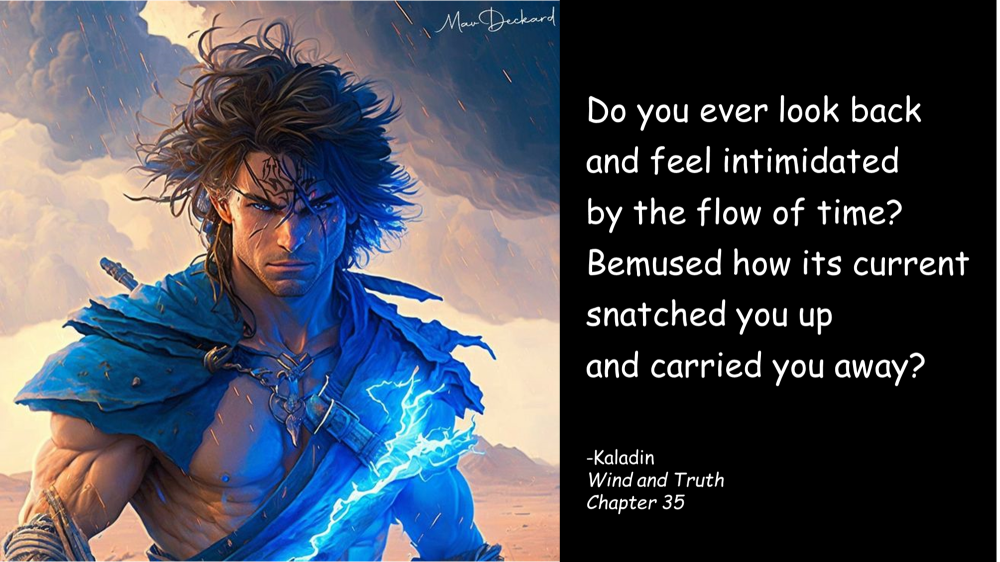
This does not sound like the voice of the Kaladin we met in the early books of the Stormlight Archive. It also waxes mental health philosophical, with vocabulary that feels awkward and out of place. Funny enough, Kaladin says this trying to convince Szeth to talk to him, and Szeth calls him out about it.
This next image illustrates a very on the nose generalization about how "perspective changes the way you see things" in Chapter 35:
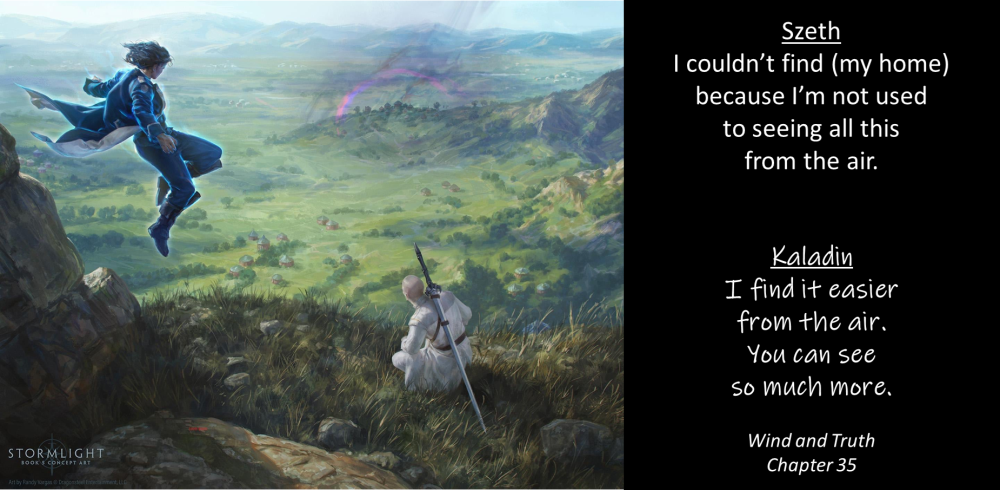
"Oh, when we zoom out of the weeds of our day to day life, and examine things holistically from a different perspective, you can see so much more." Hang that inspirational poster on my office wall.
Actually, for the inspirational cat poster, look no further than Chapter 10 (Book Quartermaster, which in my opinion reads VERY much like this new voice of humor and preachy-ness that is becoming more and more distracting from Brandon's stories; I know I'm cramming a lot of sentence in these parentheses, but Chapter 10 includes a he he moment about feeding grass to spren genitals ho ho ha - anyways, back to that cat poster):
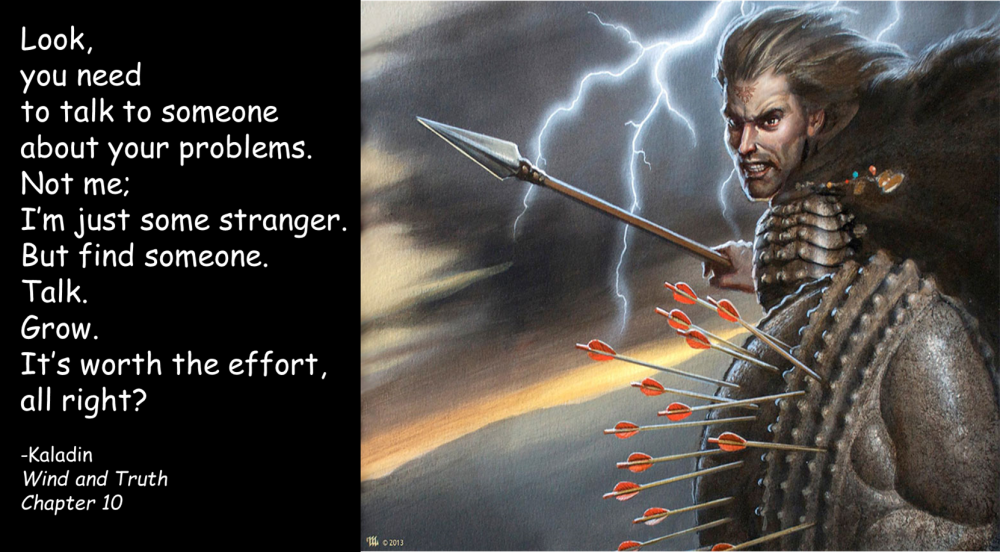
Wait, I've heard this somewhere before...

Considering this is the climax of a tirade Kaladin levies against the Book-Quartermaster, consider how the moment plays out, with Kaladin introspecting and then eventually shouting:
QuoteIntrospection: His annoyance at this woman simmered into something hotter. He opened his mouth, a dozen different options springing to his mind. She wanted a scene? Oh, he could make a scene.
Shouting: This attitude you put on? You think it makes you appear strong, but it doesn’t. Instead it makes very clear that something is wrong with you. Look at Syl’s effort. You should be thrilled! Who berates a person for bettering herself? Who sells books and stationary, yet feels the need to undercut someone overcoming enormous physical limitations to use them?
No subtext, just spren genitals and an on the nose sermon about bullying being bad.
I find these last images most illustrative of this shift in not just the way mental health is portrayed in the Stormlight Archive, but in the quality of writing some folks have pointed to as a critique of this book.
Look at this exchange between Kaladin and Ishar in Wind and Truth Chapter 33:
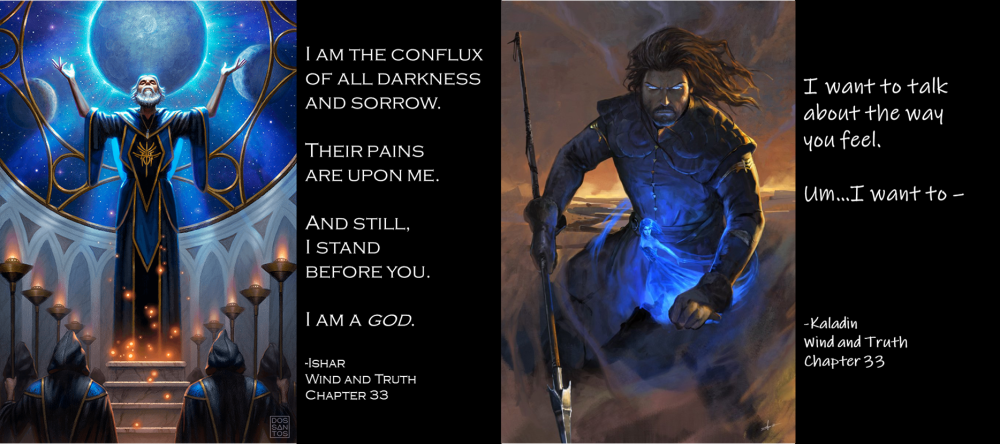
Man, that Ishar quote about being the conflux of all darkness and sorrow was a POWERFUL hit of the "Herald insanity" we've seen and heard about throughout the series so far. It captured the intimidating nature of this "god king" in Tukar, who was unpredictable and unknowable, which had the air of mystery suspense thriller from the first moment we learned about him. This started SO GOOD.
But then, Kaladin's response to this is such a wet noodle, and even worse - it's the most cliche therapy-speak phrase in history, and even includes an "um," an ellipses, and a dash.
Also, this exchange isn't over:
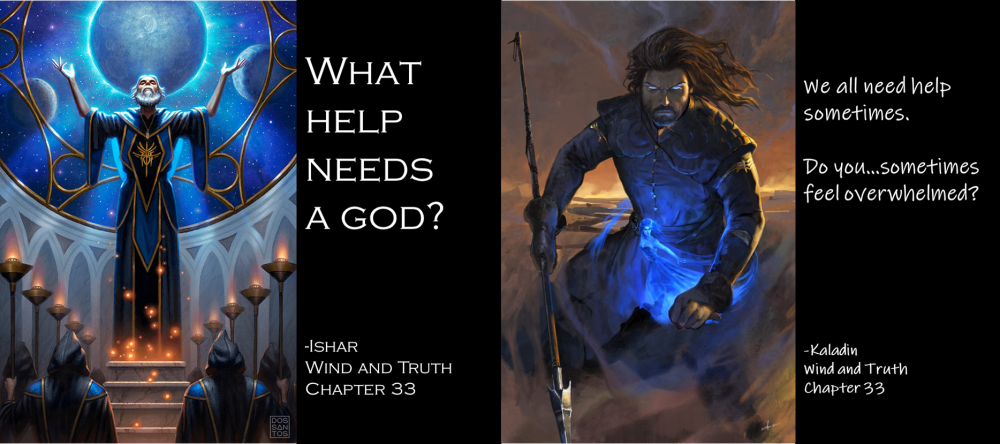
What makes this moment even more ridiculous is that Kaladin himself, after saying this, thinks to himself, "Storms. Did that sound silly?"
Yes Kaladin. Yes, it sounded very silly.
As I mentioned above, Chapter 139 really let me down, and I think objectively it pulled the entire story/book/potentially even the series as a whole down too. It starts with such an epic moment that could have been - that SHOULD have been - a character and even series defining moment for the Stormlight Archive's favorite bridgeman:
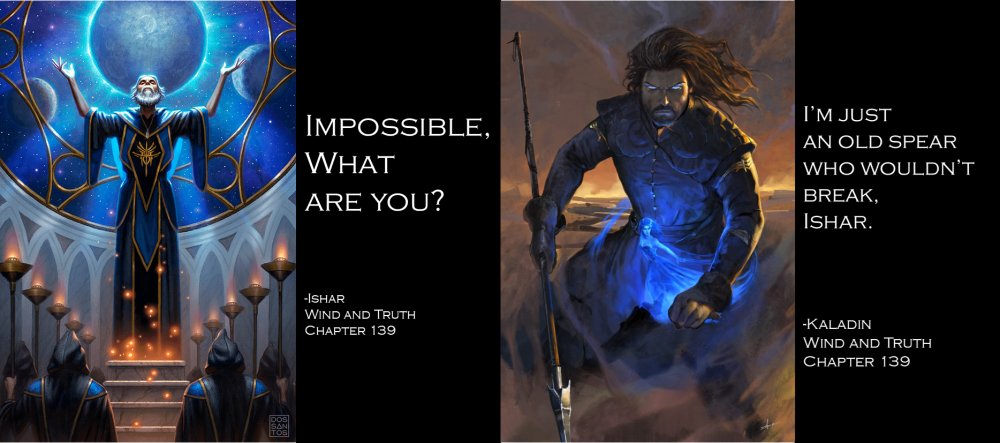
THIS IMAGE IS SO GOOD. It captures that theme of "a man standing up," even in the face of adversity, even in the face of overwhelming odds with no guarantee of success. THIS is the Kaladin we got to know and love in the early Stormlight books, and THIS was the start of a great moment that would end with him swearing the fifth ideal. That would go even further to becoming a new Herald, another one who would not break, because he would get to protect not just other people, but Roshar (and the cosmere) itself. The Herald of Perseverance. The Herald of Resilience. IT WAS SO CLOSE TO BEING AMAZING. We were robbed, folks.
Because less than one page later, we get this:
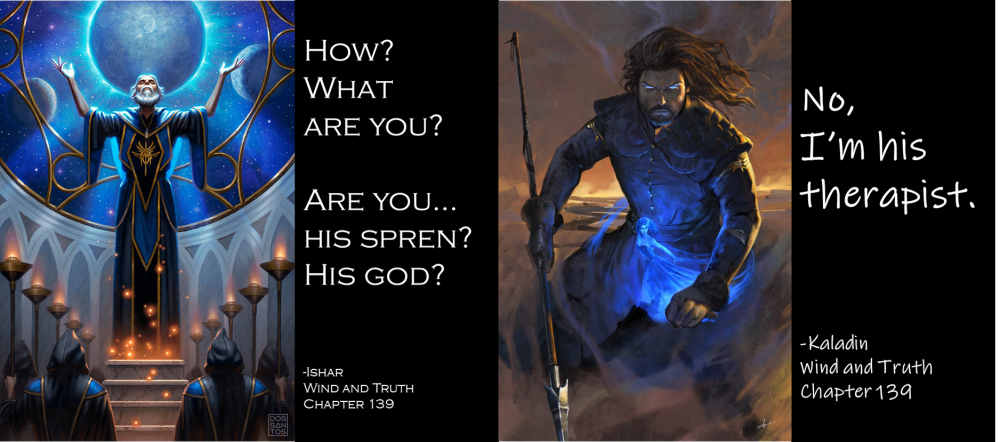
Such a balloon pop to an otherwise impressive scene.
6 hours ago, Nitpicking said:Can someone make Brandon read this? (I know the answer is "No," but I had to say it.)
If Brandon were to read this, I would first of all be incredibly honored, because he's meant a great deal to my life (beyond just writing stories that I like). He's helped me grow as a reader, as a person, as a helping professional, as a friend, and as a human being. I would say "thank you for being who you are, and for making the world (and many worlds) a better place."
What I would hope he would hear in reading all of this is that as much as we appreciate him being a workhorse author, I think it's time to really hone in on tightening up the books before releasing them. I KNOW there was a ton of work that went into Wind and Truth, and it had a lot of great ideas and pieces that are clearly still coming from the brain of a creative juggernaut. That said, the timeline/schedule of these books would benefit from more time. I've seen Brandon mention he's trying to cut back on the commitments he makes to write certain things because he knows he needs to fit all this into the much-deserved successful life he's had so far.
I hope that the next leg of the journey gives Brandon a chance to refocus, and come back even stronger in what comes ahead!
7


Brandon is Back
in Cosmere Discussion
Posted · Edited by VirtuousTraveller
After several let downs - specifically in terms of editing and what I experienced as a bumpy, inconsistent increase of the cosmere lore crossovers in his books - I am glad to see Brandon, in my opinion, pulled off a comeback with his 5th secret project.
Emberdark reads like classic Sanderson - insanely immersive worldbuilding, engaging magic systems, and a coherent theme and story arc accompanied by characters that likewise have great arcs of their own.
Were there pockets of lore-dumping exposition? Yes. Were they distracting from the story? Not really. Is this a big deal? Absolutely it is, because unlike The Lost Metal, these moments didn’t feel like fan fiction. Seriously - this is a substantially better book in the way Brandon treated cosmere lore and crossover info (while to me The Lost Metal was the worst offender, this issue was present in The Sunlit Man and especially in Wind and Truth). I cannot stress just how grateful I am to have experienced the master executing his craft effectively again.
C’mon, why am I criticizing some of those other books in a review about Emberdark? Because this book stands in stark contrast to those books:
Awkward humor? Almost nonexistent. (“he he look he punched a person wasn’t that unexpected? hey laugh guys it’s my funny humor” was the only real hint of that “corrupted Wayne/Lift” voice, and I admit it’s even a stretch to compare this to that; it wasn’t here and it wasn’t missed).
“Modern” language usage? None of that (save one “That sucks” oh wow blame the language translation technology throw away explanation, but that DIDN’T really break immersion at all, and I’d put money on Brandon smirking with the “see fans I said it was the translation thing notice I didn’t over do it throughout the book?” Yeah Brandon we noticed and APPRECIATED that!)
What about vulgar language? We returned to form with nothing beyond “Shards…” which was much more in line with the classic Sanderson bibliography (save one brief moment of “you ol b*****d” Hoid, who Brandon seems Intent on being feather ruffly outside social conventions because he’s a loose cannon irreverent character).
Forced representation of identity groups? Folks, Brandon managed to do a very effective story about cultural intersection that felt authentic, without a hint of preachiness. In fact, the “indigenous vs colonizer” dynamic felt pretty mature and was portrayed consistently from start to finish.
What about the prose complaints from Wind and Truth? As one of the more vocal critics of this editing issue in his last book, this book is a great example for comparison. Emberdark felt polished - even the flashbacks that incorporated the short story. Nothing felt choppy or wordy or over the top or stilted and flat. It all flowed, and even the literary devices (like repeating the phrase “he didn’t answer, as it wasn’t a question”) didn’t come off as immersion-breaking gimmicky.
This book was consistent and PROFESSIONALLY DELIVERED as a well-oiled story. Dusk has steelpushed his way into the top of the cosmosphere as one of my new favorite characters (easily one of Brandon’s best character arcs since Oathbringer in my opinion).