



Stormwalker
-
Posts
56 -
Joined
-
Last visited
Content Type
Profiles
News
Forums
Blogs
Gallery
Events
Everything posted by Stormwalker
-
I don't know if this has been theorized on before, but to cut the preamble short, my idea is the effects of prolonged use of soulcasters are caused because the soulcasters are draining investiture from your soul (i.e. your innate investiture). To start, for those who don't remember, prolonged use of soulcasting fabrials comes at at a cost to one's body (what I term Prolonged Soulcasting Sydrome (PSS)): WOR Ch. 35 The question is why? (I believe) we know that using investiture has a degenerative effect on oneself, and this was my first thoery, but I think PSS seems to be far too dramatic an effect for this to be the cause. Moreover, surgebinding doesn't seem to cause PSS, and, as far as we know, the fabrials try to mimic the surgebindings, so why one and not the other? The only thing I can think of elsewhere in the cosmere similar to PSS is when one uses Nightblood without breath, which had the effect of draining colour from one's body (before death). So, my idea is that soulcasters (and perhaps other old fabrials, like the regrowth fabrial seen by Nale and nameless Stoneward #1) are meant to be used by surgebinders, and as such, try to draw stormlight from their user. However, for the non-radiant ardents that use them (and thus can't draw in stormlight to fuel the fabrials), it slowly drains the investure from their innate investiture. This is exactly as the case with Nightblood, which normally drains one's breath when used, but if one doesn't have breath, it drains their innate investiture, killing them (if not stopped quickly enough). The difference here is that the soulcasters do this at a much slower rate, hence we only get a physical transformation, and not immediate death (although perhaps after enough use, death will occur). Of course, the obvious problems with this is that the Nightblood effect was only draining one's colour (which makes sense on Nalthis, as colour is drained in awakening), whereas PSS is significantly different, with no Roshar-specific reason that I can think of to explain it. Moreover, shard-severed limbs can be thought of as a damaged innate investiture, and they, like with Nightblood, drain the colour of the limb, not turn it to stone. But perhaps there are different manifestations of losing innate investiture. Or perhaps that is what happens when you drain a lot of investiture from one part of the body, whereas soulcaster-use drains a small amount of investiture from the whole body (PSS seems to effect the whole body at once, whereas Nightblood affects seems to affect your arm first). This idea actually just came to me, so I may add to it more later. So, Plausible? Obvious? clearly wrong? discussed before?
-
Sorry about the pronoun confusion, I meant that Elit's family (the Ruthars) would be humiliated, not the Kholins. My idea was this: If Adolin had beaten quickly, it would have shown that Adolin was a much better dualist than Elit, but it would also show that Adolin actually tried his hardest to win. That is where being respectful of your opponent comes in—they deserve your trying your best to win, whether or not it is actually needed. But Adolin didn't try his hardest to win, he dragged out the fight when he could have easily won in minutes. It's equivalent to if he had kept one arm behind his back the entire dual. If Adolin had tried that tactic on a better opponent, he would have lost in no time; while Elit was trying his hardest to win, Adolin was making a joke of him in front of everyone. It isn't that Adolin is just a better opponent (there is no shame in that other than Elit's boasting that he was better), it's that he showed to everyone that he didn't even need to try in order to beat Elit. The message it sends is that Elit is not even worthy of fighting Adolin (i.e. one of sheer contempt for his opponent)—I don't see how you don't think that is humiliating.
-
Sorry, but this is one of those times that I just feel compelled to voice my disagreement. I really don't think you understand what must have been the magnitude of Elit's humiliation in his dual with Adolin. Alethkar is basically a warrior society, the greatest calling in life is to be a soldier, and martial prowess is greatly revered. I don't claim to be an too knowledgable in such things, but I can't think of a single more humiliating thing Adolin could have done to Elit than what he did in that dual. If Adolin had beat Elit in a single strike, It would not have been (IMO) as humiliating. Instead, he toyed with him for a full hour, showing he has absolutely no respect whatsoever for Elit, and making a spectacle of him in front of everybody in attendence. Do you really think that no one else would have seen what Adolin was doing? I am not surprised his whole family felt the shame of that defeat. You ask what Adolin could have done differently? He could have beat Elit in 5 minutes like a respectful dualist instead of humiliating him for 55 minutes in front of the Alethi court, just to rub in how much better he is at dualing. [/inconsequential rant] My point is, it really was a jerk move—you can show your skill without humiliating someone like that. Sure, Adolin needed to do something to goad Relis into dualling him, but that doesn't make the act any more honourable (journey before destination and all that). Anyway, was I the only person who assumed Sadeas was behind the whole cripple Adolin plan? I mean, I could see Relis trying to hurt Adolin, but the way he made sure Adolin couldn't forfeit seemed (despite my last paragraph ) particularly brutal and over-the-top, and that just screams Sadeas to me. I don't see any conclusive evidence the judge was actually bribed, but if she was, than I think that would be stronger evidence for this (Dalinar has a lot of politcal power, so if you are going to actively let his son get crippled in front of everyone, than you better have someone powerful backing you). Of course, the fact that Relis didn't think the plan up, doesn't excuse his behaviour, but I think that is exactly the difference between the normal Alethi lighteyes and the particularly bad people.
-
This makes it harder, but I think the situation is still doable. Suppose you are a double gold twinborn. You first store some health in a gold spike as well as some gold shavings. You then swallow the shavings, and spike your gold feruchemy out of yourself with your gold spike, while burning your health-imbued gold shavings in order to stay alive. You then re-spike yourself with the gold spike (which now contains your own gold feruchemical ability) in the appropriate place, and then burn it. The splicing of spiritual DNA (which may also be the source of the pain, might not matter then) as it is your own sDNA to begin with (not to mention the restorative effects of the health you are burning). Personally, I don't see how this would be triple compounding, however, I think it would work as double: You get extra health for burning a metalmind, and you get extra feruchemical ability for burning your charged spike. You could then theoretically do this as many times as you wanted to to get unlimited gold feruchemy power. However, I don't know if it would actually be useful. I think that increased feruchemical power only allows you to draw from your metalminds faster (which is why most inquisitors couldn't draw from their gold-minds very fast). But clearly Miles was already at the point where he could draw as quickly as he needed to, so after a point, there doesn't seem much reason to be better at it. It would be nice if you could do this with your allomantic powers, but I think you'd need to be more than a twinborn to be able to do it (as you'd need at least Feruchemical gold in order to survive the spiking).
-
I don't think this wouldn't be an issue because the resistive force would apply to the object as well, which would cancel out the force of the pressure difference. Are you trying to describe refraction here (i.e. the bending of the light rays)? Because my point was that transversing the time bubble by itself should cause this, and the added index of refraction will do the exact opposite (and so cancel out the effect). However, now that I've had some sleep, I realize that the changed index of refraction isn't actually going to change the frequency of the light (only the wavelength), so it looks like this part doesn't work (and I can't think of any other way to get around the redshift problem). As for the dimness part: Well, my idea was more along the lines of what if planks constant was larger inside the bubble. As far as I know, there isn't any way to theoretically calculate planks constant (without using other experimentally found constants), so I don't think it's a problem. In fact, in the wikipedia page on 'physical constants' it says this: So at the very least it isn't obvious this would cause a problem. Of course, this is only a local change in the constant, so I would imagine there would definitely be some sort of wierd QM effect right at the boundary. However, this might not be noticible macroscopically.
-
I agree that I don't think there is any way to rectify time bubbles completely with physics, but perhaps there is at least one that uses relatively little handwavium. As it is a bit off topic, I'll put it in spoiler tags, but basically, I will try to deal with each of the problems addressed individually: In any case, using this modified theory, Outis's deadman switch would not work (the frequency of radio waves would be the same). Moreover, even if the theory is wrong, there is no reason to beleive a frequency change like that would happen, even if there isn't anything against it either.
-
You got it. And here I though the obscure name of Denth would throw people off.
-
One unfortunately trusted, the other unfortunately mistrusted. Apparently, a few letters makes a big difference.
-
Lan on his way to Tarwin's Gap, passing through Arafel or Kandor?
-

Has Nalan been using Szeth from the start?
Stormwalker replied to sun tzaro's topic in Stormlight Archive
I believe WoB is that one of the heralds went back for their honorblade (which would be the missing one), although for the life of me I can't figure out where it is. I agree that it is probably Nale that has it, and it is probably his own that he took. If Nale is supposed to be carefully tracking Szeth, then he doesn't seem to be doing a good job of it. We've seen him in Azir (Lift's interlude) and Iri (Ym's interlude) doing his own mission of hunting surgebinders, during which Szeth was probably on the other side of the continent (probably somewhere between taravangian and the shattered plains). I agree with Moogle here: 'let him keep it' implies that Szeth already had it before the two heralds met him, not that they had anything to do with giving it to him. However, the fact that it is said in past tense instead of present (compare 'we shouldn't let him keep it') seems (at least to me) to imply that the decision goes back further than just this feast. Moreover, from context, the thing that they did that 'was wrong' seems to be about Szeth and the blade, so it certainly seems like they did have something to do with the assassination. This would also fit with the idea of Nale trying to stop a desolation and Gavilar possibly trying to start one. -
Not to mention this scene of unexpected death/betrayal: Why would Kaladin kill his father after saving him from the voidbringer??
-
Yeah, I agree my tidal forces argument probably isn't enough to really deform the coins that much. But I don't like the thought of it acting like an external pressure, because then it doesn't really make sense when you consider that you can push on different parts of the metal seperately (we know Kelsier could, even if it was very difficult). Yeah, I sort of realized this one myself a few posts back. Of course, in theory, it really does depend on the constants in the equation (which we don't know), and more importantly, whether it is a inverse-square law exactly, or some modified version of one. I mean, you could always come up with a force equation that has the properties necessary to cause this behaviour. My point was more along the lines that the existence of such a stable equillibrium point would depend on exactly what the force is as a function of distance (or at least, if anyone asks, that was my idea from the begining ). Of course, I would think it is unlikely it actually works with such a contrived law. Using some meta-analysis, I feel that B.S., if he has actually made a force law for pushes, would have probably made it either an inverse-square or exponential, as you suggested (as those are what arise in nature). However, that is not to say that I agree with the idea of allomantic friction. I don't think you have any other evidence besides this one event for the presence of friction, and frankly, it just seems too weird for me to accept on that alone. In particular, if allomantic pushes had friction, wouldn't that resist sideways movement when there is only one push on a coin as well? IIRC we've seen many a time (or at least one time) where somebody was pushing off of a coin, which was then pushed away to the side by another allomancer. The coin in this scenario would then have regular friction plus allomantic friction—you'd think it would be hard if not impossible to move with a similar strength force (think of moving a coin trapped between two slabs of concrete). Also with Zane balancing on a coin, I agree with the others that it is more likely him pushing on 3 parts of the coin at once in order to balance himself. In any case, I agree it's been awesome to have a real physics debate on this.
-
The song Windrider by Ensiferum, naturally, makes me think of Kaladin, and for something that is completely independent of Stormlight Archive (came out 2001 I think) I think it is fairly close to describing Kal in WoK (if you throw in some WoR anachronistically so he can fly)—or at least, it is the closest song I can think of to directly describing a part of a cosmere book. If only they had made it Windrunner instead... I know there have been threads for music which goes well with cosmere books, but I'm wondering if there are any other songs out there that are similarly close to story elements from Cosmere books (also, I didn't want to be accused of necroing ). If you're not into death metal for some reason and can't stand listening to the vocals, then the lyrics are here: http://www.metrolyrics.com/windrider-lyrics-ensiferum.html (but it's an awesome song, so you should check it out!).
-
Hmm... Maybe the tidal forces aren't as negligible as I thought then. A quick calculation shows that, for the mistborn at a distance of 10m from each other, with the coin (radius 1cm) directly in between, the tidal forces on the coin (which would be a compressive force) would account for about 1/100th of the force of each allomantic push on the coin itself. So the coin is compressed with only 1/100th of the force that Vin hits the tree (and cracks it) with. Perhaps this is enough to cause the coin to deform on its own? I don't know how much force it takes to deform gold, but I've heard it is a relatively soft metal. Well, it's nice to finally have a useful application of all this physics knowledge.
-
I don't think allomantic pushes would put any stress on the coin (other than minute tidal forces). In this, I would imagine the force acts analagous to gravity (which is itself analagous to electrostatics, classically): gravity acts on every single molecule of an object identically (i.e., the same acceleration). Thus it will never cause stress to the object (again, excluding tidal forces). Even if you were in a spcae with two identical, massive gravitational fields in opposite directions, there would be no stress on your body—the forces would cancel out at the atomic level. It should be noted that your body can't even sense gravity: when you feel your 'weight' pulling you downwards, what your inner ear is really feeling is the reaction force of the ground upward (the normal force). This reaction force acts directly on the bottom of said object, and is transmitted throughout the body via a compressive stress. (I should note here, I am not that sure on the physics of stresses either, so the terminology might be wrong, but I'm fairly sure the general principal is correct). Similarly, as the coin is small, tidal forces should be negligible, and so the two pushes act on each molecule of metal individually and identically. In each of those molecules the two forces cancel out exactly, and so there is no net force on each molecule of the object. Thus there is also no stresses, and hence no deforming of the coin. I honestly didn't get how this followed from the previous statement about deforming the coin. It should be noted, in my model, the island of stability was for r > r_0 (where r_0 is point at which the verticle allomantic force is at a maximum), and thus is infinite. I do concede however, that, once one puts in the proper constants, the equillibrium position will probably be a lot more than a metre away from horizontal (but this just a guess, it is impossible to know without actually knowing the constants), as the maximum force is going to be a lot greater than mg. As to your theory, if pushes/pulls caused friction, that would mean you could levitate an object by pulling and pushing on it at the same time (for a mistborn). Fine control over the position could then be achieved by increasing the strength of either the push or the pull, while keeping the other constant. I would think this would be a really useful application, as well as one that would be fairly easily discovered, yet it was never mentioned in the books. Lastly, for interests sake, I wonder if you could derive an island of stability in the horizontal direction via special relativity. In my model, pushing is like the E field. Now, once you have electrostatics and you apply special relativity, you get the magnetic force as well (I should note I don't really know exactly how this works, but I should learn it in my aforementioned EM course by the end of the semester!). Thus applying special relativity to pushes/pulls (and assuming allomantic strength is invariant like charge is), one should get a corresponding magnetic effect. Thus, the analogy between EM and iron/steel would be complete. By applying this, we see that when the coin moves slightly to the side, the force on it (and thus the corresponding 'steel field') changes. A changing steel field then produces a magnetic steel field. The moving metal in the magnetic steel field then produces a force. I'm not exactly sure where this force would point, but it would make sense that it would oppose the movement (to offset the energy stored in the magnetic steel field). Hence there would be a tiny restorative force, which could create an even tinier island of stability. Even a very small island of stability is better than a single point (and would actually make it possible for it to happen by random chance). EDIT: two lastly's
-
Ok, I think I get it now. I was just thinking that the lattice structure didn't matter for a pure metal (as I thought it would always have the same crystal structure), and so the base unit would just be an atom. If there are multiple different types of possible lattices, then it makes sense that the base unit is made up of many molecules. So if there are different types of lattices for pure metals as well (as I assume your first set of pictures is describing), would this mean that not all pure coppers work perfectly as a metalmind either (because it doesn't have the exact lattice structure of the 'ideal' allomantic copper)?
-
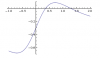
Not necessarily. In a different thread I postulated that pushing/pulling worked with an inverse square law (like electrostatics). If you assume that is the case then you will find the upward force produced by the two coinshots (at a distance of d to each of them) is proportional to r/(r^2 + d^2)^(3/2), where r is the distance above the centre of mass plane. As you can see in the following graph (in which d=1, mg =0.3), the equillibrium point will be stable as long as the equillibrium distance is large enough (over the maximum value of F, which is at 1/sqrt2 for the case of the graph). Verticle Force (F) vs height ( r): (sorry, I don't know how to make it bigger) F = r/(r^2 + 1)^(3/2) - 0.3 This would also explain why it stopped halfway between the two—as the horizontal midpoint is also a stable equillibrium point. Funnily enough, this exact problem (without the gravity part), was a question for a homework assignment in my Electrodynamics class today (phrased as an electrostatic force problem of course). I think that this explanation makes a lot more sense then that there is somehow friction caused by the pushes. Friction between physical objects makes sense. But as far as I know, there is never friction between forces and objects (like EM forces). Plus inverse square laws are a somewhat natural assumption and explain several other pushing phenomenon (like how it gets weaker as you get further away). EDIT: I do realise I forgot to account for the unstable equilibrium in the horizontal axis in the plane perpendicular to the axis connecting the two allomancers (i.e., the x axis, if up/down was the z axis and the allomancers were along the y axis), which my theory would not be able to account for. This would still make the occurance unlikely, but it would still be a lot more likely than without the inverse square law. IIRC, the book did say most of the coins were deflected when they did this, so it could have just been a chance event. EDIT2/disclaimer: Because of said assignment, I only got an hour of sleep last night (it was due today), so I apologize if it turns out that any/all of my math is wrong.
-
But I would think that with copper (or the other pure metals), the atomic structure is just a single atom of the element itself (as it is the smallest repeating unit in the crystal). So each atom of copper in the impure specimen would still individually match the allomantic atomic structure necessary for storing memories. As long as all the copper atoms are connected in the crystaline structure, they should then act as a group. Put another way, my idea was that if you had a pure coppermind touching, say, a smaller piece of lead, then I think everyone would agree that you can still store memories in the copper. Similarly, if you had a lead core surrounded by pure copper, you would still be able to store memories without any inefficiency. You could then consider the case where you split up the lead core into two seperate pieces. Again, I think everyone would agree this doesn't hinder you. You can then proceed by induction: each step you mix up the lead a bit more. I see no reason why at some point you would suddenly either stop being able to store memories in the 'mind, or start storing them inefficiently. Thus one would think this should even apply at the molecular level—where the lead is mixed up with the copper so well, that it effectively is a homogenous crystal. The only thing that would stop you IMO, is eventually, for sufficiently impure copper, you would no longer perceive it as copper, and so you could no longer store memories in it.
-
Ok. So this pretty much refutes my explanation/theory for alloys, although not my argument for (im)pure metals. Out of curiosity, do we actually have explicit evidence that the process of making the alloy matters for allomancy? I only remember them talking about the amounts of the metals. Given how complicated it sounds, and the number of ways you could possibly try to make the alloy, it would seem that it would take a long time to find the right alloy for use in allomancy. Maybe they could have found bendalloy by tAoL time, but Vin & crew did seem to find duralumin pretty quickly (and they didn't even know the right metals to use at the time).
-
I'm not so sure about this: In allomancy, one has to seemingly burn the whole metal at once, but this isn't necessarily true for feruchemy or hemalurgy. For example, I would imagine that one can use any amount of copper for a metalmind. Even, theoretically, one atom of copper (although the quantity would surely be negligible). However, this would suggest that if you had a piece of metal that was, say, 98% copper, 2% zinc, then, when trying to store memories, you would be able to store them in the copper part of the metalmind (i.e., the 98%). Thus, the compound acts like a regular coppermind, except that the effective size is (in this case slightly) reduced. I can see no reason for there to suddenly be any leakage. Now, for alloys, we can only assume that the same reasoning works.* Thus if you have 1 unit** of pewter made with 12% lead and 88% tin, it would act like you had ~96.7% of a unit of allomantic pewter (9% lead, 91% tin) and the remaining ~3.3% of a unit as pure lead. You would then store your strength in the allomantic pewter part as normal. Again, the effective size of the metalmind is decreased, but there is no leakage. My explanation for the inevitable question of "if that is the case, then why can't you store senses in your pewtermind (using the tin part)?" is that it is a perception problem. Same goes for any other metals that happen to have both tin and lead in them. A similar thing would then happen for hemalurgy. Footnotes: *I should note here that I don't really understand the concept of alloys, but I will assume they have no more structure than just a bunch of the constituent elements mixed together. **I use 'units' here because I don't know if the alloy ratios are by number of atoms, by weight, or by volume
-
Plutonium? Why do that when you can just go straight for antimatter? And hey, you wouldn't even have to convince sticks to stop being sticks: they would just be antimatter sticks.
-
I always imagined pushing and pulling worked with something like an inverse square law (which matches how EM forces in nature work--B.S. does seem to like his science). This would explain how pushing force seems to diminish the further one is from the target (eventually, you can no longer even push on an object). On a long object like a railway, you could integrate to find the net force from the whole object (like the classical infinite line charge problem in physics) and the iron/steel line would then point in the direction of the net force. A very long rail would thus act approximately like it was infinite (as very far parts contribute very little to the total) and so you would always find that the line would point to somewhere near you (probably the closest part of the rail to where you are).
-
I just thought of a theory for this this, and although I can already see holes in it, maybe it will give someone else an idea. Perhaps the KR abandonment of their Oaths wasn't as intentional as I believe people in this thread seem to believe it is. Perhaps Mr. T's secret that destroyed the KR was that they had already done something against their Oaths. For example, suppose that surgebinding indeed causes/hastens the desolations, as Nale believes. Thus the KR have been causing desolations, which I would imagine might go against some of their Oaths (for example, perhaps this goes against 'journey before destination'). Furthermore, suppose the KR didn't originally know this—allowing them to make the Oaths in the first place—and at the time of the Recreance, they somehow learn this fact. As each KR learns that they are contributing to the next desolation, they realize it is a betrayal of their Oaths, and their Spren die. Hence, 9/10 of the KR orders abandon their Oaths at around the same time. Perhaps then Skybreakers merely say 'well, there isn't any law that says it's illegal to start a desolation' and decide they didn't really do anything bad, and hence they are the order that stayed around. After their spren die, the Windrunners/Stonewards/whoever-else summon their shards and leave them for humanity as dalinar sees in his vision (perhaps to give the humans a chance in the next desolation?). The main problem with the above, of course, is that (as well as it admittedly being a very flimsy example of breaking an oath) is that of the spren's believing the KR betrayed them. The only explanations I can think of is that they disagreed that this would count as a broken oath or that they blaimed the radiants for starting the bonds in the first place. Anyway, as I said, after coming up with the theory (that is, the specific example given), even I didn't believe it, so feel free to poke more holes in it yourselves. In any case, the above was really just one example of a way the radiants could have already broken their oaths without knowing it. The point was that this could be a way for all the radiants to betray their oaths at around the same time. EDIT: Spelling and grammar and stuff.
-
I think you were right with the first sentence. Saying that a Lashing increases the 'bond' of objects together suggests to me that it is the classical physics equivalent of increasing G (Newton's gravitational constant), which would increase the force of gravity between the two objects without changing the mass (F= -GmM/r^2). This is evident as (in a vacuum), gravity makes everything falls at the same acceleration, so just increasing the mass of an object would not significantly increase its falling speed (at least until it neared terminal velocity, where the effects of air resistance would become more significant). Thus basic Lashings increase a persons weight, not their mass.
-
The Ultimate List of Questions for Brandon
Stormwalker replied to Chaos's topic in Cosmere Discussion
Can you steal a hemalurgy-given power with a different spike? For example, if someone had a hidden spike that gave them Allomantic pewter, but, as you thought they had Allomantic pewter innately, you tried to tried to spike them for it in the usual way. Actually, that makes me wonder, can you spike inanimate objects? And If you can, could you then spike another spike?
