



dstokes7
-
Posts
22 -
Joined
-
Last visited
1 Follower

dstokes7's Achievements
14
Reputation
-
Cosmere Map Accuracy? (Spoilers for Isles of the Emberdark)
dstokes7 posted a question in Cosmere Q&A
In Chapter 27 of Isles of the Emberdark, Starling states that the perpendicularity at First of the Sun (aka Drominad) is of extreme strategic importance in the Roshar-Scadrial War because "while Drominad wasn't super close to either Scadrial or Roshar, it was situated somewhat between them...". That makes it sound like the three planets are situated in a nearly straight line relative to each other, with Scadrial on one end, Roshar on the other, and Drominad roughly in the middle, perhaps situated somewhat off to the side. Yet on the map of the Cosmere included in Arcanum Unbounded, it shows Scadrial positioned very close to Roshar, while First of the Sun is clear out in the boondocks! Far from being on a relatively straight line, the three are actually arranged like an extremely acute triangle! If that map is correct, then calling Drominad a strategic midpoint between Roshar and Scadrial is like saying Johannesburg, South Africa makes a great midpoint between Berlin and Moscow! Is the map from Arcanum Unbounded inaccurate/no longer cannon, or am I misunderstanding something?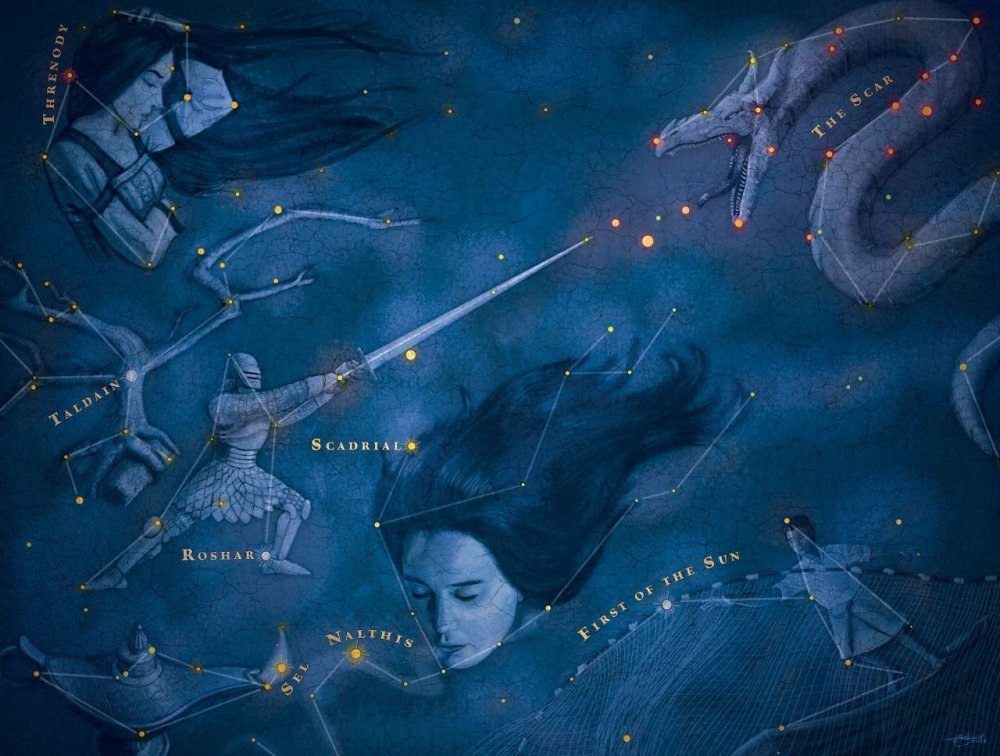
-
I really like your thinking, but the crux of what confuses me about killing the emperor is the emperor is a figurehead. So what if he's easier to manipulate, if he doesn't have any real power, there's no point to manipulating him. If manipulation of the Azish government was his goal, why not take out the most influential viziers instead, such as Noura? They are the ones actually in power, so why not focus on them?
-
When Taravangian sent Szeth out to kill a long list of world leaders, he allegedly picked leaders whose loss would cause chaos, since he wanted the world in shambles as preparation for Taravangian himself becoming "emperor of everything" per the Diagram's instructions. Yet a few of his decisions of who to kill and who to leave don't make sense to me. For example, we have no mention or evidence of him targeting any Iriali leaders, despite that country being a regional power and a potential roadblock for Taravangian's desired overlordship of all Roshar (as was indeed demonstrated when Iri proceeded to conquer their portion of the world at the start of the war rather than joining the coalition). After all, his stated explanation to Navani for killing King Hanavanar was because Hanavanar would have been unlikely to join the coalition. Wouldn't the same logic dictate the decapitation of Iri's leadership? For that matter, why leave King Elhokar alone? When it appears the king is about to get smashed by a chasmfiend in WoK, Adolin panics because he forsees Alethkar shattering with Elhokar gone. That seems like exactly what Taravangian would have liked (especially if he took out Dalinar and maybe Sadeas while he was at it to prevent either one from taking the throne), but he leaves him alone. Why? Finally, the one that confuses me the most is his decision to target the Azish Prime. There are two countries we know of on Roshar that have stable, semi-democratic governments led by figurehead monarchs without any real power: Azir and Thaylena. Both have oathgates, which would have been critical bargaining chips for Taravangian to control, and both are regional powers in some form (Azir as the core of Makabak, and Thaylenah as the chief sea power and shipping magnate on Roshar). Taravangian must have known that taking out the monarchs of these places wouldn't cause chaos there, because both would simply have replacements re-elected (as indeed happened twice in Azir). So why leave the queen of Thaylenah alone while killing not one, but two successive Emperors of Azir? Leaving Queen Fen alone makes sense, but I can't see how whacking a figurehead monarch of Azir with no real power to decide his nation's domestic or foreign policy would contribute to Taravangian's objective of chaos (especially since later events showed that it didn't have any negative impact on Azir long term at all). Why treat Azir differently from Thaylenah? Why kill the emperor of Azir at all? Heck, if Taravangian really wanted to control Azir and Makabak, he could have simply killed the first emperor, then submitted the greatest essay of all time to the competition - either under his own name or that of a sycophant who could be a puppet - and gotten selected as emperor directly (they might have even welcomed him as a disposable monarch they wouldn't cry over losing much as they did with Gawx). But he didn't. I guess I'm an idiot compared to Taravangian, so I'd appreciate any insights and thoughts!
-
Does anyone else feel like any individual who becomes the Nightwatcher's Bondsmith would have to be creepy beyond all measure? The Nightwatcher is a pretty messed up and creepy spren. What kind of person would love just chilling in the Valley with the Ghost of Christmases Future all the time? They'd have to be someone like Wednesday from the Addams Family or Yzma from Emperor's New Groove! I probably would NOT like to meet that person. Haha!
-
As a Bondsmith, Dalinar has the ability to summon a perpendicularity and to directly infuse individuals or spheres with Stormlight drawn from the Spiritual Realm. It occurred to me, though, that Radiant powers require Stormlight to function. So does that mean Dalinar must already be holding some Stormlight before he can summon more? If Dalinar somehow got stuck in the middle of nowhere without any spheres or Stormlight, could he still summon a perpendicularity, or would he first have to wait to be "primed" like an old-fashioned pump in the next Highstorm?
-
At one point, Ishar tries to use his bondsmithing powers to steal Dalinar's bond with the Stormfather, and the Stormfather seemed convinced it would have worked if he'd been given the time. That ability sounds a lot like hemalurgy. Brandon has said a hemalurgic spike could be used to steal surgebinding ability, and that ability comes from the Nahel bond. Wouldn't that mean that a hemalurgic spike could steal a Radiant's bond to their spren? If so, wouldn't that essentially mean that Bondsmiths have abilities equivelent to hemalurgy? For example, could a Bondsmith use his powers to steal a Misting's powers and assume them himself?
-
Inconsistent Consequences of Shard Clashes (Spoilers for WaT and HoA)
dstokes7 posted a question in Cosmere Q&A
When Odium clashed with Mercy and Ambition, the fallout trashed the Threnody system, destroying entire planets. When Honor attacked Odium, the resulting blast wave obliterated Stormseat and created the Shattered Plains, and both Shards agreed they would destroy the whole planet if the clash continued. Clearly, when two Shards clash, cataclysmic destruction ensues in the Physical Realm. That is, except for Vin's duel against Ati. Vin and Ati repeatedly attacked each other, even bashing so hard and so long that both Vessels died. Based on precedent elsewhere, Scadrial should have been obliterated, along with the rest of the Scadrian System. Yet Scadrial was unharmed by the confrontation (granted Scadrial was far from "fine" at the moment, but that wasn't due to the Shards clashing). Why was this event different? Is it because Preservation's power somehow contained the fallout and prevented it from hitting the planet as part of its Intent to preserve? -
Cognitive Realm Distance to an Undiscovered World
dstokes7 replied to dstokes7's question in Cosmere Q&A
I'm not sure, but I think so. In Arcanum Unbounded, Khriss mentions they can observe non-Shard worlds from the Cognitive Realm, and I always figured that included the gas giants of the Rosharan system. But maybe I misunderstood? -
Imagine that somewhere in the cosmere, there is a habitable, terrestrial planet with no inhabitants at all. Let's say this planet is relatively close to one of the established systems of the Cosmere (Roshar, Scadrial, etc), but has somehow remained undiscovered by anyone in the Cosmere except the Shards. Brandon has mentioned that the distance between planets in the Cognitive Realm is gradually increasing over time as the Cosmere's inhabitants gain a greater understanding of how far apart world's really are. In other words, it would take far longer to walk through the Cognitive Realm from Scadrial to Roshar in the Space Age of the Cosmere than it would during Vin's day. That distance increase is tied to the perceptions of the inhabitants of the worlds themselves. Considering that, would the distance from Roshar to my hypothetical undiscovered planet expand over time as well? No one knows about it, and no one is on said planet to think about it. So would the distance between Roshar and my hypothetical planet in the CR remain unchanged until someone discovered it, or would it expand like everything else?
-
Cryptics can innately detect and report lies. If in the future, when Roshar actually has modern-style police (not just city watch), would it be possible to have a Lightweaver cop administer a "polygraph" test with the help of their bonded cryptic, without ever needing a machine? If so, would this Cryptic Polygraph test be harder to fool than Earthen polygraph machines? From what I understand, Earthen polygraph machines work by measuring suble changes in the subject's vital signs, and it is possible for a well-trained and disciplined person to fool the machine into thinking a lie is a truth, or for it to falsely identify a trye statement as a lie if the subject is nervous or stressed. Cryptics, however, seem to be able to detect the truthfulness of the statement directly, regardless of the subject's behavior, which would make them far more reliable. Is that true, or am I misunderstanding something?
-
I realize this might be one we won't know until Dragonsteel is written, but it's something I've been wondering about. It's been made clear that Adonalsium was shattered using the power of the Dawnshards, and those Dawnshards were wielded by the 16 people who subsequently took up the 16 Shards. It is also clear that Wit and others are desperately trying to keep the Dawnshards out of the hands of the Shards, and that the Shards don't seem to know where the Dawnshards are currently located. If the Dawnshards would be so dangerous in the hands of a Shard and the Shards apparently still want them and can use them, why don't the Shards still hold them? How does someone accidentally misplace the most powerful weapon in the Cosmere? I have this comical image in my head of the 16 shatterers somehow dropping their Dawnshards when they took up the Shards, then someone (probably Hoid, knowing him) sneaks in and makes off with the Dawnshards while no one is looking. Five minutes later, we find a baffled group of Shards looking around the room saying "wait, guys, where's the Dawnshard?" "Weren't you carrying it?" "I don't have it!" "Where did you see it last?" "It was right here! By Me, I could've sworn I set it on this table!" "Well it ain't there now!" "It's gone??!!!" "Wow, nice job bro." "It's not my fault!" etc...
-
Dead People Ascending (Spoilers for Secret History and Rhythm of War)
dstokes7 posted a question in Cosmere Q&A
In Mistborn: Secret History, Ruin tells Kelsier that he will be a weak Vessel for Preservation because he doesn't have a connection to the Physical Realm, on account of his being dead. But in Rhythm of War, right before Taravangian ascends to Odium, he realizes that Szeth has killed him in the Physical Realm. That means that, at the time Taravangian takes up the power of Odium, he is also dead. So why doesn't Taravangian seem to have a problem controlling the power seeing as he was a cognitive shadow when he took up the power, just like Kelsier was? -
In several of the Stormlight books, there are thin pieces of metal used to cover the sharp edge of a dead Shardblade for training purposes. We are told that they break easily on their own, but when fitted to the edge of a Shardblade, they change shape to conform to the Blade. What baffles me is what these things are and where they come from. The fact that they can change shape indicates that they are 1) made of spren much as Shardblades and Plate are, and 2) that they are most likely still "alive" since they have retained the ability to change shape into the modern era. I figure it's possible they are some sort of Plate spren, and that maybe they gained their current function after being commanded to do so by their bonded radiant. But if that theory is true, why would they have been made in the first place? The only reason they are needed is dead Shardblades can't change shape to blunt their edges like living Blades can, and as far as I know, there were no dead Blades prior to the Recreance. In addition, it seems that the radiants (with the exception of the Skybreakers) all abandoned their Shards at about the same time, and Mya indicates neither the spren or the ex-knights had any inkling that the Recreance would kill the spren and have the impact it had. There would have been no indication pre-Recreance to indicate that there would be a need for an object to cover up the edge of a Shardblade in the future, since it was assumed the Blades would keep on functioning as they always had. So why would some radiant have commanded whatever spren these things are made of to become edge guards prior to knowing such things would ever be necessary? By the time anyone knew they would be needed, men would no longer have the necessary bonds to make them! So where did they come from, and why do they exist? Am I misunderstanding or missing something? I'd appreciate any insights!
-
As I mentioned in my first post, while it is true that a suit of Shardplate is made of many spren, each individual piece of Plate within the suit is made of one spren each. I imagine that the windspren that makes up Kaladin's breastplate feels just as indivisible as any other spren. You are right that the whole suit is more divisible because it's made of multiple spren, but each piece of plate within it isn't.
-
I suspect you are correct about Honorspren being more invested than Windspren, but I think the assumption that an invested object can only be broken by another, more invested object is incorrect. If that were the case, it would mean Shardplate could ONLY be broken by a Shardblade since it is the only thing on Roshar more invested. But that's not true. In Way of Kings, it is revealed that Shardplate can be shattered by heavy infantry wielding mundane, mortal war hammers (hence the tactic of toppling a shardbearer with nets or ropes then pounding on them repeatedly to break the shell and kill them), as can the stones the Parshendi try slinging at Dalinar during a plateau assult. Plus, even falling from a great enough height onto the ordinary stone ground can break Plate and kill the Shardbearer inside. So clearly Shardplate can be shattered just as easily with uninvested weapons as with invested ones. Though, I do admit that Shardplate might be more resistant to mundane weapons than to Shardblades, since it seems to take quite a few more hits with a hammer to break plate than it does with a Blade, so you might be onto something there.
