



skaa
-
Posts
1675 -
Joined
-
Last visited
-
Days Won
5
Content Type
Profiles
News
Forums
Blogs
Gallery
Events
Posts posted by skaa
-
-
Thanks for your insights, @offer! One of these days I'll delve more into Lie algebras, projective spaces, and kernels. Right now I'm a bit more interested in the stuff I mentioned in Parts 3 to 5. I have a lot of questions about them, but I'll just share a couple here.
1. Matrix representations
I really want to know what the deal is with the matrix representations of polytopic algebras. I mean, it would have been so cool if they're just always circulant. There's a whole Wikipedia article about circulant matrices, and they are fascinating. But no, for an even number of dimensions we get this instead (taken from Part 4):

Does this specific kind of matrix even have a name? Wolfram Alpha only describes it as both normal and Toeplitz, which is well and good, but those descriptions also apply to circulant matrices. What do we make of these Toeplitz matrices that are almost circulant but whose entries above the main diagonal are the additive inverses of the ones below? Skew-symmetric Toeplitz matrices are just a small subset of these, but then there's not a lot about those, either.
And yet, the 2x2 matrix representation of complex numbers are of this form. The only reason I discovered the above matrix form in the first place is because the complex numbers are the motivating example for the even cases of Xn, and so I just tried to generalize its matrix form. I just wish I could read more about this Toeplitz variant, particularly its relationship to circulant matrices.
2. The Addition Problem
For multirationals, including fractions and trirationals, addition is more complicated than multiplication. And as you move towards higher multirationals, it gets way more complicated way fast. One motivation for constructing the polytopic algebras is that since we can create multirationals in them, we can theoretically convert two such multirationals to the algebra's Cartesian form, add them together (term-wise addition FTW!), then convert them back to a multirational. Theoretically.
I mean, at least I was able to do it for complex numbers, right? The section on trirational addition in Part 2 is probably my favorite section of the whole series. Alas, I'm finding it very challenging to repeat this process for the next polytopic algebra after the complex numbers, which we can call X3 or triplex. I feel that it must be doable with enough mathematical skill. After all, I already know how to make 4-rational numbers in X3 (using the process I explained in Part 5). I also know the exponential formula for X3 so I can actually evaluate 4-rationals to get the Cartesian form. But I have no idea how to convert the X3 Cartesian form to 4-rational form. Do you have any tips on how to do this?
(If you're wondering, I was able to do this for complex numbers because I spent months playing around with trirationals in Wolfram Alpha until I one day had a spark of intuition. I don't think I can do the same thing for algebras that Wolfram Alpha doesn't support.)
0 -
9 hours ago, offer said:
In part 4 when you say "
Let's define a "polytopic group" to be a finite cyclic group whose group operation is the multiplication operation of a certain algebra. The span of the group's elements within the algebra's vector space determines the polytopic group's dimensionality, and its convex hull is a polytope with the same dimensionality."Was there a question attached to this?
9 hours ago, offer said:In part 4 chapter "Xn and the orthoplxic group" : how do tou define the multiplication in the group?There are multiplication tables in later subsections. Please tell me if my explanation of those multiplication tables was somehow lacking. Alternatively, you could just use matrix multiplication on the matrix representations of Xn (described in another section).
Edit: I forgot your other questions.
Trirational numbers are named after the fact that they represent ratios of three numbers. As I showed in Part 2, any complex number can be represented by "proper trirationals" where all three components are positive reals, but I also described other possible variants. A trirational number where all three components are integers is a "simple trirational".
While rational numbers form a field, simple trirationals don't (adding two simple trirationals does not guarantee the sum will be a simple trirational). But proper trirationals do form a field, so I feel that they are the more natural generalization of rational numbers even if not all three components are integers.
My reason for not calling them "trifractions" is more of personal taste than anything; it just doesn't sound right to me. But I'm open to discussing other alternatives.
QuoteSince you are looking at elements of a projective space and define multiplication as element-by-element multiplication it might be usefull to look at it as a Lie group...
Sorry, but I just want to reiterate that trirationals are complex numbers. I mentioned projective coordinates in my blog post as just another example of homogeneous coordinates, but... are you saying that trirationals can exist in both the complex plane and a projective space at the same time?
0 -
During the pandemic lockdowns, I started getting obsessed with abstract algebra. Take note that I am not a mathematician nor do I see myself as mathematically-gifted, but you'll be surprised how much a layperson can learn by accident just by watching YouTube videos and daydreaming, and how much more he can learn by going on Wikipedia rabbit holes and pelting random mathematicians with stupid questions.
So anyway, I came up with some algebraic structures that are related to each other, and I decided to write several blog posts about them. Some caveats:
- The whole thing is still a work in progress, mainly because I still have some (probably stupid) questions left unanswered and I don't know how to proceed.
- I have no idea how useful any of this is. I created them for fun, and so far they've been a great motivation to learn more math, so please don't pour cold water over me by complaining about how useless these things are. Corrections will be quite welcome, however.
- If you've seen my cosmere theories, you know how verbose I can be. These blog posts are long and possibly filled with errors, so lots of patience will unfortunately be needed, I think.
With those out of the way, here are links to each blog post:
Part 1: Just a rambling intro. People with limited free time can skip this as I already gave the gist above.
Part 2: This is about what I call a "trirational number". There are several ways to view it:
- A generalization of rational numbers and fractions
- A representation of complex numbers that's different from the rectangular and polar forms
- A number that represents a ratio of three numbers
Part 3: I tried generalizing trirational numbers to "multirational" or "n-rational" numbers.
Part 4: I created a family of unital commutative algebras that I call "polytopic algebras" just for the sake of providing a backbone for multirational numbers (mainly because defining the addition operation for a multirational seems impossible without referencing an underlying algebra).
Part 5: This just describes how one can use polytopic algebras, cyclic groups, and n-simplexes to create multirational numbers.
So, why am I sharing this here? I've already talked to a bunch of mathematicians in the Math Stack Exchange as well as in a couple of math-related Discord servers, but so far they've only helped me out with trirational numbers. They all become oddly silent whenever I try to ask about multirationals or polytopic algebras. I'm sharing this here just on the off chance that some people will find these things interesting. I will try to answer your questions given my limited knowledge. And if I'm lucky, someone here might help me fill up the holes in this weird framework.
0 -
Rating: 8/10
I've always liked Brandon's shorter works and Tress was no different. I think reading the preview chapters last year really helped with this one, because now I was able to easily immerse myself in the story fully expecting its whimsical YA nature.
I thought the laptop scene was funny and interesting and was clearly foreshadowed by Fort's tablet.

Too bad the book didn't have an Ars Arcanum. I just wish we could at least have a complete list of the twelve Aethers, but that's just me being an Arcanist. Brandon is probably saving that for the actual Aether world, anyway.
As for negatives, well, I think at this point I already expect cringey jokes from Brandon's "witty" characters. It's just his little quirk, I guess. It didn't really bother me much. After reading the ebook I also listened to the audiobook and I didn't like it. It's my first Michael Kramer audiobook and I guess I'm not a fan. I kinda wonder what it would have been like if Kate Reading did this instead (though they probably wanted a male voice, with Hoid being the narrator).
3 -
3 hours ago, ScadrianTank said:
They were in the middle of stopping the world from getting nuked and invaded by an alien army. Caring about stray prisoners at that moment is plot armor and protagonist privilege
I'm just saying. There's a sliding scale of utilitarianism, and Ghostbloods seem to vary from "We can let a few innocent people be murdered if our task is like super urgent" to "We can kill anyone outside our group if it furthers our righteous goals".
(I don't know if I'll be like any of them under similar circumstances. I'm not trying to moralize. I'm just stating what I observed.)
0 -
My review: Marasi and Wayne stole the show for me both as partners and individually. In many ways this was Wayne's book. I really felt his parts were Brandon's storytelling at its best. Marasi's parts, on the other hand, were Brandon's gift to us theorycrafting Sharders, and I was all for it. (Wax and Steris were cool as well.)
Now that's out of the way, please allow a bit of self-love on my part. It's been a depressing year for me so far so I'm allowing myself this luxury.
Way back in 2015, I was one of the first people who speculated a Trell and Autonomy connection. Of course nobody knew about Shard avatars back then so I naturally thought Trell was Autonomy, and also I admit I was later swayed by other Trell theories, but I'm still very happy about this reveal.
Another thing that I sorta kinda called was that non-lethal Hemalurgy is possible using very thin spikes. The Set's non-lethal Hemalurgy variant had some fundamental differences from my idea, but again I'm allowing myself to celebrate this reveal.
Finally, I once speculated that Sazed is somehow allowing (to an extent) the major conflicts happening on Scadrial in order to accelerate technological growth, with the ultimate goal being spacefaring. We just learned of Kelsier's suspicion that Saze could have defeated Trell sooner but chose not to. This theory isn't yet wholly confirmed, but TLM made me think Sazed was manipulating Trell/Autonomy (and everyone else, even Kelsier) all along.
10 -
Yeah, on first glance the Scadrial branch looks relatively decent. But then...
Quote“We have to help the prisoners,” Marasi said.
“A few lives are meaningless right now,” Moonlight said. “We need to keep moving. It’s our way.”
It seems to me that Ghostbloods in general share their founder's utilitarianism somewhat.
0 -
5 hours ago, TheWadehart said:
Interesting. This was a good read. However your use of the word Devotion got me thinking. How do you think these line up? Yes Harmony is a double shard but it seems to fit.
.png.2e77bb93af320909223db08db445ddda.png)
I wasn't even thinking of the Shards when I made this (which is why I didn't post this in Cosmere Discussions). I felt it was very likely that there are other words more fitting for these unified attributes, because I know my English vocabulary isn't that great. This is why "devotion" didn't immediately send me Shard-hunting, so to speak.
Not to say I'm opposed to the idea. There are sixteen Shards, so some will have to share Attributes for this to work, meaning Harmony being there could work. Once we get more Shard names, we could look into this again.
1 -
2 hours ago, Confused said:
This is excellent work, Skaa! Well-reasoned and presented.
But I read Kabsal’s words literally. There ARE ten Divine Attributes – the ten Primary ones. Those are the ones that attract a god – Radiant spren. I posit in this post, “Fifth Oath Achieves Secondary Divine Attribute,” that Radiant oaths progress them to full ascension when they merge with their spren. That coincides with their achievement of their Secondary Divine Attribute. They then become the equivalent of Heralds.
From a religious perspective, it makes more sense to teach how to achieve godhood, the Primary Divine Attribute. Only a handful of the faithful will ever need to worry about the Secondary Attribute.
Yes, I actually agree with you that Radiant spren are attracted to the primary divine attribute of their Order, and that their bonded Knight will need to gain the secondary divine attribute somehow through the latter oaths.
But I do feel that we cannot discount the secondary divine attributes. After all, Shallan names Honesty (secondary divine attribute of Blood/Lightweavers) as one of the divine attributes of the Almighty:
QuoteAnd what is the Almighty to think of you? she wondered. And the lies you’re growing so proficient at producing. Honesty was among the divine attributes of the Almighty, after all, which everyone was supposed to seek.
2 -
In WoK, when Shallan and Kabsal were talking about Voidbringers, Kabsal said this:
Quote“...People prefer to hear about the Ten Divine Attributes or the Ten Human Failings. We accommodate them because we, also, prefer that to the deep past.”
Ten Divine Attributes? But from the table of Essences, aren't there twenty Divine Attributes?
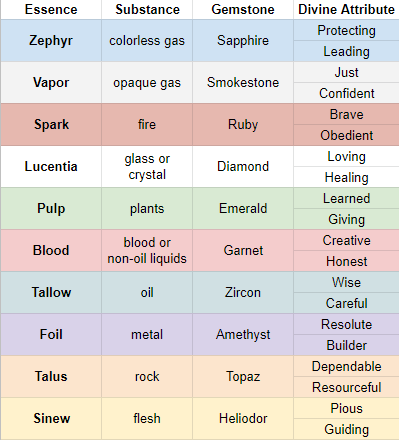
I think it's reasonable to conclude that the twenty attributes in the table of Essences were derived from ten more general attributes, and that those ten are what Kabsal was referring to. This means we can group the twenty attributes into pairs, merge those pairs, then come up with the actual Ten Divine Attributes.
So, how do we do that? There are several interesting possibilities. One is to try and merge the Primary and Secondary Attributes of each Essence:
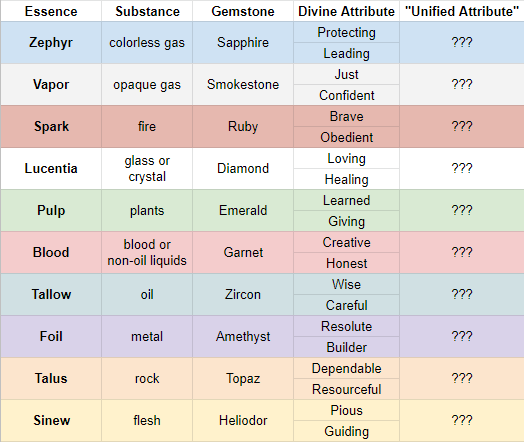
I will let someone else attempt that. I personally couldn't find a way to merge such pairs as "resolute and builder", "learned and giving", "just and confident", etc., but then English isn't my native language.
Another option is to merge the Primary Attribute of an Essence to the Secondary Attribute of the previous Essence:
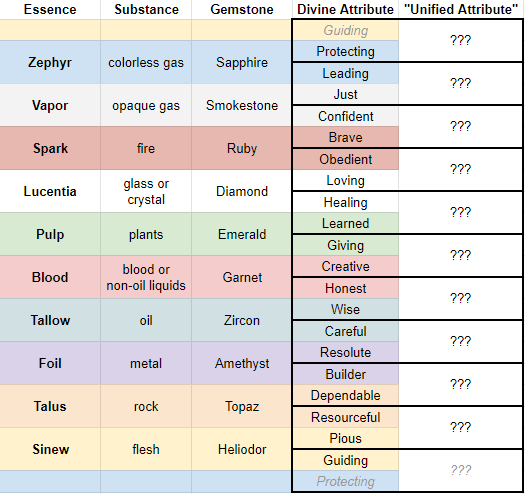
This has the added benefit of potentially mapping each unified Divine Attribute to a Surge, thereby connecting the table of Essences to the Knights Radiant chart:
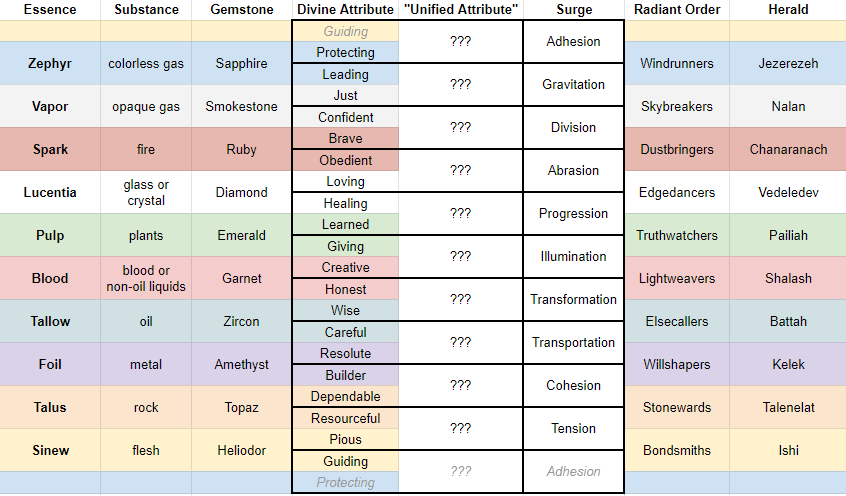
Once again, I will let someone else attempt that. I tried to do it a few years ago, pre-WoR, but I wasn't super successful.
What I ended up doing recently is slightly different but still connected to that second option. Yes, I still think that the Attributes can be mapped to the Surges, but this time I ignored the Primary and Secondary labels for the purpose of this exercise.
(For what it's worth, there must be a point in marking an Attribute "Primary", but I'm choosing to ignore it for now as irrelevant.)
So with all that said, here's my attempt:
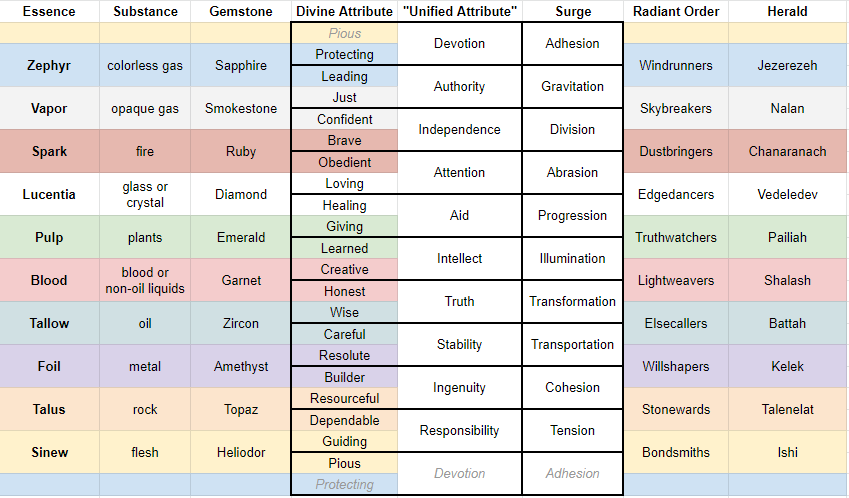
Adhesion: Devotion
Pious: devotion to gods
Protecting: devotion to the weakWhen you're devoted to something, you stick to it no matter what (or at least till the devotion is no longer there).
Gravitation: Authority
Leading: being followed
Just: to follow a moral codePeople gravitate towards authority, people or belief systems that they can follow to get the answers or the direction they seek.
Division: Independence
Confident: free from doubt
Brave: free from fearThe Division Surge removes the stuff that binds things, thereby "releasing" them from a sort of "imprisonment" or "slavery" of bonds. This can be a good thing or a bad thing, depending on the circumstance and the perspective. Just like how being free from doubt and fear can be good or bad.
Abrasion: Attention
Obedient: attention to rules/commands
Loving: attention towards fellow manYou tend to spend more time with people or things that you pay attention to or demand more of your attention, like a shoe experiencing more traction on a rough surface. But sometimes too much demand for your attention can wear away any interest you have, and your attention slips. If you don't pay attention to something, it might slip past you without you noticing, like something sliding quickly on oiled ground.
Progression: Aid
Healing: aiding the sick
Giving: aiding the needyThe Progression Surge is an aid to natural processes like the growth of living things or the healing of wounds, in that it makes those processes go faster, i.e. progress more.
Illumination: Intellect
Creative: productive intellect
Learned: well-educatedThe intellect refers to the thing that supposedly allows us to know stuff, to understand, and to be creative.
Enlightenment is what happens when you finally comprehend something. It is a concept directly related to the intellect, and is a word connoting light. Understanding brings illumination, and through it one sees.
Transformation: Truth
Honest: truthful
Wise: able to discern truthThe Surge of Transformation manipulates the truth about an object, changing its essence.
Transportation: Stability
Careful: avoiding error
Resolute: unwavering in one's decisionsThe Surge of Transportation manipulates either the spatial or the realmatic stability of objects, allowing either teleportation or realmatic transition.
Cohesion: Ingenuity
Builder: assembles parts into a whole
Resourceful: makes clever solutionsIngenuity means both cleverness and inventiveness. It is the ability to combine things into something useful and innovative. The Cohesion Surge allows the ingenuity of the user to manifest in any chosen material by shaping it to reflect his ideas, creating a cohesive structure built for a certain purpose.
Tension: Responsibility
Dependable: takes responsibility for assigned tasks
Guiding: sets an example for othersResponsibility can cause tension when the things you need to do and the things you'd rather do become opposite pulling forces. Your obligations, the oaths you've sworn, and the people who look up at you can all cause this tension. The key is to allow this tension to stretch you enough to make you stronger, but not stretch you past your breaking point.
Mapping the Attributes to the Surges like this has another benefit: It allows us to rearrange both the Attributes and the Surges at the same time. In this framework, moving an Attribute moves the corresponding Surge, and vice versa.Why am I interested in moving things around? Well, I first thought about it several years ago when we learned that Illumination was connected to Pulp and Blood; I felt Illumination seemed more thematically connected to Spark and Lucentia. At the time, I tried "fixing" that with an alternative chart, but mostly failed.
The idea of rearrangement came back to me a couple of months ago when I re-discovered a Way of Kings annotation showing that Brandon apparently experimented with various Knights Radiant chart versions. Here is one of his experiments from 2003:
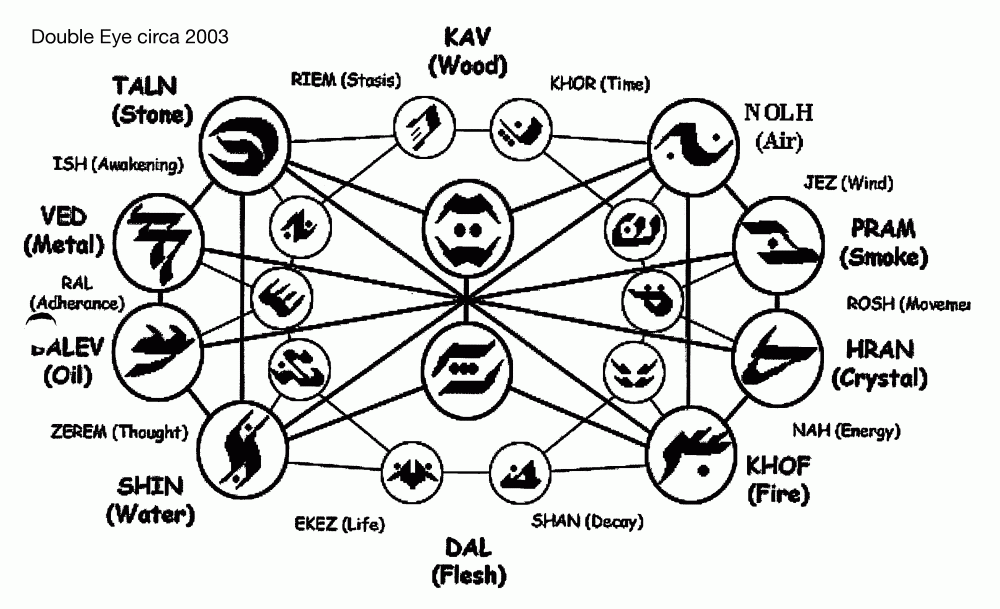
Notice how the Surges had different names back then (Division=Decay, Illumination=Energy, etc.), and different positions, and some probably were replaced with something else entirely in later drafts (like Awakening, maybe).
Anyway, I was trying to work on a theory about the Dawnshards being of Cultivation around the same time last year. Seeing this previous iteration of the Knight Radiant chart, it suddenly occurred to me that a Cultivation magic system might have Surges and Attributes just like Honor's system, but changed somehow.
And that's how I came up with the Elevations and Callings of Dawnshards theory.
16 -
Clearly I made a mistake in not justifying my premise that Cultivation was the source of the Dawnshards. To be honest, I only intended this to be an exploration of that idea, a "What If?" so to speak. It's a thing I do with my theory threads: Take an idea and just Storming play with it, you know? See how far I can go, and try to have fun while doing it. This is why I described my post as speculative several times.
But now, I do wish to explain how I came up with the idea in the first place. Here are the little things, things that might be complete coincidences, that nonetheless pulled me towards this theory.
Reason 1: Incubation
This all began when I read about the Incubators of present-day Ashyn.
The name of their manifestation of Investiture, "Incubation", is obviously meant to refer to the developmental stage of disease. That sort of icky association might make it easy to forget that "incubation" is actually a positive word. It means maintaining the right conditions for something to develop and grow. In the case of disease, the organisms being developed unfortunately make people sick. But you can also incubate benign cells. Another example is chicken eggs, that need incubation for them to hatch, producing cute little baby chickens.
Even if it only cultivates disease, Ashyn Incubation is still in line with the intent of Cultivation.
Now, disease isn't a very nice thing to cultivate, obviously. But it did make me think that Ashyn must be connected to Cultivation, somehow. It made me think that, maybe, the disease magic exists there because of Cultivation's failure with the Dawnshards.
Reason 2: Vorinism
Quote“Isn’t that the problem? What has any of this ever required of men like me? What has it required of any of us?”
“It required you to be what you are.”
“Which is self-fulfilling,” Dalinar said. “You were a swordsman, Kadash. Would you have gotten better without opponents to face? Would you have gotten stronger without weights to lift? Well, in Vorinism, we’ve spent centuries avoiding the opponents and the weights.”
Here's a question: Is Vorinism really what Honor would have wanted from those who worshiped him? Sure, it seems benign enough as a religion. (I mean, aside from the militarism and the sexism...) But notice how modern Alethi religion, i.e. post-Nohadon and post-Recreance, doesn't preach about oath-keeping or following codes. Rather, they focus on making you the best of who you already are.
Just like Cultivation.
QuoteI WILL NOT MAKE OF YOU THE MAN YOU CAN BECOME. I WILL NOT GIVE YOU THE APTITUDE, OR THE STRENGTH, NOR WILL I TAKE FROM YOU YOUR COMPULSIONS. BUT I WILL GIVE YOU … A PRUNING. A CAREFUL EXCISION TO LET YOU GROW.
Cultivation doesn't demand spiritual change from people. She prunes them herself where she sees fit, but otherwise lets them be who they are. Now, there is nothing inherently wrong with that. Her gambit with Dalinar proved that she knew what she was doing. But it isn't Honor's way. Honor wants to transform people. As Shallan said in WoK:
QuoteThe power of change itself, the power by which the Almighty had created Roshar. He had another name, allowed to pass only the lips of ardents. Elithanathile. He Who Transforms.
The ardents speak of "recasting souls into something greater", but do they teach how Honor wants that done? No, they don't talk about oaths, the honorable oaths that pull people towards change.
Upon realizing this, I felt that Callings and Elevations, as Vorinism teaches them, could not have been part of the religion of the Knights, whatever that religion was called. I started suspecting that Callings and Elevations were instead echoes of an older religion of humanity. One where they worshiped Cultivation instead, as some Western countries still do.
If you read my descriptions of the Dawnshard Callings, you'll notice references to non-Vorin cultures. The female Reshi kings. The extremely high regard for Shin farmers. I suspect Brandon put those weird things there as hints, echoes of that older culture.
It doesn't really matter if Dawnshards had some of Honor's ability to bind things, or even if some Dawnshards were more attuned to Honor (as I implied with the Calling of Scribes). After all, we see Cultivation's influences on Rosharan Surgebinding. But the Knights Radiant speak oaths, and they as an organization were founded by a Herald of Honor, and their Surge pairs were based on the Surge pairs of the Honorblades, which contain parts of Honor's own soul. So I consider Honorblades and Knights Radiant to be of Honor.
In the same way, if my Callings and Elevations theory about Dawnshards is correct, that system is of Cultivation because they align with Cultivation's intent, as I described above.
Reason 3: Surges
As for the idea that the Dawnshards might not be from any Shards in particular, that would mean Ashyn was a minor Shardworld even during the era of Dawnshards. We know that it currently doesn't have a Shard, and so basically it's a minor Shardworld now, but look at how Brandon describes minor Shardworlds:
QuoteQuestioner
What differentiates a minor Shardworld like First of the Sun?
...
Brandon Sanderson
There is inherent investiture in every world created but you are going to see-- You aren't going to find Mistborn on a world like that but what you might find is a way there are magic aspects to the setting. Spren could exist on a world like that but they would be like the minor spren, you wouldn't find Syl, but you would find something like lifespren.Knowing what we know of Dawnshards, that they gave people powerful Surges, could we really say that Ashyn was a minor Shardworld during that era? I don't think so. There must have been a Shard there that powered the Dawnshards.
Which leads us to Odium.
Reason 4: Corruption
Is it possible that Odium created the humans and the Dawnshards on Ashyn? I don't think so. Brandon said that a Shard Investing on a planet means they become stuck to that planet, and here's what he said about Odium:
QuoteQuestioner
Did Odium originally have a planet he was Invested in?Brandon Sanderson
Odium's plan always involved not getting stuck on oneThis plan to "not get stuck" is presumably why Odium prefers to corrupt pre-existing Investiture instead of using his own manifestations. Considering that the Dawnshards existed before the Oathpact, I highly doubt that Odium would have Invested so much as to create humans and give them power on that planet.
And of course, Tanavast liked the Dawnshards. Why would he be fond of the enemy's creation?
In other words, the Dawnshards must have been corrupted by Odium. They (as well as the humans) must have been created by another Shard.
Reason 5: Slammer
This final reason is more of a feeling rather than an argument. I feel that people tend to underestimate Cultivation, perhaps because of her seeming lack of action. Even Stormfather accused her of cowardice, of hiding from Odium. For me it feels too easy to assume that the Dawnshards, those powerful weapons that led to the destruction of a whole planet, could not have come from her.
Earlier, I talked of Cultivation's failure with the Dawnshards on Ashyn. I will admit that I first imagined her helplessly watching as her planet burned, before fleeing to the safety of her husband's arms.
Hoid calls her SLAMMER.
Here's an alternative, rather fanciful, and completely speculative scenario for you:
Honor and Cultivation, Shards and lovers, ruled the Rosharan system. They both Invested equally on Roshar. They both Invested on Ashyn, except Cultivation used more of her power there, for her own reasons. Roshar already had the parsh, so they created the humans on Ashyn in their image. The first Ashynite men by Honor, the first Ashynite women by Cultivation.
Honor liked Roshar because its harsh environment made the native inhabitants strong and resilient, and he spent most of his time there. Cultivation liked the more Yolen-like Ashyn because it was easier to cultivate life there as she desired, and tended to stay there in turn. Both contributed to each other's Shardic projects, the Dawnsingers and the Dawnshards. The Tranquiline Halls were happily tranquil. The highstorms were happily tempestuous. Everything was great.
Then Odium, bearing divine jealousy and hatred, arrived to destroy them. Predictably, he targeted the seemingly weaker female Vessel first, corrupting the humans and their Dawnshards. Like on other worlds he visited, Odium didn't plan to destroy Ashyn, but rather to simply corrupt the Investiture enough to kill Cultivation. Soon, many humans started worshiping the new god, believing in his gospel of passion, and using corrupted Surges: the Voids. Chaos and passion reigned.
SLAM!
With just enough warning for her faithful followers, Slammer unleashed divine justice. She held the power of both life and death, and she will cut down trees that bear no fruit. The angry goddess took hold of her corrupted Splinters, the ones that gave men Dawnshards, and Unmade them, ripping her own Investiture from them and leaving behind weakened shells of Odium's.
(She had another major Splinter on Ashyn, the tenth, but they had no corruption, for Squires had no Dawnshard. Cultivation took them with her later on to join their siblings on Roshar.)
She then engaged in all out war, with devastating consequences for both the apostate planet and the invading Shard. Odium almost didn't survive the assault. He was permanently hurt.
QuoteTo fight directly might coax out forces that could hurt him, as he has been hurt before. Those scars do not heal.
The Broken One managed to escape with the humans going to Roshar, but was ultimately outwitted by Honor and his Heralds. When Honor died, Cultivation went on her own silent war against the clever and now more wary god of hatred, and has been waging it ever since:
QuoteBrandon Sanderson
…
Odium has a fully-living, fully-aware, and very powerful Shard opposing him.Again, this last reason is more of a feeling than an argument. It was the imagery of Vengeful Slammer that led me to develop the theory. I know it's far-fetched, but I decided to put it here in case anyone else likes it.
I'm sorry I didn't initially give my justifications. But as you can see, they're pretty lengthy, and would have bloated the initial post. I hope you guys understand.
6 -
(To the old-timers out there: I'm back!)
Part I: Elevations
Here is what we know about Dawnshards as of OB:
- They were ancient weapons used to destroy the Tranquiline Halls.
- They can bind any creature voidish or mortal.
- Tanavast thought they can be used against Odium.
We know that "Tranquiline Halls" is just another name for the previous home of the Rosharan humans, which was on Ashyn. We also know that the tragedy on Ashyn that led to mass migration were at least in part caused by the use of Surges, and that Odium was involved somehow.
Based on that, I think it stands to reason that the Dawnshards must have granted Surges. And because of the way Tanavast talks about them almost fondly, I also think they must have existed before Rayse invaded Ashyn. In other words, Rayse merely corrupted them.
Since the Oathpact and the Immortal Words are of Honor, it's not that far-fetched to speculate that Dawnshards were originally from Cultivation.
(Here's a more thorough justification of that claim.)
Unlike Honor, Cultivation wasn't interested in oaths. Her manifestation of Investiture would instead require "growth" of some sort.
So here's the first part of my theory: I think Dawnshards were Cultivation-based Cognitive entities that granted Surges based on excellence.
This is how it would work: When a person reaches a given threshold of proficiency in an appropriate skill or profession, being bound to a Dawnshard for that profession would grant him a Surge. When he reaches an even higher level, he gains another Surge from the Dawnshard. This is akin to how Vorin ardents grant Elevations (whatever those are) to those who excelled in their Calling:
QuoteThe devotaries taught that when men died, the most valiant among them—the ones who fulfilled their Callings best—would rise to help reclaim heaven. Each man would do as he had done in life. Spearmen to fight, farmers to work spiritual farms, lighteyes to lead. The ardents were careful to point out that excellence in any Calling would bring power. A farmer would be able to wave his hand and create great fields of spiritual crops. A spearman would be a great warrior, able to cause thunder with his shield and lightning with his spear.
But what of the bridgemen? ... No ardents came to them to test their abilities or grant them Elevations.
For example, there could be a Dawnshard that grants Surges (one of which is probably Gravitation) to leaders with the greatest domain and influence. So, ambitious people who wish to gain power from that kind of Dawnshard would try to gain more followers, etc.
In the same way, the best physicians might gain Regrowth as an Elevation. The best artists might gain Lightweaving. So on and so forth.
Conversely, failing to sustain a certain level of excellence means losing the bond with the Dawnshard. That could be how this particular manifestation of Investiture prevented abuse.
Then Odium came and corrupted the Dawnshards. Perhaps the "Passions" had something to do with this. Perhaps Odium's corruption made the Dawnshards search for passion rather than excellence. So anyone with intense ambition could attain power just by wanting so bad to be great at a Calling. Imagine how well that would go.
As we know, the cataclysmic events on Ashyn forced many of the survivors to move to Roshar and for the rest to live on the floating cities that the planet has now. It was presumably around that point as well that Ashyn's magic started relying on disease, instead of the Dawnshards.
Thus the era of the Dawnshards ended.
Part II: CallingsThis second part is just pure speculation through and through. I just wanted to see if I could come up with a list of professions, all medieval or ancient in origin, that could have been associated with Dawnshards. Let's call these professions "Callings" after the similar Vorin term, just for convenience. In the list I'll also include the following:
- Divine Attributes best suited for each Calling
- Surges that would be thematically fitting for each Calling's ElevationsUnlike Honor's system, where the Radiants often experienced tension between their Attributes (creativity versus honesty, bravery versus obedience, etc.), I believe Cultivation's old system instead promoted complementary attributes to better cultivate the Calling.
Take Note: Obviously, in both real life and good fantasy, nobody within any profession will consistently exhibit the stereotypical traits of their profession. As Shallan said, "we’re more complex than mere bundles of personality traits." I think Brandon makes pretty complex characters, but that won't stop others, like the Dawnshards and the spren, from seeing the patterns they want to see.
Remember, this is all completely speculative, just like any Skaa Theory(TM). Feel free to post your own list of Callings if you wish.
Let's start with the only Calling in my list that was mentioned in-book in a context that involves a Dawnshard: Herald.
Calling: Herald
Attributes: Careful and Obedient
Surges: Transportation and AbrasionQuote“Taking the Dawnshard, known to bind any creature voidish or mortal, he crawled up the steps crafted for Heralds, ten strides tall apiece, toward the grand temple above.”
—From The Poem of IstaIn medieval times, heralds were messengers hired by nobles and monarchs to communicate with others on their behalf. The Surge of Transportation would have been a god-send for that task: Imagine messengers who can move between two correspondents in no time at all.
The Surge of Abrasion also fits this idea of speed, but I'm more interested in the idea of "spiritual abrasion", wherein one "smoothens" relationships between parties. We saw a glimpse of this when Lift managed to soften Nale's heart for a few minutes. Heralds were the precursors of diplomats, and endeavored for peace and understanding to prevail between their lord and others. As diplomats, they needed to be careful and logical as they forge agreements between parties, but still obedient to the will of the lord they represent.
By the way, using Abrasion would allow one to crawl up gigantic steps, as in the Poem of Ista. I bet the character in the poem was supposed to be a Herald on Ashyn. The steps were, after all, made for Heralds.
(The descriptions for the rest of the Callings below are placed in spoiler tags for length.)
Calling: Knight
Attributes: Just and Resolute
Surges: Gravitation and TransportationSpoilerKnights are a noble class known in medieval times for their horsemanship, their supposed acts of chivalry, and their oath of fealty to a monarch or other lord.
For Ashynite Knights, being just pertains to following their codes of chivalry and their oaths with the utmost resolve. Like leaves in the wind, they embrace the Lashings that bind them, whether they are Lashed through the air, to the ceiling, or to a different realm altogether.
Yes, I consider Transportation to be a Lashing, mainly because of Jasnah's experience:
QuoteThat puffed out the last of her Stormlight, which she had drawn in at the last possible moment, then used like a lash to pull herself into this place. It had kept her alive, healed her.
...
How had it happened? The academic wanted to record her experiences and tease out the process, so that perhaps she could replicate it. She’d used Stormlight, hadn’t she? An outpouring of it, thrust into Shadesmar. A lash which had pulled her, like gravitation from a distant place, unseen…To complete the medieval imagery, I imagine Ashynite Knights to all have horses, perhaps of the Ryshadium variety.
Calling: King
Attributes: Guiding and Leading
Surges: Tension and GravitationSpoilerA King is a leader, someone who is followed. He (or she; remember that female Reshi king?) has the authority to make laws that bind everyone under his rule, as gravity binds everyone, punishing those who stray far from his will.
But a King does not just lead by decree and threats. Nohadon teaches that a king must also lead by example. He must therefore be a guide for others, a model of strength, and a shining beacon of unity. As Nale says, "Law is Light," and the lawmaker must be the Illuminator. A King does this by following the very laws that he makes, and excelling in the same virtues that he demands from his subjects. Being a model and a guide, he spiritually pulls others towards the path he chooses.
There will be tension, as it takes effort for people to change their ways. Some subjects might even break due to the strain. And there is always a risk that the King himself will break. Despite this, a good King knows that people should do better and take the next step, even after falling.
That is, after all, the Way of Kings.
Calling: Scribe
Attributes: Wise and Dependable
Surges: Transformation and TensionSpoilerScribes are responsible for making official records. Throughout history, scribes have acted as accountants, clerks, notaries, journalists, copyists, and archivists, among other roles. They wrote down the decrees of kings and gods, laws and scripture alike. In their wisdom, they make sure that anything worthy of safe-keeping will be preserved, and they are usually very dependable in that regard.
This Calling is one deeply rooted in truth and accountability. I feel that this was the Calling closest to Honor, because attestation of oaths is something Scribes (as notaries) would do.
(Side note: The idea of Honor being a Shardic scribe reminds me of Stennimar, the honorable accountant from Nalthis.)
I imagine Ashynite Scribes Soulcasting important records into a much more durable form (stone?). As representatives of Honor, even in Cultivation's system they must have had a special role. Perhaps Scribes presided over sacred funeral rites that honored the deceased with a recitation of their recorded achievements before their body was Soulcast to stone. Perhaps Scribes even executed the deceased's will and testament, another act of honor that the Stormfather might have echoed in executing Tanavast's will.
In ancient Egypt, the goddess of wisdom, Seshat, was a divine scribe and record keeper. She measured things by stretching a knotted cord, something that Ashynite Scribes might have done as well using the Tension Surge.
Calling: Scholar
Attributes: Learned and Honest
Surges: Illumination and TransformationSpoilerA scholar is someone who lives a life of learning. Scholars also love sharing what they've learned, as they are part of a community that is open to knowing honest facts.
I believe this Calling grants the user the power to sense the pertinent truths around them, the same mysterious Illumination ability that Truthwatchers have. This would of course aid scholarly research.
Members of this Calling could also Soulcast, but like Shallan they would probably find Spiritual Transformation easier, using honesty to transform others, just as they use learning to transform themselves. "A true scholar who changes the world," as Jasnah said in WoK Chapter 36.
(I have another idea about this Calling, but I'm afraid to share that particular vision too soon.
)
Calling: Artist
Attributes: Resourceful and Creative
Surges: Cohesion and IlluminationSpoilerAshynite Artists can make sculptures out of any hard material using Cohesion, and create realistic illusions using Illumination. These are straightforwardly appropriate Elevations for the resourceful and creative, so I have nothing much to add except that these Artists would make excellent spies.
Calling: Priest
Attributes: Pious and Builder
Surges: Adhesion and CohesionSpoilerIn Roman times, the high priests were called "pontifex", or "bridge-builders". The term was figurative, of course, but the Romans did consider certain bridges sacred, as the rivers they crossed were seen as gods.
A priest, as a model of piety, is supposed to be a bridge between god/s and mankind. I'm speculating that Brandon took this idea to a literal level by giving Ashynite priests engineering responsibilities so that they literally built bridges. And I imagine Cohesion would fit this engineering role perfectly. I could also see them using Cohesion when creating temples, as well as ornate religious items made of precious metals.
As for Adhesion, Priests could use Spiritual Adhesion to preach to people with a different language. Like the Apostles in the Bible who spoke in tongues.
I also have a feeling that an Ashynite version of fabrials can be made by bonding Cognitive entities with Adhesion. Such items would be considered sacred.
Calling: Squire
Attributes: Protecting and Giving
Surges: Adhesion and ProgressionSpoilerSquires were knights-in-training. They became servants of full knights and did various chores like maintaining the knight's equipment, helping the knight put on his armor, and even acting as the knight's bodyguard, all while waiting to be knighted themselves once they prove their skill.
I imagine Ashynite Squires to be similar to Knights Radiant squires in that their role existed because of their relationship with someone else with power. Squires had access to Investiture, meaning they had the passive benefits such as self-healing, but they were only there to protect and serve someone already bonded to a Dawnshard, and their powers persisted as long as they remained devoted to their role.
I might even go so far as to speculate that Squires were not, in fact, bonded to a Dawnshard themselves, just like how Radiant squires aren't bonded to a spren. Ashynite Squires were granted a boost in fighting skill via Adhesion (similar to the boost that Kaladin experiences; it makes sense as an effect of the Protecting Attribute). Also, their bond allowed their sire to extract their Investiture for use, which could be critical when they needed healing.
Without an associated Dawnshard, Squires were the lowest of the Callings, though still an important one.
Calling: Herbalist
Attributes: Healing and Confident
Surges: Progression and DivisionSpoilerBefore the advent of modern medicine, most physicians were herbalists who used concoctions from plants to heal people. They usually didn't perform operations like surgery (spoiler alert: that's the next Calling), but rather simply prescribed medication based on their diagnosis.
Of course, you want a physician to be confident in his diagnosis and his prescription. After all, you came to him because of his supposed expertise in healing disease. He should be able to discern with a reasonable level of certainty what is good and what is bad for you.
Just as Scribes were the closest to Honor, Herbalists were the closest to Cultivation. They had the power over both life and death, as one needs to destroy things in order to cultivate others. Herbalists were given the highest respect in Ashynite societies. Aside from being physicians, they were also farmers, and their powers can till the land (Division) and hasten plant growth (Progression). And like the farmers of the Shin, they had the right to adjudicate on various important matters, bringing their skill to discern between good and bad to a broader level.
In other words, they were the judges.
Calling: Surgeon
Attributes: Brave and Loving
Surges: Division and AbrasionSpoilerAt first this was the Calling I was going to call "Knight" because of the Brave attribute, but I found something more suitable. There is a profession for people who do not flinch in the face of gruesome things, a profession also for those with compassion towards the suffering of others. I'm talking of course about surgeons.
In OB, Pattern said that ashspren liked breaking things because they want to know what's inside. This outlook sounds like a good starting point for a would-be-surgeon, who will need to know what's inside people, and will need to cut people up. I imagine a mastery of both the bond-breaking of Division and the slicking of Abrasion granted Surgeons the ability to precisely and smoothly remove adhesive bonds between specific cells, creating an opening in the skin or tissue without any damage to the cells themselves. So, no Dustbringer burns. Just super precise cuts.
But how to heal the cuts? Notice that Progression is not one of their Surges. Back in the medieval ages, surgeons were seen as inferior to physicians. Physicians were academics who excelled in medical theory, who studied innumerable ailments and how to heal them, and who therefore preferred to heal the wealthy who could afford them. Surgeons, on the other hand, were seen as glorified razor-wielding barbers, with a sewing kit to close surgical wounds. The physicians, if they are available, would be the ones checking on patients post-surgery. The actual healing was not part of the surgeon's job.
Fortunately, Ashynite Surgeons had something better than sutures. By applying the sticky type of Abrasion to the two sides of a cut, I believe the cells would stick together again. This is similar to how Dalinar used Adhesion to re-form broken inanimate objects, except I think Abrasion can apply this to living flesh.
This is not the same as Regrowth, as this trick will not heal disease or intracellular damage. But imagine being able to stick a fully severed limb back with Abrasion, instead of using up a lot of Investiture in Regrowing the whole limb. That could be quite handy.
The Herbalist physicians and the Surgeons would ideally work with each other, of course.
So, do you guys like my list?
By the way, did you notice how Division, the Surge of destruction and decay, is in the hands of medical Callings in my list? I believe this is how Cultivation would choose to do things. What do you think?
If you noticed my little hints here and there, you'll realize that there is way more to this theory. But I'm stopping here for now to avoid bloating up this post any further.
12 -
I was looking over the Bridge Four article on the Coppermind when a thought occurred to me: Bridge Four took in lots of new recruits in Oathbringer. Did the new members get the Bridge Four tattoo as well?
I'd be grateful if you or someone else asked that during the signing, @Dearius.

Edit: Considering that Renarin does not seem to have the tattoo, the answer is probably no. But maybe it's still worth asking to be sure.
0 -
On 4/19/2018 at 11:27 PM, Leyrann said:
I can't find it, but I've seen it with my own eyes and I know that @skaa is the one that got it. Hence the summon.
That wasn't me. Some guys confirmed it on Discord, and I just made a post to spread the word. And also to share my own vectorized version of the symbol.
0 -
On 6/30/2015 at 0:03 AM, skaa said:
The city-sized circle at Nebrask is apparently not large enough to be rendered useless by this structural weakening... Perhaps it has something to do with the Earth's own curvature affecting very large circles?
I'd just like to sort of quickly elaborate on this point about Earth's own curvature being a possible solution to the problem of Warding strength. (To be honest I just figured it out yesterday, hence this three-year necro. Yes, I'm a slow thinker.
 )
)
In the original post I listed down three possibilities for the Warding strength "reference circle": the incircle (the circle with radius equal to the ellipse's semi-minor axis), the circumcircle (with radius equal to the semi-major axis), and what I call the pericircle (a circle with the same circumference as the ellipse). Based on my Warding strength formula I then chose the circumcircle as my favorite, as it leads to the strongest Lines of Warding.
But as @ccstat pointed out, using the circumcircle as the reference doesn't explain why Brandon said that Lines of Warding weaken as they grow larger. Brandon also said that this weakening "isn't as fast as the curvature would indicate".
So what's really going on here? Recently, I've realized that there is actually another possible reference circle that I forgot to put in my list: What if the basis of Warding strength is the circle whose area is the same as the area of the ellipse?
If that's the case, something very interesting happens.
###
Notice that if the world was flat, a circular Line of Warding will always have an area-based reference circle that is identical to it no matter its size, and we're back to the same problem as before...
Fortunately, the world isn't flat (despite what some people say
 ). It isn't a perfect sphere either, but it's close enough that we can use a sphere to approximate the math for our purposes.
The formula for the area of a circle on a sphere differs from the one used for a circle on a flat plane. This is because on an ideal sphere, drawing a circle wouldn't lead to a flat disc but rather to a spherical cap. The surface area of this spherical cap is given by this formula A = τRh, where R is the radius of the sphere, h is the height of the cap, and τ is our beloved circle constant tau. (Side note: It would've been cool to post this on Tau Day, but I just couldn't wait.)
This spherical cap's surface area is obviously bigger than that of a disc on a flat plane, so a Line of Warding on a spherical surface would in fact have a bigger actual area within it than the circle area suggested by its radius (which presumably is the area of its reference circle). This difference actually increases the larger the Line of Warding is. As we know, smaller curvature ratios lead to weaker Lines of Warding. So now we can finally see why larger circular Lines of Warding are weaker: it's because their reference circles are smaller than they are, leading to a smaller curvature ratio with its reference circle.
Note that for normal-sized circles on a planet-sized sphere, the surface area is virtually flat. There's also the fact that Rithmatists normally draw on man-made flat floors. In both cases, the reference circle is still equal to the a circular Line of Warding. The weakening only starts to be noticeable when the circle gets large enough for the spherical cap to be noticeably tall.
3 -
1 hour ago, Chaos said:
He later said that any Shard can make these aspects, which is very cool.
Cool. Oathbringer spoiler:
SpoilerWell, Evi implied that the Nightwatcher is Cultivation's avatar (though I guess whether Evi's belief is accurate is a matter of speculation).
I wonder how these aspects/avatars differ from regular Splinters, and whether Autonomy's avatars only seem special because there are way more of them.
0 -
I was thinking of his solution to Alcatraz 6 (collaborate with Jansi Patterson on it to help with Bastille's voice), and I started wondering if he could use this co-author strategy to take some of the load off his other non-cosmere works. Like, we already know from the release party that he's asking Dan Wells for help on Apocalypse Guard. If Dan (or someone else) would somehow agree to co-author Apocalypse Guard, and maybe finish off the series himself (using Brandon's outlines), then Brandon would suddenly have one less series to worry about.
He could do the same thing for the Aztlanian. Since he wants to write it with Latin American sensibilities in mind, he could collaborate with a Latin American fantasy author to work on the dialogue of Aztek Federation characters and anything else that might concern Latin American readers.
Of course, all this assumes that Brandon will find authors willing to collaborate on his works and who would be faithful to his vision (we don't even know if Patterson has already agreed on doing The Worldspire), but I really hope he'd be willing to try to do more of this for the sake of his Cosmere fans.
1 -
14 minutes ago, Ookla the Delightful said:
I JUST WON NANOWRIMO FOR THE FIRST TIME EVER IM SO EXCITED!!!!!!!!!!
Congrats!
0 -
I'm about to go on a three week family vacation! First we'll visit my brother in Auckland, New Zealand for a couple of weeks, then we'll all fly to Sydney, Australia to celebrate my father's birthday.
I am particularly excited to experience a December summer for the first time. Surely it won't be as hot/humid as a typical Manila day, right? And while I loved our December trip to Tokyo last year, I almost couldn't tolerate the cold winter wind, so I'm looking forward to a much more comfortable vacation this time around.
Any Kiwi/Aussie Sharders out there who'd like to meet up? Or otherwise, any tips you'd like to share? Feel free to PM me!
0 -
-
18 hours ago, yurisses said:
https://wob.coppermind.net/events/9-calamity-philadelphia-signing/#e7590
Transcript has every line twice.
Fixed. And also the second one, @yurisses.
0 -
6 hours ago, Leyrann said:
Just to make sure, I'm going to put my whole post in spoiler tags for Oathbringer, as there's a few minor Oathbringer spoilers in there. No actual plot spoilers though.
As you're probably aware, L-Theory has been on my mind quite a bit, and I've found myself wondering wheter it might be slightly off in a specific part. To be precise, I think that not the Spiritual Realm, but rather the Cognitive Realm is made up out of the other endpoints of the strings. The Spiritual Realm, then, is made up out of the strings themselves. I believe this solves a number of problems that I have with L-Theory in it's current form.
First of all, it would explain why distance in the Spiritual Realm is so weird. In the Cognitive Realm - which would essentially be 3-dimensional, rather than incomprehensible - things still exist similar to what we know. As we've seen in Oathbringer, up to the point of life, plants, ships, cities, etc. The Spiritual Realm, meanwhile, would be impossible to truly understand, as it consists of at least four dimensions (our 3 dimensions to allow for positions of the strings, plus a fourth to allow for the strings to actually be string-formed); I can see distances and space to at the least be totally different from how we know it in daily life.
Second, and this is also something I bumped into writing my Theory of Identity, Identity, as we know from the feruchemical chart, is a Spiritual property. If it is indeed caused by Connected oscillations, then it would only make sense that Identity was an attribute of the Realm where those oscillations actually happen. Additionally, it would directly allow for strange loops to also be placed in the Spiritual Realm, as those connect the strings to themselves. I have a hard time visualizing strings in the Spiritual Realm (which you used to explain Connection) if the Spiritual Realm consists of endpoints (why are there strings in what is basically a D-brane like the Physical Realm?), but if the Spiritual Realm consists of the strings themselves, then it would fit naturally.
Third, I feel like this actually gives a better foundation for the Spiritual Realm as the pure and perfect true nature of objects and stuff: that is information that is contained in the string itself, rather than in one of the endpoints. Even if you move an endpoint (break a piece off a vase and move it somewhere else) then the string itself remains the same, also because there is no distance in the Spiritual Realm; only the endpoint changes.
The one thing that goes against this theory is that the Coppermind states that the Cognitive Realm is the Realm between the Spiritual and the Physical, but it does not actually cite a source for this. If there is a source, then that means I just wasted the time I spent on this post, but I could see it being a mistake someone made because, obviously, the sorta understandable Cognitive Realm would be closer to the Physical Realm than the totally incomprehensible Spiritual Realm. Except, as I explained, I think that's a misconception caused by the nature of the Cosmere where the intermediate Realm is the one that is hard/impossible to understand.
Those are interesting thoughts! Unfortunately, we do have a source regarding the idea that the Cognitive Realm is between the other two Realms, and it's from a Shard. Here is Preservation (in Chapter 1 of M:SH) talking about the Cognitive Realm:
Quote“It’s not the world of the dead. It’s the world of the mind. Men—all things, truly—are like a ray of light. The floor is the Physical Realm, where that light pools. The sun is the Spiritual Realm, where it begins. This Realm, the Cognitive Realm, is the space between where that beam stretches.”
Although Leras wasn't omniscient, and was severely handicapped by this point, I think his analogy must have some truth in it given that he can still see all three Realms.
2 -
I have to confess something: I have major problems with Oathbringer, especially the last couple of chapters ("Ideals" and "Debt Repaid"). Now, don't get me wrong; as a Sharder who loves getting as much info about the cosmere as possible, I am very thankful that Brandon tried to pack in so much in such a short space.
But as a reader... it was all a bit exhausting, to be honest. With all the action going on post-climax, it almost felt like I was reading the start of another story instead of an ending. Despite liking most of the ending scenes over all, by the last dozen pages a sort of fatigue started setting in.
In a way, I understand why Brandon did this. The scene where Dalinar was writing his memoirs is one of the must-haves of the book, which is named after said memoirs. Of course it has to be there. The trouble is that Dalinar would not have had time to work on "Oathbringer, My Glory and My Shame" until more pressing concerns were handled, namely, Taravangian's betrayal, the vacant throne of Alethkar, and his son's marriage. And so Brandon chose to write scenes dealing with those three things first, along with a bunch of other stuff that happened in between. Only then could he end the book with Dalinar writing his memoirs.
The thing is, in my opinion this is one instance where the show, don't tell rule of writing could have been and should have been ignored. Every writing rule has exceptions, and I truly believe a "tell" way of resolving some of the loose threads would have allowed Brandon to write a single, more effective ending chapter instead of the two chapters that we had. In addition, I believe some of the scenes would have been better off being moved to a separate novella published after Oathbringer.
Let me list down all the scenes in the last two chapters, and how I personally would have suggested changing some of them if I were Brandon's editor:
- Moash is given an assignment - Keep.
- Dalinar asks Navani to teach him how to read - Keep.
- Shallan realizes that Adolin knows the real her - Keep.
- Venli ponders on her fate - Keep.
-
Szeth swears the Third Ideal of the Skybreakers - Keep.
-
Shallan and Adolin confess their love for each other - Move to novella.
-
Kaladin ponders on stuff and talks to Teft - Keep.
-
Taravangian confesses to Dalinar - Move to novella.
-
Moash kills Jezrien - Keep. But end the scene with the Fused giving Moash Jezrien's Honorblade and renaming him as Vyre immediately after Jezrien dies, so that we can skip the last Moash scene.
-
Lopen swears the Second Ideal of the Windrunners - Keep. But end it before Lopen talks to Kaladin. And switch with the Ash scene below.
-
Ash feels her father's death - Keep. But switch with Lopen scene above.
-
Kaladin finds Drehy, Skar, and Gavinor - Drop. Instead, replace Teft's final interlude (I-14, which I felt wasn't really needed and didn't even feel like a good interlude) with an interlude from Drehy's POV showing how they managed to send a spanreed message, and perhaps giving details on how they survived the Kholinar disaster. This is the only change I would suggest outside of the last two chapters.
-
Taravangian faces Odium. Move to novella.
-
Adolin confesses to the murder of Sadeas and refuses kingship - Move to novella.
-
Palona reads gossip and Jasnah appears as queen - Drop. Instead, write a scene from the POV of Jochi of Thaylenah, where we get another spanreed conference between him, Ethid, and Jasnah. Jochi talks about how the common Thaylen folk are coping after half their city was destroyed, while Jasnah reports about Elhokar's death and the rescue of Gavinor, the confessions of Taravangian and Adolin, Shallan and Adolin's marriage, and finally (*gasp*) her coronation as queen of Alethkar!
-
Moash receives the Honorblade - Drop. See scene 9 above.
-
Shallan and her brothers reunite, and she receives a new Ghostblood assignment - Move to novella.
- Dalinar writes Oathbringer - Keep.
As you can see, if I had my way there would have been only 11 scenes (10 pre-existing + 1 new scene) in Oathbringer's ending instead of 18, and I think all of that would have fitted a single chapter. The spanreed conversation of the hypothetical Jochi scene is what I meant by breaking the "show, don't tell" rule for the sake of a shorter, better ending over all. I think it would have worked because, after all, we already had a chapter with the three Veristitalians conversing via spanreed earlier in the novel, and I believe Brandon could have pulled off another one. Also, the actual Scene 15 felt lacking to me because we never got to know Jasnah's thoughts about being queen. My alternative scene would have allowed her to express herself a bit.
***
In my alternative timeline, Oathbringer wouldn't have had Shallan and Adolin's passionate kiss except through Kaladin's POV. It also wouldn't have had Taravangian's encounter with Odium. But that's where the novella comes in. In my little fantasy I imagine the hypothetical novella to have two parts:
The first part, called "Hate", has Taravangian's POV of his treacherous acts during the battle of Thaylen City. Then comes his confession to Dalinar (Scene 8) and the Odium encounter (Scene 13), each expanded into their own chapters.
The second part, called "Love", has all the Shallan scenes after Scene 3 expanded into their own chapters. After Scene 14, there is a chapter showing Jasnah's coronation. More importantly, after Scene 17 we actually get to see the marriage ceremony of Shallan and Adolin, which is kind of a big deal if you ask me.
I don't know what Brandon would have called this hypothetical novella, but I'm thinking that "Passions that Bind" is a nice title.
***
Okay, I'm starting to wonder if maybe my imagination has gone wilder than usual this time. I guess I just felt that Oathbringer could have been a much more awesome book if the ending was handled a bit better. Brandon's writing has improved a lot in some ways, but sadly this is my least-favorite ending in a Sanderson book so far.
But the rest of the book was simply awesome. That is something I agree with almost everyone.
2 -
30 minutes ago, Elena said:
Being a cook feels lile a very practiced backstory, so I think it had some foundation and he didn't immediately come up with it in Sadeas's camp, and was indeed a cook for a while.
He actually talks about how he got his cooking experience in the chapter I got those quotes above:
QuoteKaladin was wrong; Lunamor hadn’t become a cook. He’d always been one, since he could toddle up the stepstool to the counter and stick his fingers in the sticky dough. Yes, he’d once trained with a bow. But soldiers needed to eat, and nuatoma guards each did several jobs, even guards with his particular heritage and blessings.
So it seems he enjoyed cooking even when he was fourth son working as a nuatoma guard.
0


.png.2e77bb93af320909223db08db445ddda.png)


 )
)
 ). It isn't a perfect sphere either, but it's close enough that we can use a sphere to approximate the math for our purposes.
Help wanted for some algebraic structures
in General Discussion
Posted · Edited by skaa
Haha! But no, I don't think I could say I "figured out" anything. I rely too much on Wolfram Alpha and on the tiny fraction of Wikipedia math articles that I could understand. My knowledge of abstract algebra is half-baked at best.
My IQ is not that great either. For example, I really should have realized the implications of the kernel way earlier. In Part 3, I said the following:
I'm not even totally certain I used those notations correctly. But either way, I'm an idiot because unwanted simplifications can happen in trirationals as well. Because of the kernel!
So something like 1▶exp(2π/√3)▶exp(-2π/√3) (approximately 1▶37.6223665▶0.0265799) would evaluate to 1, meaning it's not a good representation of the ratio (1 : exp(2π/√3) : exp(-2π/√3)).
I'll go sit in a corner and reflect on my actions.
(Though to be fair, how often do people deal with ratios involving the transcendental number exp(2π/√3) or its integer powers? Maybe I shouldn't beat myself so hard over this.)