Dalluminum
-
Posts
54 -
Joined
-
Last visited
3 Followers


Dalluminum's Achievements
83
Reputation
-
 All in all, I think whatever deck you want to use is great. I think a special deck could be helpful for learning the game, but let's remember that the point is to come up with something playable with a standard 52-card deck. (And you're right; sitelen sitelen li nasa suli.)
 -
You know, sitelen sitelen might work pretty well... sitelen pona looks a little too simple for Rosharan glyphs. Also, as a maintenance thing for everybody: maybe put big images in spoiler tags so they don't take up so much space on the page.
-
Beautiful. Please tell me I'm not the only one who gets it....
-
Glad you're enjoying the thread! If you could give me access to the document, I'd love to review what you've got. Sorry everyone, I've been kind of absent for a while; life gets crazy sometimes.
-
Cool Plot Structure in Wind and Truth Full Spoilers
Dalluminum replied to Rage_Fortress's topic in Cosmere Discussion
I noticed some of these, thanks for pointing out the rest! I really liked the way Towers was used I the story in general, this is yet another way it's cool. -
I'm going to propose that everyone who wants to should write their own rulebook for the game. It's kind of confusing to list out every rule you were playing with in a play test, and Towers has a lot of variations. It seems to me that many of us are going to have different preferences on gameplay for a while, so individual rulebooks for this early testing phase might be good: then we can combine/revise them to make a more common ground rulebook we can spread around. Feel free to shoot down this idea. It just seems like we all have our own take on the "official" rules we currently have, and it's faster to revise your own rulebook and share your ideas after testing it out. Overall, I love the way this is coming along! Oh, before I go, thought I'd comment on this. This is absolutely true, and something I've been meaning to bring up. Chasms are super iconic to us, but anyone from Azir would be unfamiliar with chasms as common terrain. Chasms seem to fill a nice niche in the system we currently have, giving archers an advantageous position, but some other terrain could work just as well. I like your idea of "rough terrain" or something similar to prevent or slow movement but keep the battlefield open.
-
Glad you enjoy it! One of our current rules about Shardbearers is that if your Shardbearer is your only troop on the board, the other player's Shardbearer can defeat yours. If your Shardbearers are going one-on-one, your best bet is to beat the rest of their troops or force them to retreat. Just curious, were you playing with the "dueling" rule we outlined (where one Shardbearer can engage the other, keeping them both in a duel)?
-
Yes please, I've already changed it in my head, so it's confusing to see it different when referencing the rules! This is a good idea: it kind of feels wrong to have a Shardbearer completely unable to confront the other one! Maybe attacking the opponent's Shardbearer with your own freezes them both for the next turn so they can still be used later. I remembered the point system, but kept forgetting to bring it up when actually typing, so thanks for bringing that up! It's possible the point system comes from capturing troops, maybe calculating score similar to how chess material is counted? The point system seemed designed for games with more than two players: they obviously knew who won without counting score. It would probably mainly be used in tournaments for placing second and third. I think it's optional enough we can ignore it for now, but if anyone has an idea for how it could work, I'd love to hear it! One more thing: thank you all again for your participation on this thread. I've never felt more like a part of the Brandon Sanderson community, and I'm proud of what we've accomplished already!
-
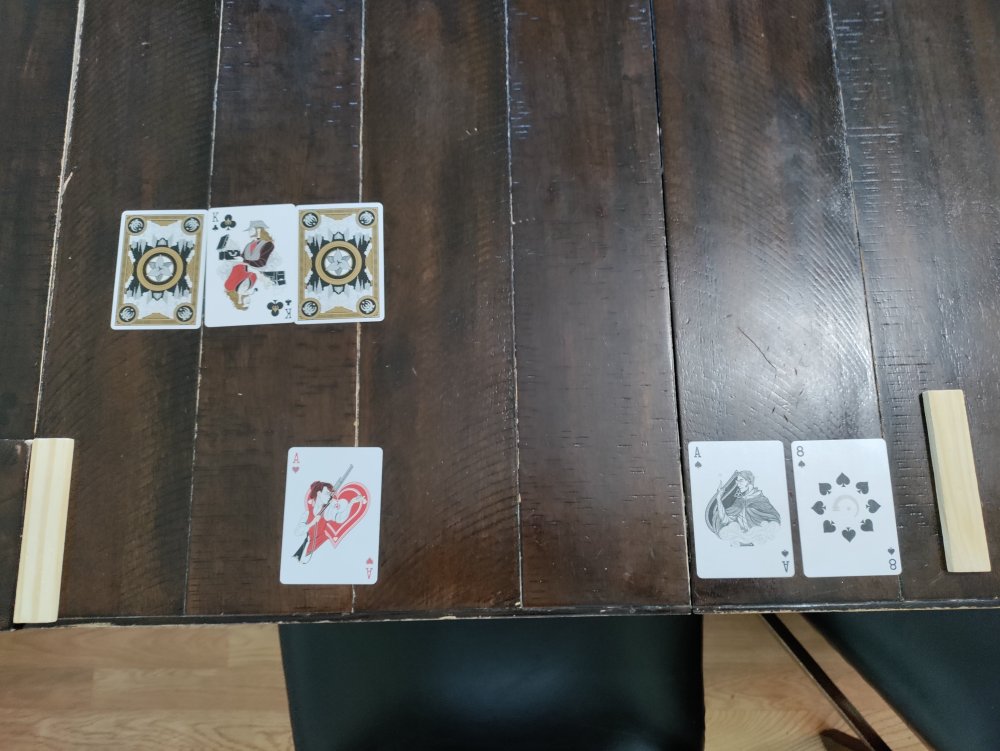
Sorry for the double post, but I (finally) got around to a bit of playtesting. I mostly focused on ensuring that gameplay was logical and made sense. I played with a few assumptions we haven't actually lined up: 1. You cannot move your troops through any troops, friendly or enemy. I could see moving friendly troops through each other as an option, it could smooth out some issues I experienced. I'm also thinking Shardbearers should be able to move through friendly troops either way, but please let me know what you think. 2. I messed around with the idea that each troop can only move along one axis (forward or backward) in the direction of their long side. You would get one one free "reposition" each move phase where you can rotate one of your cards 90 degrees. I also allowed Shardbearers to reposition if they move during the attack phase. These rules made flanking make sense: if attacked on their long side, most troops are weaker, enabling strategic reposition to keep flanks safe. 3. If a Shardbearer is on the edge of the battlefield or next to a mountain, it can be killed if the rest of its sides contain enemy troops. This is obviously to prevent invincible Shardbearers on the edges of the board, I just thought we should spell it out. I also played with terrain in the deck, and I still have mixed feelings about it. Positioning terrain is indeed really good, but I still can't tell if it is enough to compensate for lack of troops. Maybe for every 2 terrain cards you play you get to draw 1 card? More playtesting is needed here. Interestingly, I ended up with a kind of stalemate situation at the end of round two that I wasn't quite sure how to call. I was playing with the Wax and Wayne playing cards. This is Black's side of the board (this is a simplified recreation, the blocks on the sides are boundaries). Red has no troops left except the Shardbearer, and no reinforcements in hand. Black only has one other card on the battlefield, but has another in hand. It is currently Red's turn, and Black won round one. Red currently cannot kill Black's Shardbearer, but there's no way for Black to capture Red's: they can always move away. Even if Black allows Red to retreat, there's no incentive to because Red would lose the game. In chess this would be a stalemate, but it really seems that Black has an advantage here. Should we call this round a draw, or does Black win because he has the advantage? Feedback is welcome and desired!
-
This is a really good point. In chess you can capture queens with other pieces by ensuring that defending the queen would cost them other pieces. With the rules we have outlined, though, nothing is more valuable. Like we said earlier, the Shardbearer is like a combination queen/king, the most powerful and the one you need to defend the most. In chess, it would be near impossible to "checkmate" the queen. Maybe this is just part of the game design: Shardbearer are scary. We see firsthand how destructive they are, and Kaladin was the first in decades to bring one down singlehanded without Shards. In a real battle, you'd counter an enemy Shardbearer with one of your own or retreat... but with our current rules, there isn't really a way to bring down a Shardbearer with your own. Looking at it closer, though, I think the problem solves itself: if you have a Shardbearer in front of theirs, they can't kill yours without surrounding it, and they can't get past it unless they move to the side (which you can then copy, blocking them again). But even if you forced the opponent to move right next to your other troops, those troops will be killed immediately. The best you can do with both Shardbearers on the board is essentially lock them into one-on-one, then attack their other forces, hoping to do enough damage that they retreat. The other option is to just attack their forces with your Shards and hope to do enough damage that they bring theirs back to defend. It does seem that there should be a somewhat plausible way to kill a Shardbearer, but if they spend their movement on retreating troops, you might be able to at least threaten an attack on their Shardbearer, so they'd need to attack your forces, leaving an opening for you to do even more to the defending troops. Then the rule we added comes into play where a Shardbearer without any troops on the board can be killed by the other Shardbearer. All in all, the more I think about it, the more the system seems to work out. This kind of just proves my philosophy about games: model then after an existing system, and many balancing issues work themselves out. We still might want rules for moving multiple pieces, perhaps adjacent infantry or something, but playtesting will tell us how necessary that is. (I'm working on playtesting, I promise lol).
-
I like this idea: definitely a good addition. I like this too, maybe 4 and 3 instead. Again, something to tweak, but I love where we're at right now!
-
Nice, this looks good! I only have two concerns. I don't know if having terrain in hand is worth the loss in troops. This would be a specific thing to try in playtesting, giving one player lots of terrain and the other none in their starting hands: it's possible it could be very unbalanced. This also makes adding cards beneath mountains to increase their size trickier, because it has to come from a player's deck and you need to remember to put that back in the right deck. My other concern is that drawing a completely new hand every round mitigates the consequences of losing troops. If you were just going to draw a new hand of ten cards anyway, losing troops means almost nothing. Maybe this is a good thing, keeping the future rounds winnable for the loser, but it also seems to contradict what Adolin says about saving your troops for future rounds. Again, playtesting would help make sure we keep this balanced, I'll try to get back to you with results as soon as I can. I love this idea! Making everything super connected like this is a big thing in videogame design. Maybe attacking the tower means an instant win, or maybe you just lose random cards from the deck. What do other people think?
-
I agree that there shouldn't be a lot of card drawing, but they emphasize the ways of losing with superior forces, and one was random chance. Given that this is a key lesson of the game, I assume some randomness is involved in gameplay, but maybe I'm reading into this too much. I also think that since the idea is to train people for military strategy, getting them accustomed to lack of total control would be important. Once again, this game was built with variations in mind, so any rules we're deciding between could be another variation. Another spitball: should players always start with a Shardbearer in hand? If cards are randomly drawn, it's possible you won't get your Shardbearer until the end of the turn, which might be too big of a disadvantage. This could be the balance between total control and the game being unwinnable through random chance.