


Ripheus23
-
Posts
1318 -
Joined
-
Last visited
-
Days Won
2
5 Followers



Ripheus23's Achievements
1.1k
Reputation
Single Status Update
-
So since
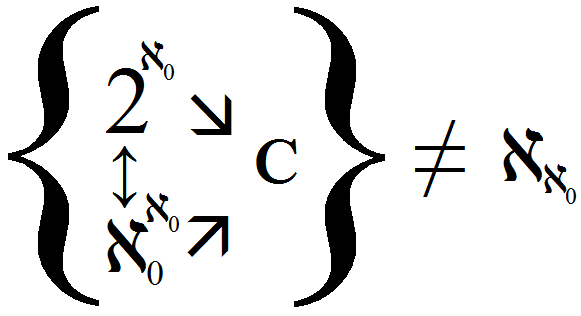 is true, I figured that the Generalized Continuum Hypothesis should read:
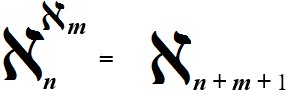
-
However, if this were so, then for n = 0 and m = 1, or n = 1 and m = 0, we get the same result. But the function should map to one and only one result. So the GCH as such is false. In fact, from this, it might be possible to show much about what c cannot be: for example suppose the formula were = aleph-{2^nm}. Then we get that c = aleph-1, since 2^(zero times zero) = 2 to the power of zero = 1. Then aleph-zero to the power of aleph-one would give us 2^(0*1) = 2^0 = 1. In fact, as long as either n or m is 0, here, the consequent aleph would be indexed by 1! So indeed aleph-zero to the power of these alephs, or these alephs to the power of aleph-zero, violate the principle of one-to-one functional correspondence at work, here, infinitely even.
That's the general rule: whatever aleph-n to the power of aleph-m is supposed to equal, it shouldn't be possible to just invert the variables and get the same result. I.e.
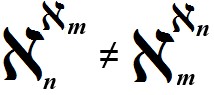
-
[Note: when I say, "That's the general rule," that's as true as far as I know. Granted, inasmuch as my theory is tantamount to an alternative axiomatization of set theory, or even a different theory than a set-theoretic one as such, I might say that these principles are true as far as the model goes, but I think they have more intuitive flare...]
-
-
 is true, I figured that the Generalized Continuum Hypothesis should read:
