


Ripheus23
-
Posts
1318 -
Joined
-
Last visited
-
Days Won
2
5 Followers



Ripheus23's Achievements
1.1k
Reputation
Single Status Update
-
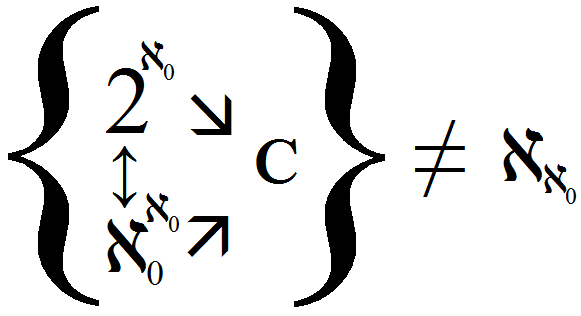
OK, so now as I understand it, 3^aleph-zero would = 2^aleph-zero, and so on, up to aleph-zero^aleph-zero. So my method of constructing the first transquadrant of aleph-glyphs using transfinite arithmetic, would not go through, as such. However, putting together all the "known" constraints on the cardinality of the continuum, I've come up with this nifty little "graph":
-
So, I have, however, zeroed in on the logic that would identify c with aleph-aleph-1. Without going into too much detail, I will present the easiest analogy [there's one based on the distinction between potential and actual infinity, that works incredibly well, too, but that's indicated below].
Allow that 2^aleph-zero = aleph-zero^aleph-zero. Now, as far as the continuum is concerned, this = c on the grounds that you can put a non-repeating two-glyph sequence into a one-to-one correspondence with a non-repeating sequence consisting in an infinite number of successor glyphs [i.e. you can convert base-10 decimal notation into binary]. Now, aleph-aleph-zero is the first infinite set of infinite cardinalities. That is, each aleph-number on the list from aleph-zero through aleph-n is an infinite cardinality, but is only a finite set of these. By contrast, aleph-aleph-zero is the successor of an infinite number of infinite cardinalities. If you conceive of the aleph-glyph with index zero to be a sort of transoperator in itself, then aleph-aleph-zero represents two uses of the glyph's operational value as such. But 2^aleph-zero, and by intuitive extension (as well as deductively) aleph-zero^aleph-zero, maps onto the nonrepeating iteration of these two glyphs [that is, at aleph-aleph-zero, we imagine each aleph-glyph as indexed by a number for which iteration of the glyph-form it is, and the cardinality of their nonrepeating iterations is the successor aleph]. Think of it like "2 to the power of the first infinite set of infinite sets," an initially recursive(?) output in the pure set-theoretic domain. Therefore, the value of c = the successor of aleph-aleph-zero, i.e. aleph-aleph-1. QED
Now, to keep the idea of dimensionalizing going, we have to map all the first transquadrant from the first list, which means 2^-aleph-n = (d+1)-aleph (number of aleph-glyphs in a staircase)-(n+1), e.g.
- 2^aleph-zero = aleph-aleph-1.
- 2^aleph-1 = aleph-aleph-aleph-2.
- 2^aleph-2 = aleph-aleph-aleph-aleph-3.
- 2^aleph-3 = aleph-aleph-aleph-aleph-aleph-4.
This might be OK but I have work to do before I can even imagine that this kind of talk is intelligible ultimately

["ultimate ouroboros of causality"]
Oh yeah, hypothesis: using the notion of an erotetic powerset, define aleph-1+ as closer and closer approximations to full Dedekind cuts [infinitesimally increasing approximations] into the set of reals. That is, they are "epistemically" better and better sets, relative to the continuum [their outputs give values closer and closer to the correct ones for actual continuous numbers]. Refer to this process as a Dedekind fractal knife, and say "the fractal knife in itself is forged, if you will, from diamonds made out of Cantor's ashes, smelted in the aleph-crucible unto eternity..."
[Also map Fitch's paradox of unknowability to Godel's incompleteness theorems. Figure out how to apply the erotetic solution to the liar paradox to this issue...]
-
-
