



bacontime
-
Posts
21 -
Joined
-
Last visited
bacontime's Achievements
39
Reputation
-
Fun Possibilities for Other Spore Seas
bacontime replied to bacontime's topic in Tress of the Emerald Sea
It's the earthquake part of that suggestion I find most interesting. Since the sunlight and zephyr spores already cover two flavors of explosions, what if these spores create vibration as their main product? Motive Spores: Pale yellow. When motive spores are activated, they let out a burst of electrical sparks which cause struck objects to start vibrating. Whereas zephyr spore eruptions are accompanied by a sharp boom, motive spores are accompanied by a roar that very slowly fades away. Both the intensity and duration of the vibrations increases with the amount of spores activated. ("motive" as in "causing motion") A particular sequence I'm imagining is a person holding a sword being hit indirectly by motive sparks. They're wearing insulating gloves (always be prepared) so the motive sparks don't jump from the sword into their body, but they have to throw down the shaking sword, where it continues clattering across the ground. I'm also imagining that skilled shapers would be able to control the frequency of the vibrations and use that to either control the noise or to destroy things by vibrating them at their resonant frequency. -
Fun Possibilities for Other Spore Seas
bacontime replied to bacontime's topic in Tress of the Emerald Sea
Void spores: Shimmering opalescent white. When void spores burst, they compress and vanish nearby matter. Matter which is invested or just plain durable is more resistant to the effect. In addition to the obvious dangers, void spore eruptions can leave large gaps in the sea during a stilling. The gaps can cause rapid shifts in the spores which bury entire ships. -
Fun Possibilities for Other Spore Seas
bacontime replied to bacontime's topic in Tress of the Emerald Sea
In the WoB about Crimson, he says that the crimson sort of corresponds to the essence of flesh. Here's a grosser take on a flesh aether: Bilious spores: Chartreuse. Bursts into slimy writhing tendrils. These tendrils have the curious property of adhering to - and sometimes even assimilating into - exposed flesh. A skilled sprouter can use bilious tendrils to patch wounds. (An unskilled sprouter can use them to make the problem much worse.) Additionally, some residents of the Chartreuse Sea say the tendrils taste great when fried. (They don't.) @Lord Spirit, those are some fun ideas. You know, actual amber can be burned as incense and comes from sticky solidified resin, so your ideas for gray and orange spores could be folded together into a thematically coherent package: Amber spores (again but more ambery): Amber orange. Amber spores initially burst into a sticky viscous liquid which then solidifies as more water is added and the growth potential is exhausted. Amber resin is flammable and its smoke is woody and intoxicating. The long-term effects of "glue smoking" are debilitating, and glue addiction is a serious issue in the Principalities of the Amber Sea. I like your idea for slippery pale blue spores. Since they aren't cold, something like "slipstone" might be a good name, but "frost" does evoke the idea of the stuff creeping across surfaces when the spores burst. Depending on how durable it is, it could be very useful for transporting goods over land. I'm thinking something like canal systems, but instead of being filled with water, they're lined with pale blue tiles. That's a fun image for imaginary infrastructure. -
We see six different types of spores in Tress, and are told that there are six more. We'll have to wait for future aether-centric novels to know for sure what these are, but wild speculation is fun! As a reminder, here are the canonical spores: Verdant spores: Emerald green. Bursts into ensnaring vines. Technically edible. Zephyr spores: Azure or sapphire blue. Bursts into breathable air. Used to launch projectiles. Roseite spores: Rose pink. Bursts into glassy crystals. Used for repair and containment. Noted for its resiliancy. Sunlight spores: Golden? Bursts into heat and light. Flares, cookery, etc. Crimson spores: Crimson red. Bursts into spikes (which are made of coral, according to WoB) Midnight spores: Black. Summons a little shadow buddy. Also technically dead spores, which are gray. WoB also tells us that all twelve spore types are at least subtly different in shades. Basic colors not yet represented would be white, purple, brown, and maybe orange. At least a few of the spores would need to be variants of the same color - perhaps a second shade of blue to go alongside zephyr, or a pale matte pollen-like yellow. A metallic Silver Sea would look gorgeous but might be too close to gray. With all that in mind, here are some other spores I think would fit in on Lumar: Silken spores: Dusty white color which could be mistaken for sand. Bursts into a snarl of pale thin fibers. The chief export of the Silken Sea is cloth woven from spore silk, valued for its durability and insulating properties. (It's a bit rough though, so nobles prefer worm silk.) In naval combat, spore silk snarls are less effective than verdant vines at immobilizing ships, but they might work better for Tress's net gun. Also, big snarls can sometimes get lifted from the sea and carried in the winds - something to keep an eye out for. Penumbral spores: Purple. Penumbral spores burst into a frigid plume of cold smoke which obscures sight and leaves behind a violet residue. Sometimes thought of as the inverse to the sunlight spores, which create heat and light. Besides its use in smoke signals, economic applications of penumbral spores are currently limited. The residue makes for a gorgeous dye, but nobody wants clothes which self-bleach near salt or silver. The residue is also a problem for most applications where you'd like to rapidly cool things down on demand, though there's always a few tinkerers in the Amethyst Sea working on perfecting the design of the "penumbral freezer". Umber spores: Brown. Bursts into something resembling rich brown clay. Umber clay, once fully grown, can be baked into porcelain or mixed into compost to aid plant growth. Umber clay is rarely a immediate hazard to ships, but can accelerate the decay of lumber with prolonged contact. And no, it's practically odorless, despite what some sailors like to say. Note that my goal here isn't to try to figure out what the other six spores actually are. (The correspondence to the vorin essences is a good theory along those lines.) The goal is to come up with strange and novel ideas of what the spores could be. Let me know if you have any fun spore ideas.
-
Based on comments from the SP3 livestream, Virtuosity is indeed about artistry. In fact, the shard was very nearly called Artistry. Ah well, it was a fun theory. Also, someone did end up asking whether Hoid was offered Virtuosity
-
I had pegged Ingenuity as proto-Invention, but yeah, it could be proto-Virtuosity instead. Nice spot.
-
My personal guess is that the final shard is something like Mystery or Transcendence. The shards of Adonalsium are fragments of the divine, and the ineffability of God is an important part of many people's faith. A Shard of Mystery seems like a good fit. It also has that dual personality trait/cosmic force kinda vibe that a lot of the shards have.
-
I'm partial to this theory as well. If the shard's intent were simply to create art, Sanderson could have named it "Artistry" or "Creativity" or something like that. Virtuosity isn't artistic ability. It's the mastery of the technical aspects of an art form. It's the intersection between showmanship and expertise. The word "virtuoso" is most commonly applied to those who can expertly play music, but a hacker can be a virtuoso at manipulating computer systems; an athlete can be a virtuoso at their sport. And the word "virtuoso" was historically applied to refer to a scholar or a connoisseur. I'm a bit biased though. My personal guess for the intent of the similar-to-wisdom shard was "Perfection", so my guess will have been close if Virtuosity's intent is about technical mastery instead of art appreciation. Virtuosity might be God's own perfect skill, separated from the virtues that give meaning to that perfection. Also, as a little bonus theory: I propose that Virtuosity was initially offered to Hoid, but he turned it down. It fits with his personality and powers.
-
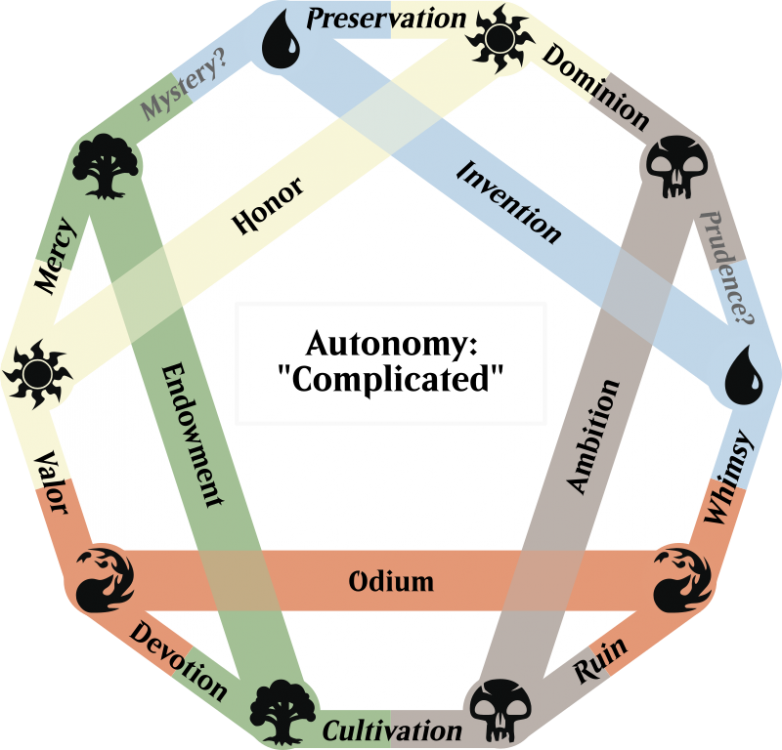
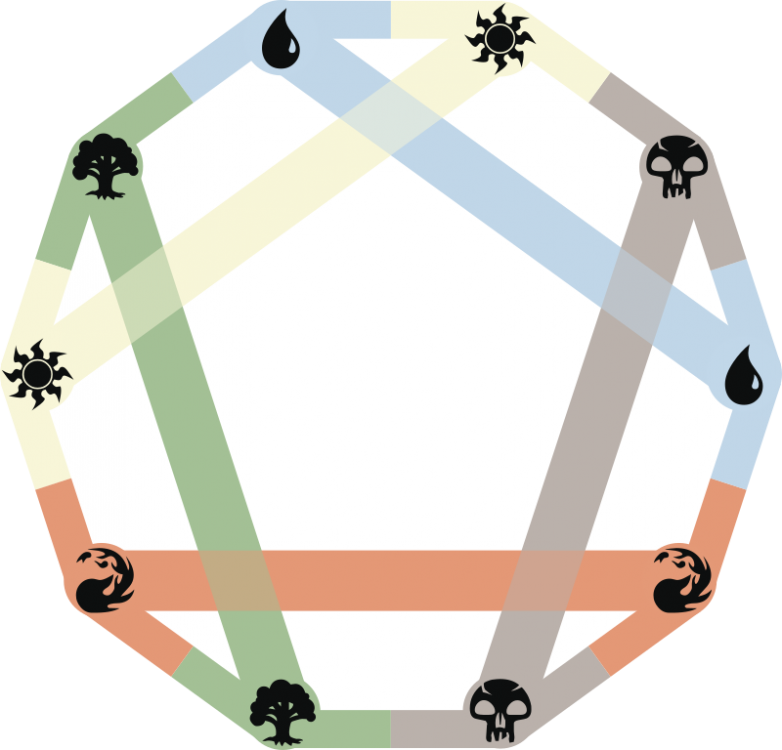
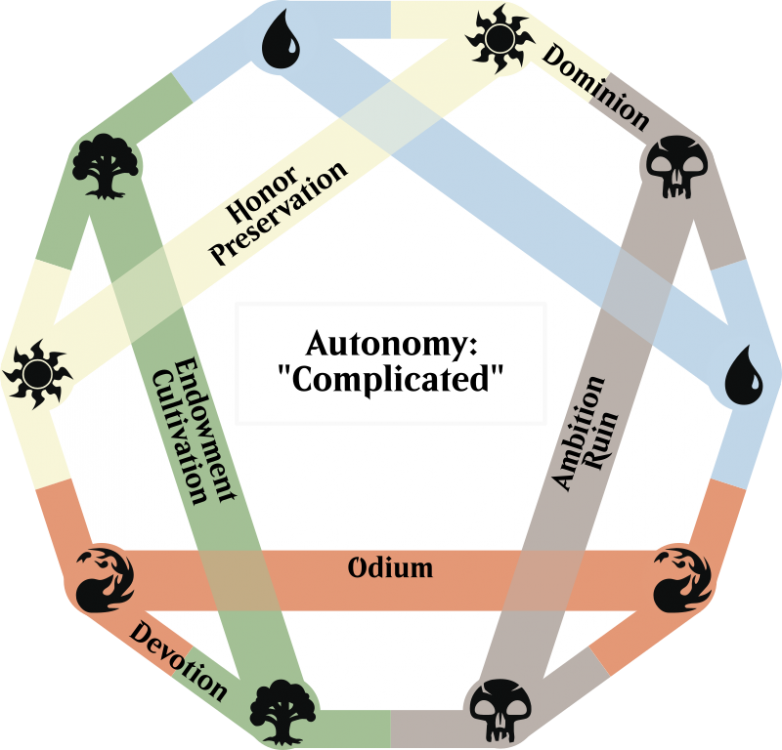
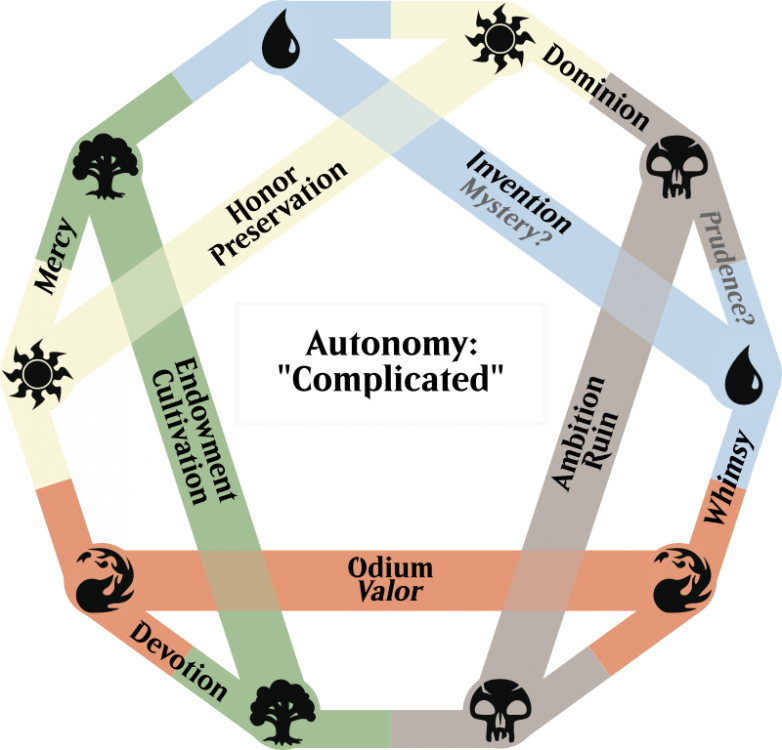
I looked at the "canonical" MtG colors of the Shards, and tried to fill in the gaps while keeping the color-pie balanced and symmetrical. I propose that one of the unknown shards is Mystery. Obviously, I don't think that Sanderson actually designed the Cosmere with a symmetrical color-pie in mind, but hey, check out the results: Looks pretty neat. 1. The Canonical Shard Colors: This imposes some constraints: 2. The New Rhythm of War Shards: In Rhythm of War, we learn of the Shards Invention, Mercy, Valor, and Whimsy. Whimsy is Blue/Red. It just feels right. Mercy has shades of White, Green, and maybe Black. We're told that "Mercy worries [Harmony]", which makes me think of mercy killings. And hey, there actually is a MtG card called "Mercy Killing". It's White/Green, so let's go with that. Valor feels White and/or Red. Valor means Courage and Boldness. It's about taking action, which is very Red-mana. And it's about heroic self-sacrifice, which is very White-mana. Ideally, I'd assign Valor to White/Red, but it's not possible to have White/Red Valor and Blue/Red Whimsy without unbalancing things, and I feel more strongly about the Whimsy Connection. It can't be Mono-White because I already have Mercy taking up the empty White slot. So Valor is Mono-Red. Finally, we have Invention, which is firmly within Blue's slice of the color pie. The act of invention can be all sorts of colors depending on what that invention is being used for. But Invention for it's own sake? That's Mono-Blue. 3. The Two Unknown Shards: Based on the Choices above, we need a Blue/Black Shard, and one more Mono-Blue Shard to complete the set. Blue/Black is the color pair of Cautious Scheming, Shrewdness, and Ruthless Rationality. Sanderson has mentioned that there is a shard which "just wants to hide and survive", and Blue/Black seems like an excellent fit for that pattern of behavior. There is a popular fan-theory-shard that this 'Survival Shard' has an intent that is something like Prudence, which seems to fit Blue/Black well. Another fitting Intent for this shard might be Perfection. Mono-Blue can be taken many different ways. It's the color of formalized learning and systematic perfection. It's the color of illusions and trickery. And it's the color of the cold dark depths of the sea. Remember that the shards of Adonalsium are fragments of the divine. And the incomprehensibility of the divine to mortal minds is an important part of many people's faith. A Shard of Mystery thus seems like a good Mono-Blue option, representing the ineffability of God, but separated from the virtues which make it worth pursuing understanding nonetheless. One of the shards, which explicitly isn't the Survival Shard, isn't on a planet. Whimsy seems like it could fit that description, flitting about from place to place. But a Mono-Blue Mystery Shard also could have thematic ties to the dark depths of space. Such a Shard might also be called Transcendence. 4. Bonus Material Here, I relax the constraints to allow some of the canonically mono-color Shards to be dual-colored. That way, I can match up one Shard with each mono-color and with each color-pair: And here are some templates if you want to make an MtG Shard diagram yourself:

-
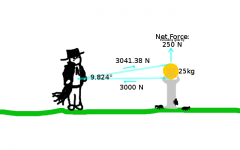 I totally forgot about this, but their are WOBs that seem to confirm that this works. And this way has the advantage of not causing the target to spin widely. The downside of course it that it causes the torque to be applied to the allomancer. So they'd need to anchor themself to something solid and burn pewter to handle the strain.
 -
Ah! I didn't know that was possible. That does make things much easier. It would apply torque to your own body, but since you need to be a mistborn to pull this off anyways, pewter can help with the strain. So you'd just need to make sure you're firmly attached to something large enough to keep you from beyblading.
-
How to hover without an anchor below you.
bacontime commented on bacontime's gallery image in Mistborn Art
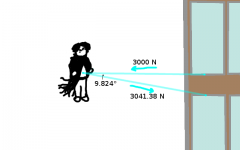 If the system is static, then no work is being done, and there's no actual energy transfer. Forces don't intrinsically have energy; they transfer energy when causing a displacement. Fortunately, the two forces applied to the allomancer both target the center of mass, so the net force on any particle of the allomancer is straight upwards, and they feel no torque. At least in theory. On the other hand, we know that allomancers can 'crush' themselves by flaring pushes in opposite directions simultaneously, so the forces aren't perfectly distributed throughout the body. We don't know exactly how the forces are distributed, but given that the two force vectors here have only a small angle between them, I wouldn't expect it to cause severe problems. An experiment worth trying in-universe: Push and pull on the same object at the same time. Whether and where you feel bodily pressure would tell about how the forces are applied. The building on the other hand does experience extreme torque, which is counteracted by the ground if the anchor points are stable enough.
 -
As for the concern about pushing only part of an object: We see both Kelsier and Wax do this in canon. Also:
-
Oh absolutely. Someone commented on the image in the gallery that you'd probably need Feruchemical Zinc to switch target points quickly enough. And I'm inclined to agree. Instantaneous thrusts à la Kelsier's battle in the square are much more feasible than hovering. Say the radius of the idol is 10cm. (That's actually a bit too large for 25kg of brass, but eh, round numbers.) The moment of inertia of a solid ball is (2/5)*m*r^2, which works out here to 0.1 kg m^2. The depicted forces apply 600 Nm/rad of torque. So the angular acceleration is 6000 radians per second per second. In other words, ignoring friction, it would take less than a second of constant hover juggling for the surface of the ball to accelerate past the speed of sound. I don't know enough about tensile strength to say exactly when the idol would explode, but yeah. It would heat up, start creating small sonic booms, and then rip in two. (The second scenario avoids these problems by transferring all the force into the ground, which makes the system static.) If you actually wanted to hover juggle something without Lord Ruler level skills, the ideal candidate would be something like a wide, lightweight hoop with a metal ring on the outside. (Cylinders have high moment of inertia for their mass.) It would also help to line the ring with some sort of structure to create plenty of drag and slow the spin. You could probably rig it up to make a musical sort of buzz. Spinning - that's a good trick!
-
Say the radius of the idol is 10cm. (That's actually a bit too large for 25kg of brass, but eh, round numbers.) The moment of inertia of a solid ball is (2/5)*m*r^2, which works out here to 0.1 kg m^2. The depicted forces apply 600 Nm/rad of torque. So the angular acceleration is 6000 radians per second per second. (Or ~57000 RPM per second) In other words, it would take less than a second for the surface of the ball to accelerate past the speed of sound. Hover juggling heavy objects is probably not possible without holding the bands of mourning.


