



Aliroz-The-Confused
-
Posts
313 -
Joined
-
Last visited
-
Days Won
1
Content Type
Profiles
News
Forums
Blogs
Gallery
Events
Everything posted by Aliroz-The-Confused
-
 Fantasy, in general, is more suited to animation than to live action, but the kind of animation that would suit it simply is not made any more and will never be made again. Honestly, I'm kind of cheesed at mister Sanderson for even considering adaptations, as though the books weren't good enough on their own, as though they needed to be improved.
 -
You know how you can't describe the taste of salt or ginger to one who has never tasted it? And if you tried to explain it you'd sound absurd and people would laugh, except for those who have tasted it, who already know exactly what it is? The self-evident often cannot be described. Imagine if there was no more salt or ginger at all in the universe. There'd be no way to intelligibly communicate the essence of what the world no longer had. Or imagine if a color was deleted, existing only in memories, with no evidence it had ever been, no word, no name, no historical references, nothing. Those who never saw it could only laugh at the absurdity of how dramatic and overblown the others are reacting, the nonsensical and clearly-incorrect grief at something that was obviously always red. (In other words: you'd all laugh and people would tell me I'm wrong, and I can't say it in a way that makes any sense to anyone, so I'm not going to say it at all.)
-
Lopen has cousins. Does Wayne have cousins? No. Obviously Lopen wins. I'm the most Scadrial-biased person ever and even I gotta give it to Lopen.
-
After thinking about this quite a lot, I don't think it's mister Sanderson's fault. Wind and Truth was released in 2024, and Rhythm of War was released in 2020. Oathbringer was released in November 2017. Nobody who lived through 2018 or the years since can write in the same way as was possible before, and it's not fair to expect non-nuanced long-form fiction in a world that simply cannot produce it anymore. It's not fair to expect ambitious long-form book series to have completely 100% happy endings (as opposed to bittersweet endings) anymore, because that species of story is extinct (for all that we think of Tolkien and Lewis as classic idealists, their main works have bittersweet endings). Perhaps the crucial distinction between Kelsier and Kaladin is that Kelsier is a character from the 2000s while Kaladin is a character from the 2010s, and stuff that would have made you an anti-hero or worse in the 2000s is just background noise in the 2010s. Now we're in the 2020s, and literature has become so aggressively colonized by nuance that the bold and subversive anti-cynic position is "maybe there is some worth to absolute ideals". As much as we think of authors as insulated and isolated from their readers and from other authors and from the world they live in, they are not. Mister Sanderson's storytelling is not recitation, but conversation, and conversation influences both ways. I think the comparison I would make is soil depletion or soil acidification or some other process of change, and I suppose mister Sanderson is grafting his story/characters onto this new focus, in an attempt to salvage the fruit of a withering tree by grafting it onto a thriving trunk. Though, I think cross-pollination might also be an appropriate metaphor. I'd place the main part of this process to those years he spent writing those Wheel of Time books. I don't think he ever truly recovered. Things that are subversive become normative, the shocking becomes routine, and the unexpected changes the expectations. Spoilers for The Hobbit and The Lord Of The Rings. Apparently I worry about ruining them for the one person living under a rock who hasn't read them already, lol. We're a few generations of the "this stuff I grew up with is neat, but what if I added moral complexity to the heroes I grew up with and made you cry" game from there. I haven't read those Song of Fire and Ice books (outside of a couple chapters of the first one, which I dropped because it was 2edgy4me) or seen any adaptations, so I'm going off of cultural osmosis, but I'm pretty sure Lord Stark (with his illegitimate son and tendency to associate with obviously evil scumbags) was seen as a subversive take on the fantasy hero back when his first book came out, and I've gotten the impression that these days he's regarded as an uncomplicated or "vanilla" good guy. I guess what I'm trying to say with this is "I agree with you, but I think this shift is part of a bigger pattern which isn't mister Sanderson's fault, and I think our disappointment is that we let ourselves believe that he could/would/wanted-to oppose the tide."
-
Man, I was already sold on direct shardic intervention, you didn't have to throw in free gifts like that. I kid, I kid, but technological advancement is only an inherent good from a Reason point of view, and progress is only an inherent good from a Progress point of view. Taravangian is right (in this instance). The problem is that he does evil heinous stuff. I'd rather be an early Terris just vibing in the mountains than be just about anyone else in the Cosmere.
-
Honestly? You really want to know? He can actually live by ideals instead of just saying them. Second ideal: I will protect those who cannot protect themselves. The so-called "lesser" spren (a term which only the children of Ashyn seem to use) cannot defend themselves from their enslavement. Cannot advocate for themselves (they display seeming consent/contentment behaviors after being trained to do so), and have had their one advocate mind-controlled into compliance. But none of our protagonists actually give a tinker's cuss about this because they don't actually care. The use of fabrials proves that it's all hollow. Kaladin doesn't actually have any convictions. His conversation to Sigzil about prostitution proves it. Sigzil tells Kaladin he has moral issues with what others in Bridge Four are doing, basically says "that voice inside me which says 'well done' when I do good and which screams when I do bad is screaming at me that this is wrong." and Kaladin more or less tells Sigzil, "stop listening to that voice, ignore it until it fades. Don't tell other people what to do, morality is relative and cultural, don't be judgmental, be reasonable.". Kaladin does this because he doesn't care to, as the captain and leader, establish a coherent and consistent understanding of morality and behavior among the men under his command. I compare this to Joan of Arc, who established exactly that among her men (to the point that when she told them to give up profanity, they did so), who died rather than go against her convictions, and I find it wanting. Joan of Arc lived in a world where honor was dead and odium reigned, where the honor-structures that had held up her society had collapsed and the new modernity had not yet been stabilized into something that limited atrocity and tyranny, in a time of horrors, and she was an illiterate peasant teenager, and she managed to instill a consistent and coherent understanding of right and wrong among her men. Don't tell me that it's unrealistic when every contemporary account of her agrees that it's not, don't tell me it's impossible to believe when the cynics and the wise and the sober and thoughtful of her time, people no strangers to the messiness of reality, believed; when her enemies who killed her wept at what they had just done and cried "O God, O God, we have killed a saint!". Don't tell me it's unrealistic when Kaladin is fictional and can fly. This is the exact archetype of the sacred knight that Kaladin is drawing his appeal and power and cultural resonance from. Kaladin talks the talk, but he does not walk the walk.
-
Copperclouds and Shardblades
Aliroz-The-Confused replied to Conure1243's topic in Cosmere Discussion
Look, the Rosharan builds are top-tier and have been since 2010. We can't even grief those servers without getting help from all the other servers. And for crying out loud, the poor Nalthians don't even have Nightblood anymore because someone decided his little favorites needed everything cool. Edit: DRATTIT, a PEJITOPPA! -
Copperclouds and Shardblades
Aliroz-The-Confused replied to Conure1243's topic in Cosmere Discussion
I know that copperclouds don't disperse Shardblades and Shardplate, but it would be really cool if they did. It would also be cool if emotional allomancy wasn't blocked by shardplate. It would also be really cool if tin allowed you to see through lightweaving illusions. Unfortunately, allomancy isn't allowed to be cool and every update since 2009 has made it less cool. I'm honestly worried for the sequel to Elantris, and how it might diminish the Dor. -
We know very little about what went on there. What we do know is this: The Southern Scadrians were dying, and he taught them to survive. The counterfactual here is the loss of local culture to extinction. In Secret History: Kelsier, after dying (which he could have avoided if he was willing to abandon helpless captives) takes up the shard of Preservation and preserves that shard from being taken by the Ire or destroyed by Ruin. He comforts Leras, who had comforted every Scadrian after their deaths, in His last days. He tries to stop Hoid from getting to the Well of Ascension and stealing the last material remnant of Leras. And all throughout, Kelsier is condemned by everyone for the wrongs he has done and for not being a good person; even Vin tells him that he doesn't understand love and essentially asks "How much of it was about us, and how much was about you?". The story teaches him that he has served Ruin more than Preservation, and that the hearts of men are not his toys. I don't think I'm entirely insane to think that Kelsier was doing Preservation's work in preventing the depopulation of a continent. Kaladin is now (or will soon be) worshipped as a Herald, replacing Jezerezeh. Nobody calls this manipulation or supplanting of a local culture. The story credits him with doing Honor's work. Why should the Southern Scadrian regard of Kelsier and the Skaa's regard of Kelsier be regarded as delusion and the regard that the humans on Roshar have for Kaladin be regarded as recognition? Kelsier was, for a time, Preservation, and though the Skaa worshipped him before that, perhaps on some level they saw a god in him because the man would become a god. Kelsier died fighting for helpless captives, helped save the world and possibly the Cosmere from Ruin, preserved Preservation itself, gave comfort back to He who comforted, gave hope to the hopeless and freedom to slaves, and prevented the depopulation of a continent, and he gets counted as a bad person. I'd like to bring this up, because it's absolutely horrifying (doing horrors to the helpless until the ones who love them break, leading them to their own destruction trying to save what remains, exploiting the limits of what the heart and spirit can live with) and also exactly what Kaladin did to the Listeners with the desecration of the dead (what is more helpless than a corpse?), and for the same reasons (seeking freedom from captivity, seeking survival no matter the cost (the other Shards are a threat to Odium), and most of all the protection of a few specific people that he loves (Bridge Four, Kharbranth)). The scale might be different, but the shape is the same, and the scale is the maximum possible in Odium and Kaladin's situations. The point mister Sanderson wants to make, as far as I can tell, is that the difference between Kaladin-at-that-point and Taravangian-at-any-point-during-his-evils is that Kaladin looked at the prideful road that lead to safety and freedom and saving everyone at the cost of morality, started leading his men down it, and then stopped and said "We have to go back. Storm it, we have to go back"; while Taravangian kept on going. My consternation with this is that I don't feel as though Kaladin has redeemed himself. I don't think an apology and a friendship multiple books later makes it okay. In my view, he didn't change how he values Bridge Four vs the Listeners so much as he added Rlain to Bridge Four. It's incomplete in my view, but I think the story is presenting it as complete. It's a change of mind, not a change of heart. This is also how I see Navani, Jasnah, Shallan, and Dalinar. Nothing Kelsier does is ever enough for the narrative to count him as good. The very last thing Vin ever tells Kelsier is, more or less, "you're not good enough". Nothing Kaladin does is ever enough for the narrative to count him as bad. Kaladin almost killed Sylphrena. If I had a daughter, and her friend almost killed her through questionable choices, choices that I kept telling him not to make because they would kill her and then barely managed to avoid the worst outcome and stopped doing that stuff, I would not let my daughter be friends with that guy. No amount of "I can help him become a better person" or "he didn't mean it" or "he cares for me" or "he won't do it again" would work. <joking>I have come to the conclusion that Kelsier ought to give himself more credit and Kaladin ought to be harder on himself. Truly, I have reached the pinnacle of reading comprehension and deserve all the money, and everyone else is wrong.</notjokinganymore> I think this whole thread is this sentence said in ten million different ways, and I think this sentence is the sentiment that I have been trying to express with regards to mister Sanderson and the Stormlight Archive. It seems there are five outcomes: Approve both (Scadrial has spiffy mists, Roshar has spiffy canyons, forget these characters and just vibe with the worldbuilding and the setting and the magic system. This is what I want to do, but mister Sanderson's excessive focus on characters makes this difficult if not impossible.) and keep reading the books as they come out. Approve the former and disapprove of the latter (as mister Sanderson does, I find this a double standard) and keep reading the books as they come out. Disapprove of the former and approve the latter (listen to my own conscience, you find this a double standard) and keep reading the books as they come out. Disapprove of both (give up on one of the few fictions I actually like, and some of the few characters I actually ever related to) and keep reading the books as they come out. Have a morally nuanced position (realize that mister Sanderson's work was never meant for me and anything that resonated with me was accidental on his part) and keep reading the books as they come out.
-
For the record, I loved Nitpicking's hypothetical alternative scenario. It would have been a classic Sanderson twist to have the metaphorical "Jasnah and Taravangian showed up to the game with pistols in their boots and bulletproof vests under their shirts." be resolved with a metaphorical "but so did Queen Fen, and now Taravangian's making that shocked expression that bad guys make in old animé when the heroes pull out some unexpected surprise". 10/10 GET CHUMPED TARAVANGIAN. I'm more arguing against the idea that what we got was unrealistic, so I made this a separate thread rather than kill the vibe of the original.
-
Or, rather, a few of the reasons why I liked the exact thing that Nitpicking didn't like (If I talked about all the things I liked about the overall talk, we'd be here forever.), and think it's more believable and realistic for Queen Fen NOT to have assassination contingencies. Spoilered for boring context. The equivalent to Jasnah isn't "President has plans to assassinate president of allied nation and has people in place to do so", it's "President has plans to kill most of the governing body of allied nation and has people in place to do so". I don't think it's unrealistic for Jasnah and Taravangian to be the only ones to operate in this kind of way. I don't think it's at all naïve for Fen to be surprised and shocked, or to not have equivalent plans. The reason why kingdoms and nations don't usually do that kind of stuff isn't "idealism", it's "in the long term, the utility of having the option is less than the utility we'd lose if someone found out and used that information against us", so they all look at each other and silently agree not to do that. The short version is: Jasnah, Taravangian (pre-ascension), and Fen are all monarchs, but Jasnah and pre-ascension Taravangian run the kind of monarchies that are robust to assassination (Jasnah's early modern centralization/bureaucracy/military-dominance and Taravangian's small city-state mean that Kharbranth and Alethela will probably have very quick power transitions (Jah Keved might not, but Taravangian's only concerned with Kharbranth)) and have little to no internal checks on power except the ones they choose to have, while Fen seems to be part of a system with an entirely different risk-reward-ratio for dishonorable behavior and assassination. Within this system, Fen can easily be as calculating and shrewd as Jasnah or Taravangian without ever considering assassination because in her context that decision is counterproductive and she stands the most to lose from a world where such things happen and the least to gain from it. The really short version is: I think Fen played her cards very well, it's just that Jasnah and Taravangian showed up to the game with pistols in their boots and bulletproof vests under their shirts. Apologies for this post being so long, I lack the skill to make it short.
-
Is Kaladin literally just Jesus?
Aliroz-The-Confused replied to Schizoposting's topic in Cosmere Discussion
Apology sincerely accepted. Peace on Earth, good will to men. -
Forget it. If you all get to root for the children of Ashyn no matter what heinous deeds they commit, then I get to root for the Scadrians no matter what heinous deeds they commit. If you all get to regard Kaladin and Shallan as good people despite what they've done, then I get to do the same for Kelsier. Maybe this is going to the dark side, but in that case I'm going to do a kickflip off of the concept of fairness while flipping double birds at the concept of maturity. I'm, honestly, a little bit tired of being told to be reasonable and evenhanded when those things seem to map to "accept that you're wrong for reasons that don't make sense to you" and "agree with everybody else's unspoken notions of morality".
-
Is Kaladin literally just Jesus?
Aliroz-The-Confused replied to Schizoposting's topic in Cosmere Discussion
I find the premise of this thread offensive for multiple reasons. That's all I intend to say about this. -
Spoilered for boring and unsupported speculation on population figures. I know all my assumptions are probably wrong and there's probably some Word of Brandon proving me wrong, but this is the pattern I see when I connect the dots. With Harmony paralyzed, blinded, and wounded (permanently, as far as I can tell) while Autonomy is unscathed and undefeated, I don't think Scadrial can hold out against whatever Bavadin tries next, much less against Retribution (who we know from Wind and Truth will go after Scadrial first). My theory is that Autonomy's repeating a pattern of wounding those who could threaten her and letting Odium finish them off so they can't become (more of) a threat to her. None of the patterns end well for the Scadrians. Autonomy's dominions expand and expand. Good gods die and bad gods emerge triumphant. The children of Ashyn leave their broken world for a new one, take it over, break it, and then leave that ruined world for a new one. Scadrial could end up like Obrodai (I might be spelling it wrong, under an avatar of Autonomy), or it could end up like Sel (wounded shard(s) attacked and destroyed), or it could end up like Roshar (claimed by the Children of Ashyn, who take everything from the original inhabitants). Dalinar gave Honor to Taravangian. Bavadin broke Scadrial's defenses. From the words I have read on the printed page, I can see no way that this ends well. Having not read The Sunlit Man or Isles Of The Emberdark yet (I'm getting the latter for Christmas), I have to wonder if maybe what those books call Scadrians are Children of Ashyn being referred to by the name of their current world in the same way that in-universe sources refer to them as Rosharans. I am referring to the Heralds, and comparing them to The Lord Ruler, with Jezerezeh especially fitting as one whose death allowed for the nightmarish events that would follow.
-
Will the real Survivor please stand up?
Aliroz-The-Confused replied to Cosmer's topic in Cosmere Discussion
Know the difference, it could save your life.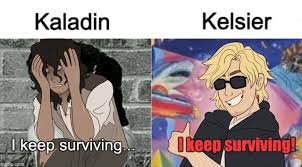
-
I'd like to make an unfair comparison between the Children of Ashyn and the Nobles of Scadrial in the original Mistborn trilogy, in that both are the preferred peoples of immortal shard-splinter god-kings/queens (which immortal being(s) do horrible things in efforts to maintain the imprisonment of an evil god, and end up being compromised by said evil god, while claiming to represent the dead/broken/incapacitated good god), both are inheritors of conquest and see their position as natural and right, both claim the right to enslave beings which they define as "unintelligent" or "lesser" (remember when Elend asked Vin if Skaa were intelligent like people?), both have been the dominant population for an unimaginably long time, and both grankle my bajankles. In Mistborn, we're supposed to go "Hey, that's some evil heinous crap, that's nonsense, nothing makes this okay." and in the Stormlight Archive we're supposed to go "Well that's kind of questionable but that's just the way it is and the evil god is REALLY evil, that takeover was a long time ago, they didn't know their Parshmen slaves were more than animals, it's supposed to be morally ambiguous, the ones alive now didn't build the system, that one made a sincere apology, this one gave up some of her power to get rid of the worst parts of what's going on, you can't expect people to be perfect, they're not the only ones who ever did evil heinous crap...". I think a lot of why the children of Ashyn get absolved by the narrative and by readers as much as they do is because of the emotional attachments we form to the characters, because of the feelings the books make us feel, and because something in the story resonates with something within the reader in a way that speaks to the soul. Because there's some of the coolest stuff you've ever read going on, and because we appreciate things that appeal to us (this is not a criticism, if it was, it would be a flaw to like art or music). Not all of it, but a lot. I'm the same way. I'm emotionally skewed with regards to the Mistborn books and Scadrial because that stuff resonates with me. I can find the idealism and the flame of heroic goodness and human decency there, I can connect with it. At some point, I stopped being able to find it in The Stormlight Archive. Without that flame, what I find is the dark and the cold.
-
Different worlds do not work as a metaphor for different parts of the same world. I don't agree with the premises of this comparison, as I think that nothing that humans can ever do on Earth is comparable to invading a planet. I reject this interpretation of the ending of Rhythm of War. It's too soul-crushing, too heartbreaking, too despairing, and (despite his obvious sadism) I don't think mister Sanderson is quite that cruel. I do not think that the central message of the Cosmere is meant to be the Melian Dialogue's "the strong do what they can, and the weak suffer what they must".
-
World Domination
Aliroz-The-Confused replied to Through the Living Wrath's topic in Cosmere Discussion
Mistborn negotiates world peace with emotional allomancy and convinces all significant political leaders to arm-wrestle/pumpkin-throwing-contest/sock-organizing-contest Feruchemist for their positions. Feruchemist cheats and wins. Since these guys made world peace happen, and since the last respectable politician died on December 5, 2013, nobody rebels because everybody likes world peace and wants to see what happens next. Radiant brings snacks for Mistborn and Feruchemist. Radiant sees a piano. Radiant learns how it works, then learns to play, and, by a twist of fate, turns out to be the greatest pianist since Liszt. All other music is abandoned because nothing else has any appeal once the pinnacle has been heard. This means the end of musical theater. Upon being freed from the evil that is musical theater, humanity, in infinite gratitude, unanimously agrees to cede the planet to these newcomers. All is well. -
I can't stop laughing at this typo, because mustborn sounds like what would have happened if mister Sanderson had been incredibly hungry while writing and based a magic system around condiments instead of metals. Ferranchemy, Hotsaucealurgy.
-
I think there isn't any simple pattern which works for all contexts. I choose the homeworld-as-origin-planet-for-very-first-ancestors terminology-pattern at least partly to stress my intended point that the ones I call "the children of Ashyn" come off quite differently if every reference to them is also a reference to their past and current actions. I don't like calling them "Rosharans" as much because it hides these actions and implies that they were always where they are now and that the status quo is how things always were, and I just don't feel that that's fair to the Listeners and the spren. In a different thread, a different conversation, I might use a different pattern so as to not turn every thread into this exact conversation. Edit: As for trying not to come off as racist, the same goes for me. If I accidentally say something offensive, please tell me and I'll do my best to fix it. I think we would all prefer not to derail this into inadvisable real-life subjects.
-
Oh. It's world-of-birth? That makes a strange sort of sense, even if it's kind of random (a couple could have thirteen children born on thirteen different worlds, hypothetically). I guess it's one of those things that's intuitive to everyone except me. I really don't feel as though different places on Earth works for me as a metaphor for different worlds. The continents have been joined and split in the past, and they rest upon the same mantle. There's a physical contiguity from the very start. The seas and oceans that separate continents are not voids but masses of water. Worlds, though, weren't previously or originally conjoined, and are separated by empty void. The same sun that shines over Tazmania shines over Arizona. The same particles of water and air may, through natural cycles, go all over the world, but no naturally-occurring cycle moves water and air from Threnody to Sel to Taldain. Worlds intuitively "feel" like they're "separate" in my mind, while different parts of a world intuitively "feel" like they're "connected". It's some little-kid part of me that thinks you could dig a tunnel to the other side of the Earth but knows you can't dig a tunnel to the moon, I guess.
-
Because I don't know the proper demonym for Ashyn, and don't want to get corrected for guessing it wrong. I'm going based off of what might be described as "homeworlds". I think "Homeworlds: Iyatil=Scadrial, Eshonai=Roshar, Kaladin= Ashyn, Vasher/Zahel=Nalthis, Hoid/Midius/Cephandrius/Wit=???" terminology is internally consistent and works for what it's trying to keep track of. In this context, this is what I use. I think "Homeworlds: Iyatil=Roshar, Eshonai=Roshar, Kaladin=Roshar, Vasher/Zahel=Roshar, Hoid/Midius/Cephandrius/Wit=Roshar" terminology is internally consistent and works for what it's trying to keep track of (world-inhabitance). I think "Homeworlds: Iyatil=Scadrial, Eshonai=Roshar, Kaladin=Roshar, Vasher/Zahel=Nalthis, Hoid/Midius/Cephandrius/Wit=???" terminology (???) is internally inconsistent. This is what everyone else seems to use (this is probably me missing something that is obvious to everyone else); I don't understand why. To my mind, an internally consistent pattern would have either both Iyatil and Kaladin as Rosharans (if a population moving from one world to another changes which world counts as their "homeworld" for these descriptive purposes) or neither of them (if it doesn't).
-
Ah, I get it now. Frustration said "a set of sixteen metals" in the original post, without specifying WHICH set of sixteen metals, and I assumed the prompt was structured to allow us to pick which metals. Mea culpa. You're right about the dynamite, though. Darn, I thought an intuitive and relatively straightforward win was possible for a second there.
-
<petulantycomplaining>Well, this is entirely silly. Not only do we have bloodlusting meaning that the non-physical attack of emotional allomancy probably doesn't work, that darn Word of Brandon means that Shardplate functions as aluminum but only in ways that exclusively advantage its wearer and disadvantage allomancers. Do copperclouds get to block shardblades or dissolve shardplate or dispel lightweaving or anything cool like that? No, of course not. What a scam!<nolongerpetulantlycomplaining> Only way I'm seeing the mistborn win in an intuitive and not-requiring-unusual-knowledge way is by exploiting speedbubbles + Atium + iron and steel to go fast, plant dynamite, and get out of explosion range while avoiding all attacks and debris.

