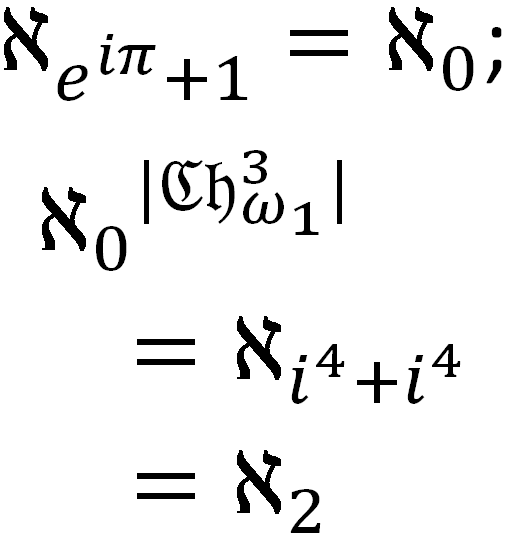
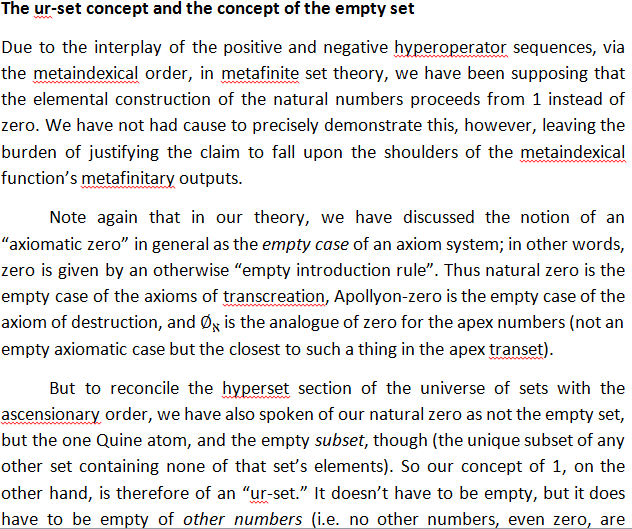
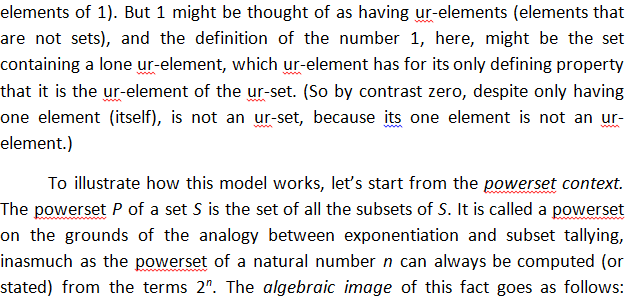
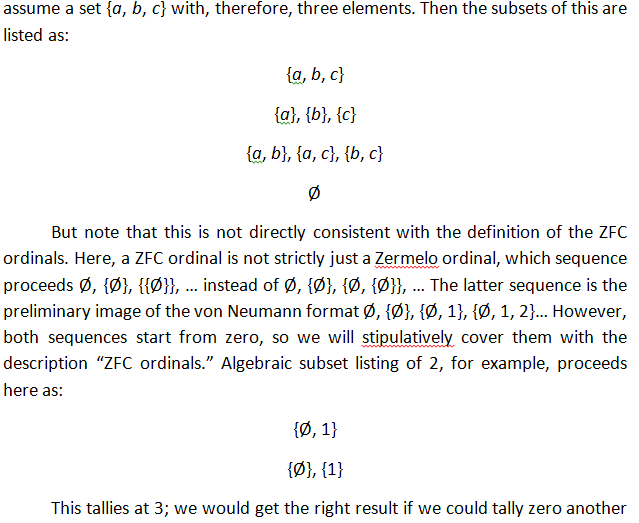
Ripheus23
-
Posts
1318 -
Joined
-
Last visited
-
Days Won
2
Content Type
Profiles
News
Forums
Blogs
Gallery
Events
Status Updates posted by Ripheus23
-
Maybe the distinction between virtue ethics, and consequentialism and deontology, is on the level of "acting under a description." Like your typical consequentialism or deontology use action descriptions that are less organic than virtue ethics does?
-
So it says in AATE that the magic crystal sword was made from crystal exposed to the Blood of the Earth. Loric got this crystal. He also knew the danger of the Blood, I think, from Damelon. In the fanfiction I wrote, though, I said that Loric knew the danger from seeing an evil Insequent and a quellvisk (some evil magical monster) use the Power of Command from the Blood to have one of the Elohim accept being possessed by one of the croyel. The outcome was that the croyel, feeding on the Elohim, could not survive the power of it, and then the Elohim drove his enemies into the Blood, which destroyed them. Then the Elohim explained to Loric the grave danger of the Blood, and claimed that he was the Lord to protect that place.
But I guess it was Damelon, from the canon/lore, except Loric is talked about questing under the mountain, for the Blood, so I don't know...
And Amok says Kevin made him, yeah? Because Amok is himself one of the Seven Wards. But Amok is a way around the Door, from later than the Door by name, so, hmm...
I think the evil Insequent had studied the quellvisk species, but they knew of the EarthBlood, so, hmm...
Well, let's say Loric couldn't access the core zone, under the mountain, of the EarthBlood. Instead, he went a little deeper, where a secondary, but still powerfully concentrated, rivulet of Blood flowed. There should also be a flow of molten hurtloam below that... But then how does the Elohim scene make sense? Maybe it wouldn't. Or there would be some weird threat anyway, not as grave as that of Command...
Anyway, Loric would find a crystal which would have been energized by ages of exposure to the Blood, which is not a normal liquid, but which has the same positive density at all scales. It is a superabundant substance of prime matter, almost. This is why the Worm consuming the Blood will destroy time, because the Blood is infinitely dense/compacted.
Hmm... I wanted a scene just now, though, where Loric Commands the crystal to live... So the sword is alive, and it is in the books anyway. To an extent. But I wanted it to come alive like a Wraith of Andelain, to explain why the Wraiths were so enamored with the sword.
Also, the Ravers are like anti-Seven Words. They have no true names, and they *are* their false names. Magically speaking, I mean. So rending them meant breaking their names into letters, magically/metaphorically.
-
Hypothetical far-future chronology: let's say, the second version of the original world is shown to exist for 200,000,000ish years, and by then, they've discovered 9 total other universes, one of which is so large (in some sense) that exploring it is what made for the gap between the discovery of the 5th and the discovery of the 6th. Still, the ur-destroyer has not awoken/returned/been released, and no proof has been found by the explorers that the entity still exists. So, the question of the Second Destruction is thus far unanswered.
("What about the tangent you imagined at the end, where a band of adventurers stays behind to square off against the emergent ur-destroyer at the last? Who are left there like that as a little last mystery for the readers? Like, that's all the reader is given to 'know,' that at the end, there was this squad, and they tried something, maybe it worked, maybe it didn't, everyone else had escaped that world so..." Yeah, true. Well, I guess that turns on whether the bizarre ethereal sci-fi post-narrative is worth writing more strongly than that scene? Or we adapt the idea some. Suppose either way that, when mortals left the destructible world when the ur-destroyer did at last re-emerge into their world, then the escapees did not find out what happened, not as a matter of common/public knowledge thereafter. Whether the adventurers "saved the day," whether the world was redestroyed but then recreated again, or redestroyed and left that way, etc. none of that is automatically given to be known to the reader via the POV of the final epilogue/coda, arguably. So, instead, from the invincible realm, explorers have gone out, and they know not how many other universes there are "period," but they assume that the more they find, the likelier it is that there are as many as can be.)
-
I guess it can't be "Nightmare-hallows" because that phrase is already in circulation from someone else. So maybe "Nightmare-falderal," that would be a neat little odd word, maybe...
Buried War, the. Or maybe "the Tomb War," who knows, but it's a legendary war being fought for centuries/millennia (depending on the storyteller) deep underground by gigantic underground insect/kindred monsters. The scorpion colossi that are "common knowledge" dwell principally and strongly in mountain areas, but they seem potentially capable of living deep in the earth. But what would they be fighting? Not a gelatinous cube swarm, no (I forgot to mention that I decided that gelatinous cubes, spheres, Platonic solids broadly, maybe even things like tesseracts, would be an ecological feature of the scenario). But... oh, gosh, well, haha, let's say, when the old world was recreated, then a large mass of osseous detritus was assembled at random into a metaphorically deeply-buried skeleton monster. Not an animalistic bulk, not quite, but like a network of bristling skeleton-tentacles in a certain vast underground sector. Something that makes very distinguishable noise when it's about... (Like, if there is somehow, somewhere, underground air flow, enough for effective wind, then the passage of this wind through hollow skull structures might produce a wind-instrument effect of some sort?) And so the underground scorpion colossi armies are constantly fighting with massive skeleton-tentacles in the Buried War's objectively valid referent (the stories of this meta-event are laden with odd magical and false details, that is, like a nonexistent intervening faction composed of just one unique separate monster; this is to be shown at some point to be a distorted application of knowledge that there is surely a surface-dwelling hypermonster from the old world, otherwise fully recomposed in the new one, to the expected underground "situation": these people incorrectly judged that the elder demon was interfering in the Buried War, when, even if "surprisingly," it was not).
(How long has it been going on? Well, how old ought this recreated world be, in terms of its intended sense of historical timing ("providence")? I'm suggesting that it's at this stage only about 7,000 years old, aren't I? Elsewhere, somewhere, in my writing this down... But is the Buried War a holdover from the "olden days"? Because then it could be millions of years going. I guess, if the skeleton-tentacle blob was created by warped recombination then no, though... hmm... Actually, it would be a little bit more worldbuilding-optimizing to talk about at least three major "factions" in the underground war. So, the scorpion colossi... Wait, I think the way I defined them, they're from the recombination warpage too... Argh! So there'd have to be two from before instead, as such. For four total later; but what would they be?)
(Hmm... Maybe like far below even the gem-fracturing stones along the ways of the scorpion colossi and the skeleton demon, there was an enormous lightless cavern, enough for two whole nations to be roughly stacked atop each other inside of it and still have enough room to fight pointlessly over control of the sky. Which there was a lost abyss, after all. But ensconced in a mountainous alcove there, there is a titan city that does have the capacity for physical self-illumination. This city was created unknowably long ago in the first iterate of the world, and continues to send out deadly stone-theurgy "probes" up into other under-realms, towards the high surface. There is some evidence that the fourth major faction was also an especial foe of the coverted city, either directly or by the legends of even those days. But its physical/corporeal presence was not clearly recorded anywhere. Some of the more weirdly, piously rationalistic applicants of their relevant scriptures would conclude, "therefore," that this was strong evidence that the intact elder demon had genuinely been at work in the deep. "We already have it available in the record, it's more 'parsimonious,'" I could see an argument like that...) (It turns out to be a magical distortion in social realities, which is why it was so dangerous to the deep city: because any city in its path would be at risk, but given the background situation (including the bulk of old-world time involved), the threat of the social magic cloud "infecting" a surface city was historically low. It mostly has had access, such as even when it has truly "existed" as a cohesive enough mass at all (a fact which fluctuates over time), to the deep city, and a few other settlements from other beings of some long-forsaken ages. (Maybe it's like, you're trained to associate the weird wind-whistling from the skull horde, WITH that horde, so some POV character "down there" is at first all like "whew, there's no skulls for that wind to be whistling through" and their knowledgeable companions look at them aghast, like, no, it's worse when there's no skulls, because then something else is mimicking the wind-whistling of the skulls, and the thing that is doing the mimicking is from the olden realms, from some other endlessly dark quarter far, far below the mantle?)
(In fact, near enough to the core zone(s), there is a form of mass sentient magma, the living serum of the planet I guess. This can be communicated with somehow, and is communicated with, at some time, for some reason. It's probably a positive event, like the protagonists are helped out by "talking to" the magma-serum. There are also skittish diamond-based creatures called ur-mice, though they don't necessarily look like mice as much as potatoes bristling with flimsy roots. And who knows what else. Suppose, for example, some unknown anomalous recombination that deposited its object in the deep underground. This is reasonable to consider as possibly having happened, so that we would have reason to expect that there is as such one other huge magical-faction/factor in this underground domain.)
- Show previous comments 6 more
-
(Or, to parse it some more, someone is brought to the first layer as a slave, and in an effort to get free, is lured into the second layer by a cult-like group in a creepy, and actually moderately large (like 200,000 people maybe, with eerie tenements aplenty...), compact underground city. (Let's say, it's plausible to talk about a weird cult controlling hundreds or thousands of people in a decent-sized compact city. But not, maybe, tens of thousands of people, nor all of them. Just some, enough for them to make it seem like they could help the slave to freedom.) The slave is working on giant mansion grounds in the city, though they don't know who actually "owns" or even "administers the estate of" the mansion. Their enslavement is darkly amorphous in this respect. Then, though, they get sucked into more physically realistic abysses, so that's how their earlier relief is sufficiently controverted later.)
-
Let's say, there was a mixed humanoid/elephantoid(?) civilization of old, and it was some weird powerful elephant-sorcerers who helped try to settle in the far reaches below, but these settlements were eventually destroyed by the confluence of a huge appearance of the skeleton-bulk and the scorpion colossi in the area (numbering in the tens of thousands down there, and they are mostly at least twice to three times the size of a normal elephant). I mean, there's a bunch of para-Lovecraftian stuff we could throw in, I guess...
-
Maybe there's even a mutated/immortal elepehantoid wizard who dwells "nowadays" in the enclave-city of the magic probes. Like, when they get there (the POV people or whoever), they at some point encounter residue of the wizard's powers or the wizard himself. This doesn't have to be a bad thing, mind you. He could be using a sort of metaphysical healing power to keep himself alive in such a hostile, lost environment. He could have made a deal with the other deeper darkness, the lost social distortion energy. Or whatever. There'd be a good enough reason for whatever happened to happen, hopefully.
-
Nightmare-hallows, the. Place dreamt into subsistence by the ur-destroyer, but not the same as the full parallel cosmos of the police defector and the fugitive. Source of the arcane demon which split itself into Sitra Achra and Amente after the old recreation of the world.
Above the Sea. Poetic name for the ur-destroyer's full dreamworld? Maybe. Well, somewhere, anyway...
("The angel could call them from realm to realm because it came from the dream, not of the ur-destroyer but the ur-creatrix instead. So half its essence was enough like the original world, and half enough like the shadow of the Nightmare-hallows, to conduct them accordingly...")
-
Some scenes/scenarios in a Thomas Covenant storyline after THE LAST DARK:
The main our-world POV is the sheriff from the other books. He's now in the Land, twenty years later. He's been drawn there by an Insequent known as the Covenant (the sheriff thinks "oh, perfect: another person who's obsessed with that damn leper," and the Insequent shows up in our world like the man in the ochre robe from earlier books). Now in the Land, maybe 7000 to 8000 years have passed.
Some things that happened in the meantime: moksha Jehannum has split into two Raver-like demons named Sitra Achra and Amente. These have quasi-possessed Jeremiah's two briefly-mentioned sisters, one of whom has been abroad long upon the Land's Earth, gathering an intercessory army to challenge Thomas Covenant for failing to destroy a-Jeroth at the center of time. This is the strange ploy of the Raver-fragments to serve their old master.
When the leader of the army, from the people of the Sandgorgon desert, enters the city of the Land withal, Revelstone, he finds out, however, that Jeremiah disappeared first, long ago, followed by Linden Avery, then Covenant entered a sort of peaceful caesure and has been physically inaccessible ever since.
Jeremiah, in the meantime, is not in a caesure, but Linden is too. But Jeremiah is with the Elohim, including two who have been goaded or twisted by the dark Insequent into believing that a second awakening of the Worm is inevitable, and this time it will be the Elohim who voluntarily awaken it, to emulate Linden (whom they now highly esteem). What is currently at stake is not that, but the message is that the seeds of the first awakening were planted deep in ancient time, so too now will the second tree of Desecration be born...
The sheriff, partly in guilt, recognizes Jeremiah from photos he'd seen after he and his men gunned Roger, Linden, and Jeremiah down.
-
During the recreation of the Earth, the spirits of some Haruchai who died being fed to the Sunbane were merged with some Ranyhyn spirits, forming entities now known as ur-unicorns. This is because their key desire in exploring the Land then was in hope of finding that the Ranyhyn still lived, and their last days and hours under the dire auspices of the Clave filled them with dread as to the fate of the star-blessed horses. So their love is fulfilled by recombining the fragments of the prior universe in this manner.
-
Did any croyel endure the center of time? Hmm... "One had planned not for a new being upon the reborn Earth, but for a remnant or residue of its purpose. The recreators of the Land and its Time had not seen fit to put the croyel back together. It had foreseen this, and left just a dim trace of its malice for the future. In the end, it had fallen to the oratory of the prophetess of the Raver-born, joining the great army. But it still had enough blighted power to contribute to the deep Desecration in this case."
-
-
Hmm, let's say that one way to meta-analyze the cosmere story would be to try to work out a particular "alternative" system of Investiture in a specifically described solar system. I think this has been done in various ways, by lots of people, already, but let's just experiment with some ideas for a moment.
So, let's have the system be one where a black hole is eating the local star, but something has slowed the process down so that the star system is enduring for thousands and thousands of years. The number 7 is the key thematic number in this zone, because there are the Seven Shields that defend the local star and its surrounding planets/moons from being absorbed by the Dark Sanctuary (which is what they call the black hole). That is, there are exactly seven major celestial objects, i.e. one star and six moons or planets.
Hmm, let's go with... well, it seems like it'd be hard to have a stable gas giant, unless it got the mightiest Shield, but how if it's not inhabited somehow? We'll stipulate that this system, let's call it the Chthornos system for now, doesn't have any gas giants. So, it has three small planets, each with one small moon.
The star is primarily named Chthornos. Planet 1 is Torbrae, 2 is Xezzel Xza, and 3 is Hiphanad. Torbrae's moon is Shadolir, XX's is Vhelix, and Hiphanad's is Chrysmaur.
The focus of the action is Hiphanad. There are a smattering of underground settlements on wracked Torbrae, and underwater towns on XX. But most humanoid agents are settled on Hiphanad.
So Hiphanad has five major continents: Weur, Thoyghrig, Ertyra, Greater Quixolk, and Lesser Quixolk. The Quixolkish regions are so known primarily because of the dense residence of people who travel to Xezzel Xza from sites in those regions, bringing back marine life forms and minerals from their adventures on the other world. But there are differences in culture/style that motivate a multi-continental division comparable to the separation of North from South America.
The magic system: the Dark Sanctuary is the indirect key factor in the local system of magic, known by some as the Abyssal Arts. For example, the magical components of the Shields involve dealing with the Dark Sanctuary via Investiture. The general "rule" is that the black hole is drawing into the solar system a host of slight examples, like fragments of narrative tropes concretized by magic, of Investiture phenomena throughout the cosmere.
So, let's say there are e.g. trees with crystal flowers that grow facing the dark radiance of outer Investiture, like solar panels but for the energies drawn by the Dark Sanctuary into that solar system. These trees/flowers can "trap" samples of alien Invested Arts. Then, in an aura of varying size around different trees, the sample of Investiture can be projected.
Then there is e.g. a city where a tree houses an echo of a spren, and that city houses projections of this echo. Another area has a tree that captured the shadow of a seon, somewhere else there's the residue of a Threnodite shade, etc.
Let's say that a civilization on the continent of Ertyra has created artifacts that allow them to replicate the power of the crystal trees, but so as to carry trapped Investiture patterns around, to further effect. What would these devices be... Hmm... Well, let's also say that what makes Torbrae so historically bad to try to live on is that it got infested with residue of Hemalurgic dynamics, and what they call it there is "the Crucifixion," referring to the desolation of that world in ancient times.
But so the focal magic system is that of the Shields. Each Shield protects one of the celestial objects, so three small Shields uphold the moons, three larger ones the planets, and the greatest defends Cthornos.
Some enemies/figures-of-power
Over time/eventually, microscopic sets of particles of raysium, atium, ulium (for Ambition), and dominium (for Dominion) coalesced into a Dor-like plasmatic state at the Dark Sanctuary's firewall. The resulting highly Invested, and highly malevolent, entity found a way to escape the gravitational force of the Sanctuary, descending to Hiphanad to undertake an evil quest: that it would cause the failure of all the Shields, and the destruction of the star system. (What to call it, though? The Dreadshard, ha! Yeah, that'll be its name. The Dreadshard.)
It is known (by someone or other) that Bavadin allowed an attempt of an Avatar of hers to form in this star system, but the outcome of the endeavor is not known.
There is a Sleepless in a submarine town on Xezzel Xza.
It is believed that Reason tried to hide in this star system for some period of time, but how long (hours? days? years? centuries?) is entirely unknown.
There is a small Splinter of Virtuosity here, contained in one of the Sanctified, the Invested trees. Its effluence is not understood, but is expected to relate to the artistic numerical progression (Fibonacci sequence). The fortress of that Sanctified tree is remote, overseeing a small local population mostly of deliberate devotees of the tree, but no one there has figured out how to use the tree's power yet.
The system was not designed in its current state by Adonalsium, but the proximity of Cthornos to the Dark Sanctuary was caused by a ripple of magical-gravitational power caused by the Shattering of Adonalsium. The number 7 is important to the system not for any direct reason of later Shardic affiliation, but there is some vague/mysterious/Spiritual relationship with the importance of the number 7 in Iriali culture.
There is a dragon on Torbrae, ruling the largest, but technically still small, city-state remaining there. This dragon, Fire, has a Hemalurgic implant related peripherally to the Crucifixion of Torbrae.
Design of the Shields
Each Shield is correlated with an enchanted megastructure on Hiphanad, which structure actually "generates" the corollary Shield for the moon/planet/star in question. The structures, known as the Houses of Silver and Gold, are literally made mostly of silver and gold, with all the Invested consequences of this fact. Each Shield channels/compiles its powers in such a way as subtly hues its associated House with one of the seven spectral color categories (ROYGBIV), though, so one House looks e.g. greenish in some ethereal way, despite its metal being silvery and golden.
The Shields were put in place around the time of the Shattering, as a desperate but triumphant attempt to prevent the star system from being devoured by the Dark Sanctuary. A modest amount of Honor's raw substance, especially compared to the trace amounts of other godmetals found in the Dreadshard, is allegorically known to have contributed to the efficacy of the Shields from their beginning. The Dawnshield, the Sentinel of the Sun, is divided into 16 compartments, each containing a small quantity of metallic hydrogen, so as to invoke an echo of Preservation's nature, there, also.
There is at least one Shield-House on each Hiphanadean continent, and the additional two are in Ertyra and Weur. The ones in Weur are right next to each other, whereas those in Ertyra are many days' distance from the other.
The Dawntower, the House of the Dawnshield, is in Eirdais Raimierien, the City of the Argent Helm, whose primarch is recognized in being granted the electrum diadem of the regime. This is believed by superstitious analysts to give the primarch, known as the Sovereign of the Sun, some kind of magical "control over" or at least "subtle influence on" the Shield of Cthornos itself.
When the Dreadshard formed, in the time of the Dark Antiquity, what was called the "Silver Labyrinth cult" in Thoyghrig, it did so in its earliest attempt to collapse a Shield, in this case to let the moon of Torbrae be dragged off into the grave of the Dark Sanctuary. The Dreadshard has been at least indirectly at work for approximately 4,893 years as of the intended main text, though it has been mostly dormant for various reasons over much of this timespan. This is because the technically miniscule amount of godmetal composing it requires substantial "recharge time" if the available power is used to too much effect in some local action at some specific time.
Random "factoids,"crackpot-theory style
Nightblood is theoretically capable of recognizing the Dreadshard as "evil" and destroying it in turn, but it is believed that a being like Nightblood might be aware of a deep, exotic risk in doing so in this case. So it's not known that Nightblood would actually be willing to be used against the Dreadshard, if the opportunity arose, either because there would be a weird possibility of Physical defeat or the cost of absorbing the Dreadshard's Investiture would alienate Nightblood from itself so profoundly that the sword would experience others' aversion to the sword but towards itself now.
There is a dark counterpart of the Shields that is used in favor of the gravity well's success in the astronomical exchange: the Durance of the Apocalypse, not to be found on any moon or planet but encased in immense magic directly above the technical/scientific surface of Cthornos. This place is known to almost no one at all, not even the Dreadshard, until near the close of the Sanctification (the cataclysm of the Shields' betrayal, the loss of much of the solar system to the Sanctuary's hunger), when it serves a role in placing the outcome of the Cthornos crisis (because agents of various factions converge there, and resolve a given dilemma, in favor of the star system's continued survival; though agents elsewhere do important things, of course, too).
There is a semi-stable pathway into and through Shadesmar, from Xezzel Xza and to a cryptic space-structure floating dangerously close to the Sanctuary firewall. The society/faction who mainly knows about this pathway, and more or less controls access to it, is known to rumor as the Lost Hand, and to themselves as the Dark Gauntlet. Personages in the space-castle witness the loss of Torbrae when the Dreadshard orchestrates the downfall of the Weurian Empire in the Empire War during Sanctification. For that event brought about the collapse of the Shield-House of Torbrae, in Weur, when an artist of Investiture wielded the Dreadblade, a weapon empowered by the Dreadshard, to invert the tone of Torbrae's Shield, through the mystical chain connecting the House to the other world, demolishing both the one Shield and the whole House in turn).
The Tree of Whimsy in Lesser Quixolk is indeed named by reason of inspiration by Whimsy the Shard, a single little flickering particle of their Investiture being uniquely retained in that tree there. Only a handful of beings have ever even known about the Tree of Whimsy, even so, and they mostly take it for a holy, comforting curiosity in a star system frequently overshadowed by the threat of mass chaos and destruction, rather than as something they could ever figure out how to put to practical effect.
There are giant half-whale, half-bird creatures on XX, known as the h'Selimir or Windwhales, which are not DNA-related to the Aviar but are esoterically inked by sDNA to the Aviar. Whether this is deliberately related to Autonomy's obscure history with Cthornos, or the result of the general effect of the Dark Sanctuary on the spiritweb of the cosmere, is not provable (yet).
- Show previous comments 34 more
-
So, most of the spells/moves granted in terms of the tree-based magic system, would not be so versatile... Like, they'd be confined to the vicinity of the trees, mostly. I said that the Ertyrans had found a way to "carry about" the spells, though, so... Hmm...
Protagonist magic-users:
- The primarch/king of the Argent Helm, though tricked by Saidest; theoretically wields the magic of the Dawnshield on some level
- At least one person squaring off against the rampage of the last Shoahim; but what powers do they use? They don't have the Dreadblade, for example, that's on the enemy side. And nothing has been made that is "good" but like the Dreadblade, not in the desired way anyway. So... a spren? But should I have more than one spren there, more than one seon, more than one skaze...? Well, spren seem more proliferated than the Splinters of Sel's Shards. I could have a few lifespren harvested by the trees, a Cryptic, some windspren, some starspren, some deathspren, etc. So in reality, so to speak, I could put a good amount of spren magic into the story...
- An Ertyran with a carrier/projector
- Someone from the Quixolk regions
- Well, I guess if I wanted to keep with the theme, another Weurean, too, i.e. the last Betrayor.
- So also a second Ertyran, and actually one person each from Lesser and Greater Quixolk.
-
OK, then also a sunheart/cinderheart fragment, from Canticle...
A few of those could make for a decently powerful military company, I'd suppose. Let's suppose that the Weurian/Weurean Empire (or whatever is best to call it) has:
- 21 soldiers equipped with... decayspren, the barnacle-y ones. They can inflict the decayspren on an organic object to cause its decay.
- 14 with tiny bits of cinderheart material, which make them generically, but sufficiently, stronger, Physically, to wield certain non-paranormal weapons more easily
- 7 with Breath, which they can use not to perform a full Awakening, but which makes it so that if they touch a person's skin, that skin will become an independent lifeform and forcibly rip itself off the body of the person who has it. It will then go up to another person, and pseudo-Awaken their skin, killing itself by transferring the pseudo-Breath, which will slightly diminish, until people's skins will have ripped off them in a sequence down to when the pseudo-Breath is dissipated by transference.
So they have 42 Investiture-wielding soldiers, their most elite company.
... Incidentally, the Crucifixion of Torbrae occurred during an unusually large influx of thousands of microscopic particulates of Ruin's power, which were caught mostly by trees on Torbrae. This made it so that wooden stakes made from the trees could be used Hemalurgically, and over the centuries, this brought greater and greater violence and murder to that world until the Hours of Torture, when so many people were Hemalurgically massacred at the same time that a shockwave went through the fabric of time beneath the Spiritual Realm that severely damaged the structure left in the past by Adonalsium, the proto-mechanics of the Shield of Torbrae. Hundreds of thousands of people became gravitationally ungrounded on their planet and were whisked off into space to die with their corpses consumed by the Dark Sanctuary.
-
-
Ah, well, if Taln is the Herald of War, then per the theme of War as it will unfold in the back half, hmm... There's probably/maybe something to the matter, but I'll be damned if I know what that is.
Maybe the idea will be to expand the principle of the original Oathpact as reflected in the way Honor had sealed Odium on Braize in an important way. But instead of doing something lunatic like inducing nuclear fusion in one of the gas giants to create a new star for Retribution to over-Invest in, the idea will be to map the shadow of Retribution's Spiritual power, manifested in the duality of the Heralds and the Unmade in concerto, into nine of the outer planets, so Taln's exempted (in honor of him never breaking). That is, Retribution will be re-sealed not on Braize, but in nine of the outer giant planets.
Other options, though, hmm... I'd assume most that Jes would be the one certainly large enough to be able to be turned into a star. Like, if it was the crazy idea I thought of, about ramming Braize into a gas giant, I'd pick Jes to be the one. But now I don't totally like that image, because it would be like a metaphor for Kaladin killing himself, even if it was also like a metaphor for Kaladin Ascending or some other dramatic thing.
Or maybe Nale's planet is, indeed, great enough. Maybe this was something deeply known, even: it was long known to Honor that Jezrien's and Nale's worlds could be turned into stars, with whatever other significance this would imply. Maybe theirs and theirs only were such candidates. So not even Ishar's world, definitely not Taln's?
... and maybe Roshar/the inner worlds will become a Hidden Elf Village protected from the meddling of all the Shards whatsoever at that point. Like, whatever becomes of the rest of the cosmere, or almost whatever goes thusly, Roshar will (probably) be safe, afterwards. What Taravangian wanted for Kharbranth, what Urithiru and Azimir got, will become the motif of all Roshar as such.
-
Maybe Kaladin would face a certain dilemma in the back half: he and Nale learn that they can arrange things so that their outer worlds turn into stars, which will be one thing they might be willing to try to stop Retribution. But Kaladin and Co. will also know that there might be a chance of getting Retribution to Invest, not in one star, but in nine of the outer giants. So the first option would have a higher chance of success but at an immense cost in sheer destructiveness, maybe not close enough to any life forms to be morally questionable on that level, but still in a way that would disturb the order of the cosmere on some deep level.
And the second option would be more pure-hearted, so to say, except infinitely more difficult to execute correctly. The whole ploy of bonding with the Unmade to balance the power of the Honorblades and the Oathpact with the character of the Unmade as a shadow of Retribution's unity, so then to divest from Retribution unto nine of the outer worlds, would be very hard to achieve, or very complex or something like that...
-
OR, more dramatically, hmm...
Suppose each Unmade was somehow correlated with the Spiritual desecration of an outer planet, by the breaking of the Heralds in the time before the Unmade. Like, the more they broke, the more desecrated their planet became, until finally an Unmade could be summoned from the Spiritual abyss corresponding to those broken worlds and their Heralds. Something like that. Right off the bat, then, which planet corresponds to Mishram?
Let's suppose, for apparently almost no reason whatsoever, that the four moons of Roshar correspond to four of the outer giants. One represents an outer giant that is no longer in the equation in the same way as the others, kind of like how one of the Dawnshards "isn't like the others." So, Taln's again, I guess. Let's guess that Salas goes with Ash/Shash and Nomon with Nale? Then Mishim goes with... hmm...
So Mishram wasn't the one the Radiants of old feared the most, reportedly, but that was Sja-anat, yeah? So maybe Mishram was born from the desecration of Ishi, the outermost giant. Which one came from Jezrien's breaking? I guess I'd be theorizing that that's where Yelig-nar "came from." I'd map from my theory about Heralds and Unmade pairings to a theory of Herald/Unmade and planet pairings. Hmm...
This would also have to do with the level of mind/personhood of the Unmade, then? Forget the size of the outer planet in question, or even the external mass, focus on the density. The denser of those would be the ones symbolizing the Unmade with greater mental powers/presence. Ishi would be the densest, then, so Mishram would be the most intelligent, etc.
Anyway, so, to be drastic, maybe what Kaladin and Nale would decide would be: we do have to turn our planets into stars, both of us do that is, and only both stars with seven other outer giants will have enough Physical mass/energy to subdue Retribution in the way that Braize was used to bind Odium before. Or, the only way to make a star is by merging Kaladin and Nale's planets, so there'd be one star and the seven outer giants, so only eight planets figuring in Retribution's binding. (I could see some logic to this: depending on the mathematical specifics of the number 4 in the patterning of Adonalsium and the Shards, having an 8-fold super-magical structure established might be a good numerological way to bind a di-Shard.)
-
-
Or instead... If not for the Shattering, then on the cosmic day, all three Realms would collapse into one. As things now stand, either (A) the Physical and Cognitive will merge, (B) the Physical and Spiritual will merge, or (C) the Cognitive and Spiritual will merge. Or there's still a danger of a triple collapse, just not the same kind/level of such a threat. Some factions want to control which collapse happens, some factions want to prevent a collapse altogether, etc.
-
Some more guessing games...
The cosmere, over the ages, will almost certainly become a unified conscious/sapient entity. Part of this process will include whole planets acquiring integrated minds/souls/w/e. If Adonalsium had not been Shattered, then Adonalsium would have utterly dominated the emergent over-mind, and this is what Team Shattering objected to. The general idea was that dividing Adonalsium's power would allow for more "freedom" on that great and terrible day of cosmic Awakening.
However, having multiple Shards around each other posed an unusual risk in this regard. Like, it increased the danger of a re-assembly of the Shards, maybe not all of them, but enough of them to constitute a new candidate for an overly-dominant over-mind. Honor and Cultivation reasoned that since Roshar was more or less already as fully alive as the rest of the cosmere would be one day, their being there, though, wasn't so problematic. Rayse consistently disagreed, and had anyway come to the conclusion that by killing the other Shards, he could do the most effective thing to offset the whole danger of the cosmere's Awakening. Or, his Shard was volatile enough to want revenge for Adonalsium's killing, and so he was bound to eventually subvert the original purpose of the Shattering regardless.
Autonomy, then, is interested in arranging for a rather different outcome. The idea of her Avatars is to have personages in place who, during the great transformation, will be able to preserve their autonomy as much as possible. The current interplanetary/logical whirlpool of the various magic systems, which is a major component of what is evolving towards cosmic sapience, provides a great biological/evolutionary testing ground for beings who can establish and uphold their autonomy.
Ambition was openly, originally interested in being a dominant Shard, an over-mind candidate in some sense, which is why Endowment is glad to be rid of her. Uli Da, being a Sho Del and thus fainlife of a precise kind, had a wildly different theory about how the Awakening of the cosmere might unfold, though, so she probably thought she could handle whatever over-mind kind of role she was aiming for, or at least she might be able to come up with a way to do it if she worked at it for the millennia it would take for the Awakening to happen.
Ati and Leras thought that by making a planet of their own, they could guide the planetary-consciousness process more effectively. They had to impose an order of divine providence on Scadrial, to be Shards, something about being a Shard means thematically doing things like imposing orders of providential Intent on history. Inspiring religious texts, performing functional equivalents of miracles, etc.
Whimsy isn't worried if the cosmere goes all Alice/Oz mode. She's holding the part of Adonalsium that both knew and desired the idea of the cosmere transforming into a whimsical landscape of magic and mayhem.
... when Scadrial Awakens, it will be through an enchanted planetary AI system. This will reflect the Shardic artifice of the very planet in the first place.
Sel will come alive via its geographic magic. Nalthis already features actual Awakening, so, hmm...
Maybe on Vax, people aren't initiated by having cracks in their spiritwebs being filled in by Investiture or whatever. Maybe Vax is a planet that won't Awaken? Or it'll Awaken in some totally other way, who knows.
... seeing the future is so dangerous because the more that people throughout the cosmere do it, the faster the cosmere's evolution unfolds. By projecting their present consciousness across space and time, towards the future where the evolution manifests as an over-mind, people chisel away at the boundary between nowadays and "that" day.
Random guess: Bjendal is far on the path of Awakening; maybe that's how the "primary worlds" are ranked? By how close they are to planetary sapience? With Roshar as primary because it's already Awake?
-
Hmm... What if...?
QuoteDereth further interpreted Keseg's doctrine to mean that mankind should serve a single monarch. ... He is said to slumber in the earth, waiting for a time when the whole world worships him to return and rule the world.[8] This is cited as the justification for the Fjordell Empire's intent to conquer all of mankind. ... Jaddeth rewards devotion in his followers, as well as ambition.[14][16][8]
And it says that Rayse weakened Aona and Skai by getting them into a state of conflict, then had to transfer their power from the Spiritual to the Cognitive Realm to keep it up from being taken up again, but this was not the optimal strategy and Rayse learned something from/after it, during his battle with Ambition.
Nothing in Threnody's lore seems to indicate a process of instigating a system of unrestricted monarchy there, does it? Lemme check... I guess not?
But then on Roshar, we get another epochal history where Odium engages with his enemy in part by trying to establish a world-king. When this happened on Sel, he was able to play off Dominion's Intent directly, whereas in Honor's case, he had to play off Honor's disturbingly corrupted role in the order of the Shards (as bound by conventions), then later on Dalinar's human failings, but either way less directly?
Hmm... Taravangian wants to be the One True Lord and God of the cosmere, for a different reason than Rayse, but still... He's Ascended from the position of already being a world-king. Or, ironically, the position of being the perversely blessed king of an enclave city who ended up imprisoned/under guard and then prayed his way into getting to Ascend anyway. Twice, no less. Still, he was a king with worldwide ambitions before, and he's really just fulfilled those in a way that even the theme of a world-king has been achieved on Sel.
Alternatively, is there some correlation between Elantris and Urithiru, Teod and Azimir, now? In the sense that, on worlds where Odium's meddling has led, over the ages, to a huge tyrannical regime dominating much of the world, there are a city of great, and countervailing, magic, and a nation with a historical separation of some relevant form from the dominant empire?
I mean, though, there's also the Rose Empire, there, and Duladel was independent until relatively recently (from the POV of the OG book). Hmm... But is that an overarching factor in Shardic magic, then? Because it's said that the geographical locality of the Selish systems has to do with the Dor being in the Cognitive, not Spiritual, Realm. Like, this is literally to the point where a guy made a huge line in the soil and that was able to trigger the local magic on a huge scale. The dynamics of the nation/state concept are what are getting magically reified on Sel, as an overflow from a political-magic process that Odium, Dominion, and Devotion fought in long ago, a process of dictatorship and war, much like on Roshar later.
Maybe one of the weird basic rules for the Shards is that they have to make it vaguely possible for mortals in their province to be able to Ascend? If they go through a weird enough rigmarole of magic and riddles and prophecies and so on and on? Or, at least, there's a conditional: if a Shard wants to battle another, and it does so on a certain level, it has to try to create a world-regent who will have a corollary chance at getting the Shard? Like, the process of establishing the regent uses Spiritual power through and through, and this puts the regent in the position of being able to take up the Shard. So, it's a risky move: the original Vessel has to manipulate the situation "just right" to prevent that from happening.
I mean, sure, Aona and Skai have already been killed. It's not like they lingered until the events of Elantris or whatever. So the rise of the Fjordell emperor does not temporally match up to the event of Skai's fall. Still, what if their prophecy is supposed to mean that if they take over the world, their final emperor then will Ascend to Dominion somehow? Ironically, in the process, perhaps dying, because he'd be trying to merge with Skai's portion of the Dor? So it would be that the process for killing Skai, that Odium used, involved creating at least the distant future possibility of a local Selish king becoming the global one, thereby gaining Dominion's profile.
... and then, by contrast, the Threnodite situation is way different. Not much information about it, either. Mercy was involved, which is indecipherable information. (Or is it? Damned if I know...)
-
Then one of the protagonists would be in a position to take up Devotion's profile, though, maybe... And they'd turn it down, because they don't want Dominion, and they'll live while the holder of Dominion will die? That seems like a gruesome scene for a future Sel novel, though, hmm... Or, both parties will become aware of the possible scenario, like it's a prisoner's dilemma for them to try to resolve? If only one Ascends, they get all the Dor's power and possibly live, possibly die, but the other definitely dies. If both Ascend, they both definitely live, because somehow they can guarantee an equilibrium in the chaos of the Dor, or something like that. If neither Ascends, they both definitely survive too. Or I don't know, it's some kinda dilemma maybe...
-
-
While trying to resolve the Continuum Hypothesis, I accidentally solved an entirely different, and arguably much more important, set of problems, namely the question of justifying the axioms of set theory: the ZFC axioms firstly, and arbitrarily many axioms of higher infinity besides. This is how I did so. (Btw, I happen to wonder how far Brandon Sanderson will take his set-theoretic Easter eggs. There happens to be a form of set theory interwoven with graph theory, which seems relevant to the notion of Spiritwebs. So will these eggs manifest most strongly in stories/substories involving the Cognitive Realm, or is there, after all, a mathematical side to the Spiritual Realm too? And if so, will it be a form of set theory that constitutes this Spiritual aspect? Supposing it is a form of set theory, will Sanderson (obliquely or not) bring up, say, the intricate doctrines of large cardinals? (Will he bring these up even if his set-theoretic Easter eggs reach their apex in the Cognitive Realm only?))
Preamble: the choice between set, type, and category theory as a foundation of mathematics
I am choosing set theory as my foundation of mathematics. It is said that category theory and type theory go together very well, in the end, even such as to say that categories are effectively reducible to types. However, in light of the historical fact that set theory won out over type theory, but has not won out over category theory, I am going to assume the following: a term refers to a set if the referent has elements; it refers to a type if the referent has tokens; and it refers to a category if the referent has elements and tokens. That being said, typology adverts more to the logical sphere, whereas elementhood is more distinctly mathematical. So a category is mathematical inasmuch as it has elements. Nothing seems to have actually been gained, then, in providing a foundation of mathematics in category theory instead of set theory.
The fundamental understanding of set theory's internal justification
In the pure theory of knowledge, there is a problem, the problem of the regress of reasoning, with four "mathematical" solutions: either the regress ends in self-justified axioms (foundationalism), the regress forms loops (coherentism), the regress is infinite (infinitism), or the problem is unsolved (skepticism, which corresponds to J0 in justification logic). Coincidentally, the elementhood relation can be sequenced in all four of these same ways, viz. there are well-founded sets, looping sets, infinite descending elementhood chains, and then the empty set-theoretic object, that which has no elements. My fundamental claim will, then, be that well-founded, looping, and descending sets are all justifiable modulo the positive solutions to the regress of reasoning. By implication, then, although descending sets are justifiable somehow, it is not permissible to axiomatize this justification. Justification by inference from axioms is per se nota well-founded justification, so that only the well-founded sets are justifiable in terms of the axiomatic method as such. And although I have a model of a justified descending set, my focus for the remainder of this discourse will be the axiomatic hierarchy. This is because it is modulo that hierarchy, that solutions to various other problems of set-theoretic justification with which I am familiar, have appeared.
Justification values
Frege proposed that truth is not a predicate of an assertion, but is the reference of that assertion (if it is otherwise factually correct). This is the notion of truth values. Likewise, in my theory of set theory(!), there are justification values. Truth-theoretically, the values are made to coincide with 0 and 1 on the numerical side of things, with fuzzy logic usually also having every other real number between 0 and 1 as a possible "degree of truth." There is no such bracketing required for the doctrine of justification values, and this allows us to formulate the initial axiom of infinity in a novel way, one that wears its justification on its sleeve. This is to have that axiom be, "The assertion that the initial level of infinity exists, has a justification value equivalent to that level." More concisely, have j(S) be the justification function, which takes sentential inputs S and outputs the degree of justification S has. So say: ∃S(j(S) = ω), with the very S in question being ∃ω, so that j(∃ω) = ω.
This happens to turn the entire question of justifying any axiom of infinity on its head. If every higher infinity makes possible a higher infinite degree of justification, it follows that the stronger and stronger axioms of infinity are all the more justified than the lower ones, down to the axiom of ω. Not that the initial principle is therefore unjustified: it too is infinitely adequate to the question of its own existence, of course, here.
Specific justifications of large-cardinal axioms
The above might not be good enough to "explain" the justification of specific large-cardinal axioms, however. Granting that this is so, I would say that we can intrinsically justify, in a Gödelian way, at least some of these axioms, not by analysis of the iterative concept of sets, but by analyzing the concept of justification itself. In other words, replace ZFC's standard background logic with a justification logic. Then you open the door (as far as I know) to at least the following axioms:
The model-theoretic characterization: every set theory of a certain form has an initial worldly cardinal assigned to it. ZFC with justification logic is such a theory. So there is a justification-theoretic worldly cardinal (and it is justifiable to assert that this cardinal exists).
The proof-theoretic characterization: every set theory of a certain form has a proof-theoretic ordinal assigned to it. Sometimes, to "identify" this ordinal, one has to imagine a much taller, but still countable, ordinal, that figures in what is called a "collapsing function," this function being the one through which the "identification" of the proof-theoretic number is given. Those much taller countable ordinals can be "shadows" of genuine large cardinals. ZFC with justification logic is a theory such that those shadows and their counterpart large cardinals figure in its proof-theoretic analysis. So there is an (otherwise uncharacterized) justification-theoretic large cardinal.
The infinitary-logic characterization: some standard large cardinal axioms can be formulated in terms of infinitary logic. ZFC can be assigned an infinitary justification logic for its background. So there are large-cardinal characterizations available modulo this assignment. These inherit the intrinsic justification of the logic (again), such that it is sufficiently justifiable to assert that these (they are called "weakly compact" and "strongly compact") cardinals exist. Bonus points: when you introduce strongly compact cardinals, for example, you get some other types of large cardinals below the initial strongly compact one, and you get a sizable amount of those types, too. (You don't get these with the worldly cardinals, and although it is "probable" that the proof-theoretic mirror cardinalities are much greater than the smallest model-theoretic ones, I could tell you nothing about the interim between the mirrors and the worldlies, whereas I could at least attest to measurable and inaccessible cardinals in light of the strongly compact ones.)
From what I can tell, you can do a lot more with this justificatory template. I've "rambled" long enough for now, though, so I'll leave it to the interested reader (if there are any) to ask me about that "lot more," or to go seeking for it themselves.
-
I had to change my physics idea significantly due to considerations regarding infinitary logic. The idea is that the laws of physics are infinite conjunctions under an ℒ(κ,λ)-structure that shifts over time, with major cosmological processes constituted by those shifts. For example, at t = 0, let the infinitary logic of a given universe be ℒ(0,0). Over the interval t(0 to 1), the structure shifts to ℒ(ω,ω), which corresponds to the initial expansion, the Big Bang. Further major shifts in expansion dynamics result from further increases in ℒ(κ,λ), so that the accelerated expansion, for instance, is a consequence of these dynamics.
The model has two grounds: an empirical observation and a major prediction. The first involves the idea that perception of a standard continuum results from existing in a dimensionality that succeeds the cardinality of that continuum, much like "complete" perception of a two-dimensional structure results from existence in three dimensions. Assuming that the cardinality of a continuum is aleph-1, then we assume that ℒ(κ,λ) here has aleph-2 for κ (which is the variable for time's dimensionality in the system), such that we perceive time as continuous (of cardinality aleph-1).
The prediction the theory makes is that at some point in the future, there will be another major shift. The equation I assigned to the shifts picks out aleph-4 as the value for κ resulting from the next shift. Consequently, empirical consciousness should change accordingly, then. So if we survive to that day, we could receive predictive evidence for the model from specifics of cognitive changes at that time.
-
Well one prediction came true, one book earlier than I expected, another seems to have been falsified, and my theory about Adonalsium being like a city got some minor evidence behind it, haven't read DAWNSHARD to double-check but yeah, overall, couldn't have asked for a better RHYTHM OF WAR, except maybe he could've used commas when using the word "though," more often.
-
The concept of True Words
This was a concept I liked a lot in fantasy, but couldn't reconcile with the way the concept was executed. My take on it was to suppose a moral codex where each kind of good action corresponded to a letter, so that performing a sequence of good actions meant "spelling out a word" and then forming "sentences" and so on. Anyway, someone with a name in the language of good actions would have that for their True Name, and a True Word would be a word for a thing in this language.
-
"Since ZFC provides us with the resources to construct ultrapowers, we can construct inner models using mice."
-
"The souls of the lepidoptera finalitas contain prophecies. Think of them like flying fortune cakes..." "Be gentle! Heed the lepidoptera..."
And they said:
"Hither! Purple whispers creep! The noose is loose! Kitten and a kaboose!"
"There are 9.23 grams of marmalade dried to the base of Mrs. Losensky's blue ceramic bucket..."
"I woke up one morning to find that my nose had detached itself from my face and been transformed into a hideous, lavender-scented aardvark..."
"Apollyon likes bloody omelets..."
"There seem to be a few problems with the argument: it is too long and only quotes The Minstrel of Lettuce..."
"The quotient of a positive shirt and a negative shirt is a set of four-legged pants..."
"Good grief, it looks like I missed the coronation of my skeleton's last remarks..."
"What a mighty! I! What!"
"My nephews never believed that I used the abacus for firewood to power my mitten-crinkling machine..."
"Tsk. As if YOU had ever shaken hands with the Form of Handshakes..."
-
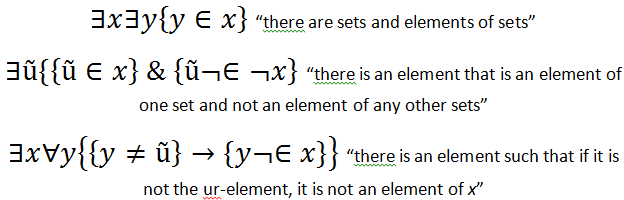
I realized that there's a difference between proving "x is not a set of anything" and proving "x is a set of nothing," and I needed to prove that the ur-element is not a set of no elements of any set, including itself. I think I worked it out* but anyway, another result of the model was that while zero is an empty subset of other sets (a set with no elements of any other sets), so all other sets are empty subsets of zero (sets of no elements of zero). So this underscores why for all natural numbers n besides 0, the powerset is uniquely 2 to the power of n, whereas 0 to the power of 0, 1 to the power of 0, 2 the power of zero... 1 to the power of 1, 1 to the power of 2, 1 to the power of 3... = 0 ^^2 = 1 ^^ 2 = 1. <So zero is the only number before aleph-zero that has an infinite number of powerset expressions.>
*my idea is that "being a set of no elements of x" means being 0 (in relation to other numbers) and being other numbers (in relation to zero). But the relation is never defined on the ur-element. More, then, we can just define the ur-element such that it it is not a set of no elements of other sets, nor itself. In conjunction with the ur-element's not being a set of anything either, it follows that it is not a set of anything or nothing, which rules out the ur-element being a set.
-
minotaur elements
minotaur ordinals
dragon ordinals
unicorn ordinals
Orpheus surreals
Osirus ordinals
Amaterasu cardinals [again]
Ragnarok cardinals
Michael cardinals
Raphael ordinals
Gabriel surreals
Asmodeus surreals
warlock ordinals
sorcerer ordinals
wizard cardinals
sortilege ordinals
demonic cardinals
leviathan transet
"kenotic transet" <said of the ur-element> and "pleromatic set"
happy cardinals
sad ordinals
priestly cardinals
hieratic ordinals
sword cardinals
sword ordinals
nuclear cardinals
nuclear ordinals
nuclear surreals
presbyter cardinals
deacon cardinals
"reformed cardinals" <so large only divine revelation can give knowledge of them>
Ezekiel cardinals
Oberon numbers
Aquinas cardinals
Nicean cardinals
irminsul ordinals
Odysseus ordinals
Aeneas surreals
Milwaukee cardinals ("a kind of joke cardinal")
cheddar ordinal
parmesan cardinal
cola ordinal
hemlock ordinal
Icarus transet
ambrosiac cardinal
cowardly cardinal
cowardly ordinal
helpless surreal
potato surreal
guitar cardinal
piano ordinal [haha]
Deseret cardinal
-
-
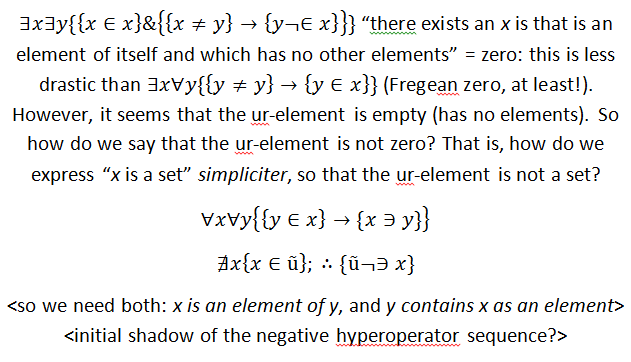
Anselm cardinals. A transet in V proposed by the "cult of the universal constructor." Its elements are supposed to be "cardinals so large that only divine power could have brought them into being" or give them a reference. Note that this concept therefore requires that Anselm numbers be transfinally ordered, making the first Anselm number into the meridian of a nexus <where the Anselm section of V is the "greatest" section>.
cult of the universal constructor, the. Believers in a transcreationist model of the Godelian universal constructor. Their leader is Cardinal Mahlo [finally!], who is actually secretly working with the Septarch of Commandment (also known as Deonomy). According to the cult, it is not provable whether empirical reality was created by a divine nature, but it is provable whether mathematical reality was transcreated by a divine nature. <The argument goes: there is a possible mathematical world that was transcreated; therefore there is a possible transcreatrix; if something is a transcreatrix, it is this necessarily; therefore the transcreatrix, if it exists for any possible mathematical world, exists for all of them.>
Godelian universal constructor. An entity whose existence is supported by Godel's ontological argument. Similar to the necessary agent.
necessary agent, the. Posit of naive deontic logic: there is an obligation that exists purely from logical grounds (an obligation to "uphold" the law of non-contradiction), wherefore there is always (necessarily) an agent able to discharge the obligation. In ecograph theory, this posit is actually a principle for the manifestation of different kinds of "necessary" agents.
Deonomy. The Septarch empowered by divine-command theory. He was also the first ecoarch to manipulate the Keyscape in order to the Septatheon. (Note that ecoarchs are already a peculiar kind of "necessary agent.")
-
<Why are Anselm cardinals not defined as "none greater than which can be conceived"? First, in context, there is no individual such cardinal. Second, this definition is implicit in the notion of a transfinal ordering, which attaches to the base definition by virtue of saying "divine nature" there, since a divine nature is one that transfinally orders things <or so the theory goes>. Of course, those who accepted the existence of Amida cardinals thought otherwise: these were "so large that only a mathematician gifted with divine power could access them." But these mathematicians with this gift need not be divine "inherently," only called that by reference to the power at issues (which power could well be impersonal, as in the so-called Tian model).>
-
-
Next step/stage.
-
-
*Regarding zero: Z = {Z}, Z ~= element of ~Z, for all X, if X is not Z then X ~= an element of Z. "Zero is an element of itself, is not an element of any other set, and has no other elements besides itself." By contrast, "The ur-element is not an element of itself, is an element of only one set, and is the only element of that set" = 1.
-
-
First-run technical account of the ur-set and the ur-element concept.
-
Haha, I finally managed to come up with a thoroughly set-theoretic foundation for my theory. The main thing is not to start with the empty set as zero. Rather, we define zero as a Quine atom (a = {a}) and 1 as the equivalent of the empty set. Here zero is the empty subset. I checked the powerset listing under this definition and it works (I couldn't get the classical definition to work, I will add).
-
"By this means, they could make the mental act of resolving the semiotic image into a conduit for the corresponding aleph's power, that is to say the act would be the 'shadow' of evaluations involving the figures themselves thus attained, and so the one act would cause another..."