



KalynaAnne
-
Posts
39 -
Joined
-
Last visited
Content Type
Profiles
News
Forums
Blogs
Gallery
Events
Posts posted by KalynaAnne
-
-
This is amazing. Thank you.
Also, that Artisan's Script? It'll become a thing.
There are already a few of us actively playing with it... I'm slowly working on an alphabet book as a fanart project. You can see a few of the pages I've finished in the gallery :-)
0 -
I think it's been translated. Here's a key: http://www.17thshard.com/forum/gallery/image/466-alethi-key-01/
Good job on figuring that out yourself, though! Keep up the good work.
Yeah, I know it has been mostly translated and I've spent a lot of time with that key
 . But there are still gaps in the translation (at least as far as I can tell after searching the forums, certainly in the translation on the first page of this thread) where the text is partially obscured by Shallan's lovely drawings of the lait flora. The bold parts of my previous post are where I'm filling in uncertain/missing things in the first few lines. There are still sections that are unknown in the later lines. 1
 -
So... I started looking at the women's script on the Shallan's notebook page about the lait plant life which was analyzed here thinking that my goal was to figure out which vowel sounds correspond to the different vowel symbols (since English vowels are a mess...) and whether there is anything interesting going on with diphthongs. Instead, I got distracted with looking at the translation and, after poking at it for a while with zhencongming, have an update for lines 2 and 3. I think the beginning of the passage is:
"The statement that intrigues me though is that of King Nohadon. He implies Urithiru could be reached by any of the main cities. If such a thing were possible, evidence of the roads would likely be in place among the kingdoms of today."
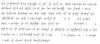
I added a transparent layer over the page and did my best to trace the women's script in black, filling in what I could by symmetry in blue. Things in green are places where the script is reasonably clear but funky. I filled the word "likely" in in red so that we can see how perfectly it fits in (though hidden by the plant). There are things in line 5 that I really feel like we ought to be able to figure out, but that I'm not currently getting sense out of. I might look at it more later, but right now I'm kind of fed up with it...
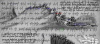
A version against white rather than the original image is in the spoiler tag if you want it. If you want the Gimp file with the layers, let me know and we'll figure out how to get it to you.
 7
7 -
I checked the anthology out from the library a couple of weeks ago, but just finally got around to reading Shadows for Silence. I enjoyed the story, though it didn't suck me in like his longer works do (though that could just be a function of the length). Does Daggon remind anyone else of Galladon? His speech patterns, and particularly his use of the word "friend" feel familiar...
Also, when I read Silence's lullaby, my brain immediately provided a tune, so I recorded myself singing it. The gallery section for "audio art" doesn't actually let us upload audio files, so I can't put it here directly, but you can find it on tumblr here if you want to hear it :-)
2 -
I wonder how hard it is to imitate metal vials.
Go to a craft store. The fancy cake decorating section should have vials of powdered food coloring. This collection includes a few different metallic colors that I've thought would probably be great for creating metal vials. That same section will have various different kinds of sprinkles (including metallic ones) if you want larger "metal pieces" for your vials. These options are especially cool because they mean that your 'metal' is actually edible! The craft store also likely has a section with assorted glass bottles and bowls that probably has glass vials as well.
I have definitely seen these things at Hobby Lobby, but I would be very surprised if Michael's, Jo-Ann's, etc. didn't have them.
...I spend way too much time in craft stores...
3 -
The illustration kinxer linked to is the one referenced, but the one here is also relevant. The vagueness comes from the fact that in the first illustration the stronger line has both greater frequency and larger amplitude.
If you don't want to dig through the giant theory thread, the relevant bit is that Brandon confirmed that Lines of Vigor behave somewhat like light waves. Those with higher frequency (ie. shorter wavelength) are better at attacking. Those with lower frequency (longer wavelength) are not going to be as strong at attacking but will be better at pushing things. (This parallels the fact that high frequency UV waves are more destructive and low frequency infrared is better at transferring energy.)
I didn't get to ask what effect changing the amplitude would have, but if we continue with the light analogy then increasing the amplitude should increase the amount of "energy" they have and make them better at what they are already good at.
1 -
I'll reply more fully later (I've only got about 10 min right now and I'm certain I will need more than that), but I wanted to point out that the diagram for the Sumsion Defense indicates bindpoints for optional chalklings. It may just be that it counts as a 2 bind point circle without them and that if you add one you have to add both to make it a 4 point circle, but it is an interesting situation.
I'm glad to have someone to bat ideas around with :-)
0 -
KalynaAnne In part 5 of your original post, you theorize that a Larger circle would be easier top break than a smaller circle, But doesn't the great circle at Nebrask depend on being Strong? If circles were weaker the bigger they got, there would be no point even having a Circle at Nebrask, since the wild chalklings could destroy it so easily.
Yeah... there are a lot of things that don't make sense to me about what is going on in Nebrask (we know so little...). In the duel between Fitch and Nalizar at the beginning of the book, a straight hit by one of Nalizar's LoV's nearly breaks Fitch's circle. We see other places where chalklings don't take very long to do significant damage. If the great circle at Nebrask is a basic LoW (even at the strength of our familiar smaller circles) and there are any significant number of wild chalklings (plus Forgotten and whatever else is out there), I have a hard time seeing how they hold it, even with large numbers of Rithmatists monitoring it. It would be like... you know those old arcade games where you have to shoot down the invading aliens or asteroids with your laser gun? Where you can run along the ground (around the edge of the circle) but can't fly after them? You can keep those up for a while, but eventually something is going to get by you. I know they have lots of Rithmatists out there working together, but even so... Also, regardless of how large the circle is, you still (presumably) only get at most 9 bind points and you are still, presumably going to need to anchor it with LoF. You can get 9-point circles where some of the bind points are arbitrarily close together, but there are still going to be stretches where your path is blocked by a LoF. There is also the fact that we are used to seeing LoW attacked from the "outside" (where the curvature is positive) and at Nebrask it seems like it would be attacked from the "inside" (where the curvature is negative) and there's no telling how that would change things. I would LOVE to see a diagram of the current defense scheme in Nebrask.
Basically, I don't have a good answer to this, but I have various tentative half-baked theories:
- We know that there are extra things Rithmatists learn when they are ready to head to Nebrask that they don't get to learn while they are still in school (and thus that we don't know about). It is possible that there is some sort of strengthening ward or something that gets used on the great circle.
- 2) Maybe the great circle is the last line of defense and there is a ring of smaller not-quite adjacent circles inside it that the Rithmatists defend from. It could be that it is mostly there to buy an extra few crucial moments to deal with chalklings that get past the main line of defense.
- Maybe there isn't actually a giant chalk circle and there is actually a much more complex set up. Maybe we talk about the "Great Circle at Nebrask" in a metaphorical sense because in this world defenses are synonymous with circles.
Regarding curvature, the part you reference is one of the parts of my theorizing that I am least confident in...more tentative half baked ideas:
In one of the diagrams in the book (this one) we are told that an ellipse "will be stronger where it curves more than a circle and weaker where it curves less than one." As I mentioned in part 5, this statement is naive and doesn't actually say much. At the signing, Brandon acknowledged that 9 point ellipses would be Rithmatically valid but also made it clear that it would not make sense to use them. The implication seemed to be that if you were in a situation where you expected to need to defend the sides of your LoW, you should have started with a circle. (Note that the usual method for determining the curvature at a point in real world math is effectively determining what radius circle would best approximate the curve at that point. We say that the curvature of a circle with radius a is 1/a.) Some possibilities for (at least part of) what is going on :
- The simplest reasonable explanation I've come up with - the one from part 5- would be that every curvature is assigned a strength and that the strength proportional to curvature. Assuming my calculations are correct, this would mean that if you have an ellipse with semi-major axis a and semi-minor axis a/2 (so it is twice as long as it is wide), then the curvature at the strongest points would be 4/a and at the weakest points would be 1/2a. That is, it would be 4 times as strong as a circle with radius a at the strongest points and half as strong as a circle of radius a at the weakest points. Another way to think about it is that the strength of the ellipse at the weakest points would be the same as the strength of a circle whose radius is twice the semi major axis of the ellipse. The closer together the two axies are in length, the closer both factors will be to 1. If you were in a situation where you were expecting the brunt of the attack from one direction but there was still the possibility of an occasional attack from the side, it seems like a 9 (or 6) point ellipse where you could bind a couple of defensive chalklings and could add more stabilizing lines could still be a good idea.
- It could be that the basic premise of 1, that every curvature is assigned a strength, is correct, but that the relationship is more complicated than a simple proportionality. This could lead to weaker sides for the ellipse, but it would also lead to larger circles getting weak faster as well.
- There could be a certain total amount of strength (which I tend to think of in terms of charge) in a Line of Warding. That charge then could be attracted to areas of higher curvature. In a circle, where the curvature is constant, it would spread out evenly. In an ellipse, it would concentrate in the areas of higher curvature and leave the longer "sides" weaker. Depending on how this "attraction" worked, it would mean that larger circles are still weaker than smaller circles (since the charge is more spread out), but that the long side of an ellipse could be weaker than a circle of equivalent curvature.
- We could have something similar to 3, but where the total amount of charge in the LoW depends on the length of the curve (every inch of chalk contributes a unit of charge, or something) rather than being fixed for lines of warding. This possibility would mean that all circles could have the same strength. It would also lead to the possibility of long narrow ellipses with extraordinarily strong ends and equally weak sides. This option is the one that currently feels to me like it fits best. The idea of a LoW being somehow charged also fits thematically with the LoF that produce something reminiscent of a magnetic field and LoV that behave like EM waves. It is also rather more complicated to work with and raises more questions (How exactly is the total charge related to length? How does the "attraction" component work? How does the charge distribution affect the way LoF work in stabilizing the LoW? etc...)
- There could be something else going on entirely.
I wish I were a Rithmatist so I could draw a bunch of circles and ellipses of different sizes and shoot equal LoV at them from equal distances but different angles and record all of the results and analyze them. I actually have a whole list of Rithmatics experiments I wish I could run. Ah well.
8 -
Hi ccstat! Thanks for recording the signing! We'll have to do a better job of coordinating meeting up next time there is a gathering of Atlanta area Sanderson fans :-)
Ooooh I like the retroreflector idea! You have to be careful any time you use LoF since you can't get your offense past them either, but that could be a great defense. If you have multiple opponents, drawing in a retroreflector line to fend off one/some of them while you focus on others could be effective. There would be a balance then in how many zigzags you want to use since each segment presumably has to be dismissed individually if you want to get through later and also because you don't want their LoV's to be likely to hit the intersection points... hmmm... there is more thinking to be done on this topic.
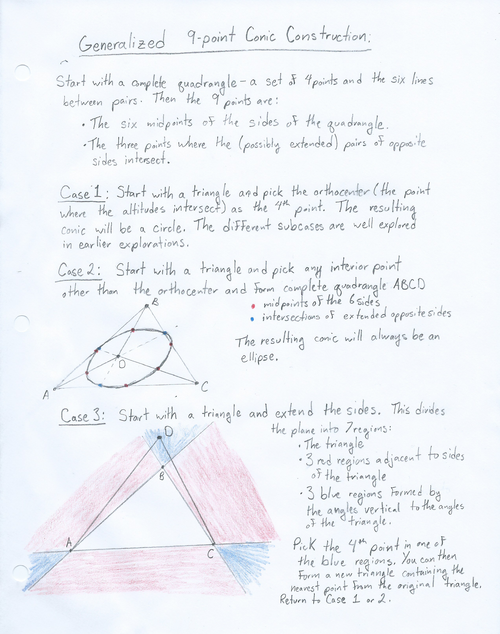
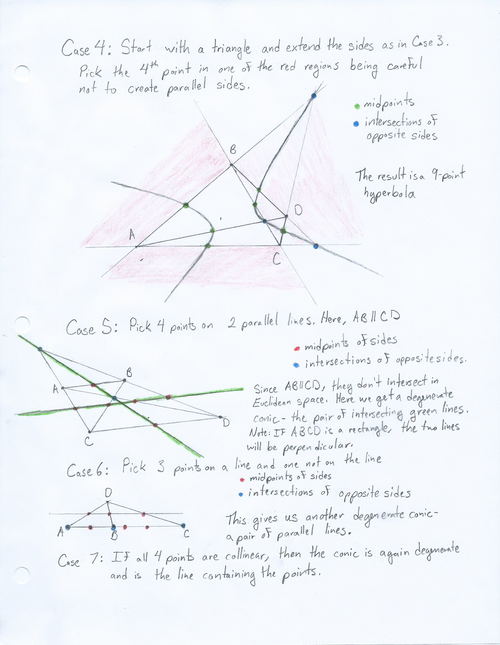
Ah. General 9 point conics. I have two pages of case by case analysis showing everything you can get that I'll attach to this post. Prior to talking to Sanderson at the signing, I was half expecting that there would only be one special kind of point that would give Rithmatically valid ellipses. That does not appear to be the case. Those particular centers have the advantage of being easily constructable with just a compass and straightedge, so they seemed like good candidates. There is also a particularly nice symmetry to the 6 point ellipse that comes from using the centroid. I've got some more stuff here that I'm playing with, but it isn't organized well enough yet to try to explain over the internet :-)
It's possible that the issue isn't so much that you can't have small 9-point circles but rather that it isn't practical. The smaller they are, the closer together the points are going to be and I could see there just not really being space to add that many chalklings around it. None of the defenses we are shown ever actually use more than 4 bind points on the small circles. The most interesting diagram on this topic though is the Eskridge Defense. My understanding would suggest that the point where the circles touch has to be a bind point for both circles (whether there is anything else they need to match up with or not). For the small circle in the upper left, it is reasonable that we are treating it as a 6 point circle - that would at least come pretty close to allowing bindpoints at both ends of the LoF and at the point it touches the main circle. For the lower left circle though...The only way to get those three points is if it is actually a 9 point circle. One of the things I'm currently working on is trying to determine what kinds of point patterns (right now starting with three points) can be extended to 9-point circles. Determining where all 9 points would need to be if you know three of them is likely to take far more time than would be practical.
There is also something interesting going on with curvature. I have a couple different ideas here that I'm poking at and teasing out the implications of. I'm trying to come up with a theory that would explain why Sanderson was so confident in stating that 9-point ellipses aren't practical for defenses even if they are Rithmatically valid.
9-point conics analysis in the spoiler tag.
 2
2 -
Hello fellow Rithmatics nerd :-)
I showed up to the signing with a binder full of rithmatics notes and asked more questions than was really reasonable, but I had decided to start with the more basic things (solid foundations are important), so I didn't get to lines of silencing. I also haven't really thought about how Lines of Vigor would interact with Lines of Silencing - that's an interesting theory. I did get it confirmed that LoV behave like light. Different things affect light and sound, so I'm not sure if I would expect it to work or not. I'll have to think more on that.
Unless we can make circles using something other than the 9-point circle construction, those are the only options. (There is another theorem known colloquially as the Mystic Hexagon Theorem - see http://en.wikipedia.org/wiki/Pascal%27s_theorem - that feels like it is in the same spirit that might be able to lead to other things. I haven't really explored it much in this context. The statement of the theorem is straightforward enough geometry, but the proof requires algebraic geometry, so it isn't particularly widely known even though it is really nifty)
You can definitely use the 9 point construction to produce hyperbolas (though this doesn't guarantee that they can be LoW). Start with a triangle. If you use the orthocenter to form the quadrangle (see the first post I made about ellipses) you get a circle. If you pick any other point inside the triangle you get an ellipse. Extend the legs of the triangle. If you pick a point in one of the sections that is not adjacent to a side of the triangle, that new point can be used with two of the original points to form a triangle containing the third, so you get an ellipse (or possibly circle if you are tricky about it). If you pick a point in one of the sections that is adjacent to a side of the original triangle, then the three vertices and your new point form a convex quadrilateral and the 9-point construction produces a hyperbola. If you pick the fourth point actually on one of the sides (or side extensions) of the original triangle, then the 9-point construction leads to a pair of parallel lines - which is a degenerate conic. I'm fairly certain this covers all of the cases and that you can't get a parabola from the 9-point construction, but it's late and possible that my brain isn't functioning at full capacity. (Also, my scanner is being dumb right now, but I'll add pictures to clarify things when I get it working again.)
Note:
Non-degenerate conics can be a : circle, ellipse, hyperbola or parabola
Degenerate conics can be: two lines (which can be intersecting or parallel), a single line (when the two lines coincide), a single point, or the empty set.
Crazy theory time:
What if LoW are closed conics and LoF are open conics?
This would mean that Circles and Ellipses can both be LoW, but that other conics on their own can't. You might be able to do something funky piecing parts of curves together to get other LoW. I tried to ask about the Blad defense at the signing and got a look that fairly clearly seemed to say "you expect me to know that off the top of my head?" I'll have to try again armed with a sheet of possibilities for piecing together LoW rather than asking about Blad specifically next time he comes to Atlanta. [on that note, I like your idea for smoothing it, but it doesn't fit with the description in the book where we are told that the Blad defense is formed of 4 elliptic curves. Getting bind points to line up properly is going to take some serious work though.] There's also something funky going on with curvature and the strength of LoW, but I haven't quite thought that part though enough to explain my thoughts yet.
Now, LoF. I got it confirmed that a LoV behaves like light and bounces off of a LoF like it is a mirror. Since a line is a degenerate conic and *much* easier to draw accurately than other conic segments, it would be easy to believe that someone discovered that straight line segments work as LoF and that since then everyone has just assumed that is the only option. However, in real world physics, elliptic, hyperbolic, spherical and parabolic mirrors are all legitimate and useful things. It would be amazing if we could have conic segment LoF. This would open so many new strategies for working with LoV...
Also, I really want there to be Lines of some sort that behave like lenses when they interact with LoV. They likely wouldn't be practical for dueling, but they could lead to other interesting applications of rithmatics (we know they use it for at least some non-dueling things).
9 -
With most of the lines though, the intent is built-in. A LoW does what it does while a LoF and revocation do what they do. Melody's chalklings would be the exception since they don't operate on express drawn instructions as most rithatist chalklings do.
Based on what we have seen so far, yes - though the rithmatist does have to know what the line they are drawing is supposed to do, even for the basic ones. We see evidence of this when they are trying to figure out what is going on with the squiggles.
On the other hand, according to anyone you talk to in the story (other than Melody and Joel) the only way to command chalklings is express drawn instructions. Rithmatics is not as well understood in the story as they would like to think it is. In addition to not fully understanding chalklings, there are LoW circle bind point patterns that aren't fully understood (I've had this confirmed). I have a feeling that intent, and maybe also confidence, play a bigger role than the characters think they do
0 -
I think it's interesting that a Rithmatist can activate the drawings of a non-Rithmatist. Assuming that intent is a factor (and Melody's chalklings certainly suggest that it is), does that mean that when Joel draws a line he's imprinting it with his intent even though he's a non-Rithmatist?
I don't think Melody is activating Joel's lines so much as using them as a pattern to draw hers. During the duel, we get things like:
"Melody traced his line, and hers shot across the floor- conveniently dusting away Joel's original as it moved."
The exact role that intent plays intrigues me a great deal though. We see it in Melody's chalklings and in the fact that the new swirly squiggle line doesn't activate for Prof Fitch until Joel tells him what he thinks it is supposed to do. I wish we knew more about it, but I get the impression that it isn't well understood even in-world.
1 -
Some form of rithmatics dueling game could be fun :-)
That said, it is mentioned briefly that rithmatics is used for more than just dueling. I think there is a lot of potential for rithmatics puzzles. Maybe something Incredible Machine style where you are given a parts box with a limited number of different kinds of lines/chaklings/chalkling commands and have to figure out how to meet objectives.
1 -
Sparks. Please not Hotlanta *shudders*
Atlanta doesn't have the concentrated downtown that many other cities have, but most of the skyscrapers here do lie within a couple blocks of the main Peachtree Street. It would be interesting if that long strip was all that's left.
Also, you know what else is in Atlanta? The CDC. (And if this whole business with the Epics was caused by an experiment gone wrong at the CDC I'm going to laugh so hard.)
8 -
Well wouuld you look at all the smart people! Actually, I hope some of this stuff makes it into the azlatianainain. It would be nice for us "Not as smart as Kalyna Anne/The only Joe" type people to have that type of thing explained by Brandy Carpenter Kid
If you have questions about any of it I would be happy to break things down further! Just let me know what you are interested in knowing more about :-)
1 -
Hey guys.
I asked for something about Kaladin when he was signing WoR. Before I tell you what he wrote, I should mention that he was halfway through writing it when I opened my rithimatics notebook and kind of distracted him. "Kaladin has known multiple lightweilders."
I also asked a bunch of rithmatics questions at the signing today. I'm afraid I don't have a recording (which wouldn't be completely clear because it involved me pointing at drawings in my notebook) or his exact words, but I can pass on what I learned.Note: The tumblr posts linked below are meant to help you understand what I mean by constructions, but they were written before the signing and any theorizing not confirmed here is still theorizing.
- Yes, 5 and 8 point defenses (constructed from applying the 9-point circle construction to right triangles and isosceles triangles respectively) could exist. They haven’t really been explored in world though.
- You can always bind more than one thing to a bind point, but binding multiple things weakens the point. It is a much better idea to add a small circle that gets 3 additional bind points. It doesn’t change anything if the point comes from multiple points in the 9-point construction.
- When I showed him the 9-point ellipses constructed from different triangle centers (see the constructions here ) he stared at them for a moment before answering. He hesitantly said that, yes, those constructions should be valid in theory, but that they shouldn’t be used in practice. The sides of ellipses are weak enough that if you expect to need to defend your sides you really should be using a circle.
- Yes, Lines of Vigor behave like light waves.
- Yes, this means that higher frequency waves are better for doing damage, lower frequency waves are better for transferring energy (and thus moving things)
- Yes, Lines of Vigor follow the rule that the angle of incidence = angle of reflection when bouncing off Lines of Forbiddance.
- LINES OF VIGOR ALSO REFRACT. I asked it in terms of whether they slightly change speed and direction when they move between materials like, say, concrete and asphalt. He said yes and that you also get the wavelength adjusting.
8 - Yes, 5 and 8 point defenses (constructed from applying the 9-point circle construction to right triangles and isosceles triangles respectively) could exist. They haven’t really been explored in world though.
-
- Popular Post
- Popular Post
EDIT: I've been informed that the signing report belongs in a different part of the forum and that what I should put here is all of my theorizing with the comments I got today added in, so... In the interest of this not being super ridiculous long, I'm going to link you to the series I've been posting on Tumblr with a note about what each post is about:
Part 1 Here I outline how to get all of the binding patterns in the book from special cases of 9-point triangles
Part 2 How you could get a 5 point defense as a result of looking at right triangles. Brandon confirmed the existence of 5 point defenses at the signing today, but said they haven't been well explored in-world.
Part 3 How you could get an 8 point defense as a result of looking at right triangles. Brandon confirmed the existence of 8 point defenses at the signing today, but said they also haven't been well explored in-world.
Note: In these tumblr posts (which were written before the signing) I postulate that some bind points might be stronger than others. Brandon told me that this is not the case. You can always bind more than one thing to a bind point, but binding multiple things weakens the point. It is a much better idea to add a small circle that gets 3 additional bind points. It doesn’t change anything if the point comes from multiple points in the 9-point construction.
Part 4 Where I analyze the 9-point circle construction on obtuse triangles and come to the conclusion that they don't give us anything new.
Part 5 Lots of thoughts on the changing curvature of ellipses and my guess at the Blad defense. I didn't get a chance to confirm any of this.
Part 6 So, there is a generalization of the 9-point circle construction in Geometry that allows for the construction of ellipses. Here I talk about different triangle centers and how they could be used to produce 9-point ellipses. When I showed Brandon my page of 9-point ellipses constructed from different triangle centers he stared at them for a moment before answering. He hesitantly said that, yes, those constructions should be valid in theory, but that they shouldn’t be used in practice. The sides of ellipses are weak enough that if you expect to need to defend your sides you really should be using a circle.
Part 7 More on 9 point ellipses
Part 8 Various thoughts on lines of vigor many of which were confirmed today! Things that Brandon confirmed for me at the signing today:
- Yes, Lines of Vigor behave like light waves.
- Yes, this means that higher frequency waves are better for doing damage, lower frequency waves are better for transferring energy (and thus moving things)
- Yes, Lines of Vigor follow the rule that the angle of incidence = angle of reflection when bouncing off Lines of Forbiddance.
- LINES OF VIGOR ALSO REFRACT. I asked it in terms of whether they slightly change speed and direction when they move between materials like, say, concrete and asphalt. He said yes and that you also get the wavelength adjusting.
There, ah, may still be more theorizing coming as I get it written up
43 -
So, I just called to make sure they are planning to have copies of The Rithmatist(because I had checked it out from the library previously, but am fascinated with rithmatics) and to confirm that if I bought The Rithmatist that would count for the wristband. The lady I talked to told me that to get a wrist band I have to pick up a copy of either Steelheart or Firefight. If we are getting conflicting information, that would be interesting to know, but I just wanted to let you guys know what I was told today.
0 -
I'm planning to go and would be happy to meet up with fellow fans before hand, but that moment I'm not certain exactly how early I will be able to get there (I might have things that have to be done in the morning, though I'm trying to clear it). I don't have any other obligations that afternoon/evening, but, ah, my phone also isn't smart enough to record with. My laptop would be, but that seems rather intrusive.
0 -
I hadn't thought about the strength thing, but I've wondered if it would be possible to attach more than one chalkling to the bind points where multiple points from the 9-point construction coincide.
By the way - I was playing with the triangles stuff before I came here hunting for what other people have done. We mostly seem to agree, but I've also figured out how to make the 2 point circles fit. My take on triangles and 9-point circles for the existing circle based defenses (including 2 bind point defenses) is here: http://kalynaanne.tumblr.com/post/107361151487/rithmatics-part-1
2 -
It would be fun to meet up beforehand if you find some others that will also be there.
*waves at the other Atlanta/Georgia people*
I only got sucked into Sanderson's work in the middle of last fall, so I haven't been to any signings yet, but I'm hoping I can avoid having to work that afternoon so I can make it to this one :-)
0 -
WHAT IS THIS PLACE
Newnan is a suburb south of Atlanta, out along 85. It seems like an odd choice of location to me - if he was going to pick an Atlanta suburb rather than Atlanta proper I would have expected something like Marietta or Roswell - but I'm *hopefully* going to be able to make it even though heading down to Newnan is likely to take up the entire afternoon.
0 -
Hmmm, I'd forgotten about that part, Moogle. But ok, so we factor in the time dimension. His name could still describe the exact shape of the fractal part of his form at any given time. It could still be the case that the only movement Pattern has control over is effectively translation/rotation type movement. I really like the idea of a fractal character who has to work within the confines of his form rather than being able to simply move around like a human. The intricacies of his shape would give him a lot of freedom in what he would be able to do, but the process for making it happen would be completely different.
Pattern has some control over how much of him is present in the Physical realm as displayed by his ability to both hang out on the surface of things and to appear as a wriggling mass of lines. It doesn't seem out of the question to me that he could move to where we are getting a smaller cross section when he shrinks.
Transformation being represented by a mathematical construct makes me really happy.
0 -
Our dear friend Pattern is a fractal. This much is clear from Shallan's comment the first time she draws him:
“The pattern seemed impossible to capture. Its complex repetitions twisted down into infinity.” (pg 67, WoR kindle edition)
It takes a while, but Shallan finally gets around to asking Pattern if he has a name beyond the one she has given him. His response:
“Name is numbers. Many numbers. Hard to say. Pattern…Pattern is fine.” (pg 215, WoR)
Fractal patterns that are on some level infinitely complex can often be described by seemingly simple equations and/or sets of rules. You can see this in things like the Koch snowflake, Sierpinski's triangle, the Mandelbrot set, and the Julia set.
Theory: Pattern’s true name is a mathematical description (in some form or other, there are multiple possibilities here) of his fractal form. The fractal exists in multiple dimensions and his appearance in the physical realm is just one tiny slice of his full form - the intersection of his fractal with the physical realm. His apparently changing patterns are not actually his pattern changing, but instead him moving so that the intersection changes and we get different views of him. His ability to shrink corresponds to moving so that his intersection with the physical realm is smaller. As a fractal, even a tiny intersection would have the complexity necessary to, say, pick a lock.
Now I really want to know Pattern’s true name.
9
 . But there are still gaps in the translation (at least as far as I can tell after searching the forums, certainly in the translation on the first page of this thread) where the text is partially obscured by Shallan's lovely drawings of the lait flora. The bold parts of my previous post are where I'm filling in uncertain/missing things in the first few lines. There are still sections that are unknown in the later lines.


Stormlight Archive Translation Guide
in Stormlight Archive
Posted
Yeah, I go back that section and stare at it periodically, but I haven't managed to get it to resolve into anything coherent yet. Maybe one of these days something will strike me slightly differently...