



Seonid
-
Posts
2346 -
Joined
-
Last visited
-
Days Won
6
Content Type
Profiles
News
Forums
Blogs
Gallery
Events
Everything posted by Seonid
-
 So, I also didn't pay attention in high school physics, but I have the advantage of also not paying attention for an entire bachelor's degree worth of physics after that. Unfortunately, I was focused on space-time stuff, not materials science, but I'll see if I have anything useful to drop. My first thoughts are that you are looking at some kind of natural capacitor (rather than a battery - capacitors are capable of rapid discharge, unlike batteries which provide a steady current). Stored electrical energy in a capacitor is done by separating electrical charges - there are two plates of conductors, one negative, one positive, separated by a thin layer of something called a dielectric. A dielectric is something that can't conduct electricity, but when it's exposed to an electric field, the charges separate - positive charges to one side and negative charges to the other. Now, natural capacitors can happen, and do all the time. Thunderstorms are natural capacitors - two clouds act as the separate conductors, while the air acts as a dielectric. As far as storing energy from outside disruptions, you might look into thermopiles, piezoelectric materials, and photovoltaics. These are constructions that directly convert heat, vibration, and light into electrical energy. So you're in luck, in that literally all of the things you want zap metal to absorb energy from happen in the real world! It's only a minor handwave to have them all show up in the same material. Now, to your questions: In conclusion - this is a really cool idea, and I don't think you need to add much more to it to get something really functional for an early modern setting. And it's already close enough to what we can do with modern materials that you don't need much handwaving at all. I'm excited to see what you come up with with it!
 -
Weekly writing accountability post for week ending 09/28/25 Total words written: ~28,000 No new scenes written, and no words added to the total. But that doesn't mean no writing was done! I didn't most of my energy this week trying to revise a few scenes. I hoped to finish them faster, but I'll take what I've got. I might even post one of them if anyone is interested. Goal for next week: 32,000 words
-
It's Saturday, which means another worldbuilding post! We are (finally) going to finish up Gaeletii politics today. Part 3 of our series on the political geography of the kingdom is an explanation of how things got to where they are (and perhaps why you are seeing Earls, Counts, Dukes, Landgraves, Viscounts, and Barons all in the same kingdom - it's a whole mess, and it was meant to be). But before we get to that, let's talk about upcoming worldbuilding topics! With the politics mostly wrapped up, we can turn our attention to the kingdom's culture. Gaelet sits along the zone of intersection of multiple major cultures, but the two that shape it most heavily are the Kaloneri Empire to the west, and the Avran fiefdoms in the east. I intend to focus heavily on nailing down details of these two cultures over the course of the next few weeks. The order doesn't particularly matter to me, so I figure I can share a number of potential topics upcoming, and if any one of them catches anybody's interest, you are more than happy to request that I turn my attention in that direction first! The Worship of the Tribunal The Pantheon of Constellations (The official state religion of the Kaloneri Empire) Courtship, marriage, and family relationships among the Avrans Imperial metropolises and Kaloneri urban culture Political Geography of the Kingdom of Gaelet - Part 3: Historical Development of the Power Structure In 1302, the Kaloneri Empire and the newly established Kingdom of Gaelet reached a settlement that recognized the independence of all of the land east of the Ainin River. However, the new kingdom was a mess, administratively. The bulk of the initial armies had come from the former territory of the Duchy of Caedros, and the exiled Duke had been the figurehead around which the movement had coalesced. However, he was dead, and though his son had inherited the house seat, the unity of the new kingdom was already threatened. Lords to the east of Caedros, from the domains of House Harleon and House Livermore, had been more than willing to send military support to Caedros to set the duke up as a buffer state between themselves and the Empire. But when the new kingdom organized itself, they declined to join it. Similarly, the southern fiefdoms of House Samane and House Feravut, along with the Viscounty of Sirre, remained independent of Gaelet. They had been stripped of their vassals by the Empire, but retained a great deal of their former strength. Now, rid of their burdens of fealty to the Imperial Throne, they were not inclined to take on new burdens. Of the noble houses that had participated in the war of independence, the only ones to join the new kingdom were the houses that had once been vassal states to the House of Wyst, which ruled the Duchy of Caedros. They had been stripped from Caedros by the Empire, and were not necessarily keen on merely changing out one master for another. At least, not with the old Duke - whom all of them had respected as a leader - dead. Najar I, the new king, finally bought their allegiance by releasing them of their bonds of fealty to Caedros and elevating their most prominent leadership to become the heads of their own noble houses. They still owed fealty to the kingdom, but were guaranteed a seat on the King's Council, made up of the heads of the noble families of the kingdoms. These became the Houses of Ester, Glenfax, Cellidore, Montagnesse, and Ruitte. The House of Wyst still held the original territory of the Duchy of Caedros, but without the former vassals, its influence was much reduced. To further reward his noble supporters, Najar I created two new noble ranks within the kingdom. The first, the rank of Earl, originated in the eastern fiefdoms, where Najar had spent his youth in exile. Najar used it as a high noble rank, ranking just below the rank of Duke - which he steadfastly refused to grant to even his most loyal supporters. The second, the rank of Landgrave, was taken from the nobles of the northwest, near the borders of the Dahl. The king decreed it as a rank between Baron and Earl, and used it as a way to reward those nobles who had earned his favor during the war. The House of Verekai sided with the Empire during the independence war, and all of its vassals and most of the land in the duchy of Terrignon was stripped from it for that crime. There were calls to have the house entirely disestablished, but upon learning that the steward of House Verekai had gone with the empire only because the last heir of the house (which he had raised as his own daughter) had been held hostage in Kanread to ensure the loyalty of the house, the king was minded to have mercy. Their former holdings were given to the Houses of Montagnesse and Ester. However, the western reaches of House Verekai, as well as much of the land around Lushbeck and as far north as Kelysford, was designated as the king's lands. These lands were not given to the House of Wyst corporately, but held by the person of the king, for the king's personal revenue and army. Though he did not relinquish the title of Duke of Caedros, King Najar I certainly intended for the king to have a power base separate from any one of the great houses, even the one from whence he came. West of the king's lands were lands that had not been ruled over by a noble family in many generations. The empire had held power in Lushbeck and the west for over a century, and there were no remaining claimants to those lands, if the houses that once had right to them could even be found. Najar also found himself with empty coffers and a host of unruly mercenaries who were beginning to get angry about their lack of pay - indeed, a large number of the minor mercenary companies had already banded together and attempted to seize the city of Gadre, which controlled the only pass through the mountains that was navigable by caravans. To mollify the remaining, more powerful, mercenary commanders - as well as to reward them for their loyalty during the mercenary rebellion - Najar divided the western lands up into 6 counties, selected 4 among the mercenaries' number, and gave them the noble title of Count, labeling them as non-ruling nobility administering the lands under the king's authority. The remaining two counties were given to two of his most loyal supporters - Samhain Marchandson, formerly a captain of the garrison of Lushbeck, and Martin Surrestor, the former Imperial Governor of Kenesthyn. The remaining mercenary companies were given lands under the auspices of these counties, many leaders being nominally given the rank of Viscount, a lower-level administrative rank that operated under the supervision of a Count. This move enraged the mercenary commanders, who had expected to be named ruling nobility, but the king had made a deal with the ruling nobles of the east to avoid creating more new noble houses in order to preserve their influence. However, after the noble houses began to systematically oppose a number of the king's initiatives in the King's Council less than 6 months after the kingdom was formed, the king reneged on that agreement and elevated all six Counts to become the heads of their own new noble houses, giving them each a seat on the King's Council. He also proclaimed that the rank of Count was equivalent to a northern Earl, thereby making each of these new noble houses the equal of any of the former vassals of Caedros. The new noble houses and their domains were as follows: The County of Comenlaryn, held by House Devrashal, the County of Marcester, held by House Burnist, the County of Kenesthyn, held by House Surrestor, the County of Arcady, held by House Calliester, the County of Chalys, held by House Seonid, and the County of Cherlienne, held by House Lasofer. These land grants and divisions caused great tension in the new kingdom. Although their existence as independent Houses was new, the ruling nobles of the eastern region had pedigrees that stretched back for centuries, and it was a major irritation to share their rank and influence with new, upstart houses that had been given their titles only for service during the war. Or even worse, simply as a means to pay off a debt. And the fact that the new houses neatly balanced their power on the Royal Council was another blow. In addition, the six new counties were much more fertile and populous than the eastern regions, so the old nobility had to bear the double insult - first that the new noble houses were given rank equalling their new independent noble houses, and second that the lands given to these new nobles were far more populous and productive than their own. As a result, political maneuvering in the early years of the kingdom was marked by the so-called "Old Nobility" attempting to shut out the "New Nobles" from decision-making authority. In particular, the old houses placed a blanket ban on any of their members making any sort of marriage contract or other similar contractual alliance with a scion of the new nobility.
-
I'm alive. Sleep deprived, but alive. We've changed my 6 year old daughter's ADHD meds, so that's an...interesting...transition. But the focus is better, she hasn't had a potty accident in 2-3 days, and she isn't randomly falling asleep at awkward times and then denying she was ever asleep when she wakes up. So... progress? In other news, my novel is up to 28,000 words, I'm doing revisions on a few scenes and know what I'm going to do when I'm done, so... also progress?
-
Hi back! I was a mod around here once upon a time, and I GMed quite a few games (for my time, at least!) It's not surprising that you might have fun into my name some where , especially if you ever run around looking at the old games. My specialty was Shard games - a style where the game included multiple planets, more factions that you could shake a stick at, every one of the then-known shards of Adonalsium, and multiple competing win conditions. They were a delightful mess to play, and even more stressful to run.
-
I'll take a spectator spot, if those are still a thing around these parts
-
Oh, the AG! I'm definitely gonna sign up to play in that. I'm taking a couple weeks off around the end of the year anyways. Other than that, sounds interesting. 10-12 isn't a whole lot, but it's enough to run fun games. Also, apparently someone forgot to revoke my mod powers when I retired...
-
Thanks! Glad to see some familiar faces around still. So many of the ones I remember haven't been on the Shard in years (according to their profiles). What does the SE scene look like these days?
-
10 months might actually be enough time lol. Go ahead and sign me up. I have no idea what for - I don't even know what the norms are for games anymore. I'm probably feeling something simple-ish to get back in the swing of things. Depending on whether my job shuts down (I'm an American government employee these days, and the government might well run out of funding this year), I might even have time to sign up to play a game sometime.
-
So, it's been a while since I've been around these parts. Hypothetically speaking, and without making any commitments, how long is the wait on the MR list?
-
Oh that's beautiful. This is what my prose wishes it could be
-
Thank you so much, that is excellent feedback! Some of the terms are in-universe words - "lockbow" instead of "crossbow," specifically. I'm not sure where the singular use of horse came from - I had this sense that it was a standard term during the time period, but as I reflect on it, it might be a Wheel of Time thing that crept into my mind . That's a good place to standardize it just to make it easier on the reader. I'll probably keep "lockbow" for now, just for a little bit of world flavor; my hope is that if I tone down some of the other stand-out terms, it will be easier to digest on its own. As far as the tent scene - I can see it being abrupt. I've been thinking about it, and the scene might work better if he enters his mind palace while he's standing on the hill watching the battle - a bit more contrast with the chaos going on around him and the stillness of his mind is never out of place, and I feel like the transition would be smoother that way. Make it more obvious that he's not leaving the battle to randomly meditate, but that this is something very much part of his command approach. And I love that his embarrassment made you laugh - he's very good at war, but he's awkward in a lot of social situations. We're going to see a lot of him in these awkward social situations going forward, so I was hoping to show his competence within his arena before we show just how much like a fish out of water he is during peacetime. As for the wall of worldbuilding, I'd say I was sorry, but I don't want to make a habit of lying to y'all . In all seriousness, walls of worldbuilding is kinda what I do. (For those who are curious, one of my older worldbuilding repositories is still on this forum. If anything, I'm still trying to live up to the tradition of that one .)
-
Weekly writing accountability post for week ending 09/21/25 Total words written: ~28,000 Finished my opening scene, which I was really excited about. But a combination of a busy week and some really annoying mental health issues made it hard to keep up the momentum. It's not the end of the world, though. New week, new opportunity to get back on the wagon. And even though my mental health took a sledgehammer to my ability to continue with the story this week, I still got a fair amount of worldbuilding written up, so it wasn't a total loss. Goal for next week: 32,000 words
-
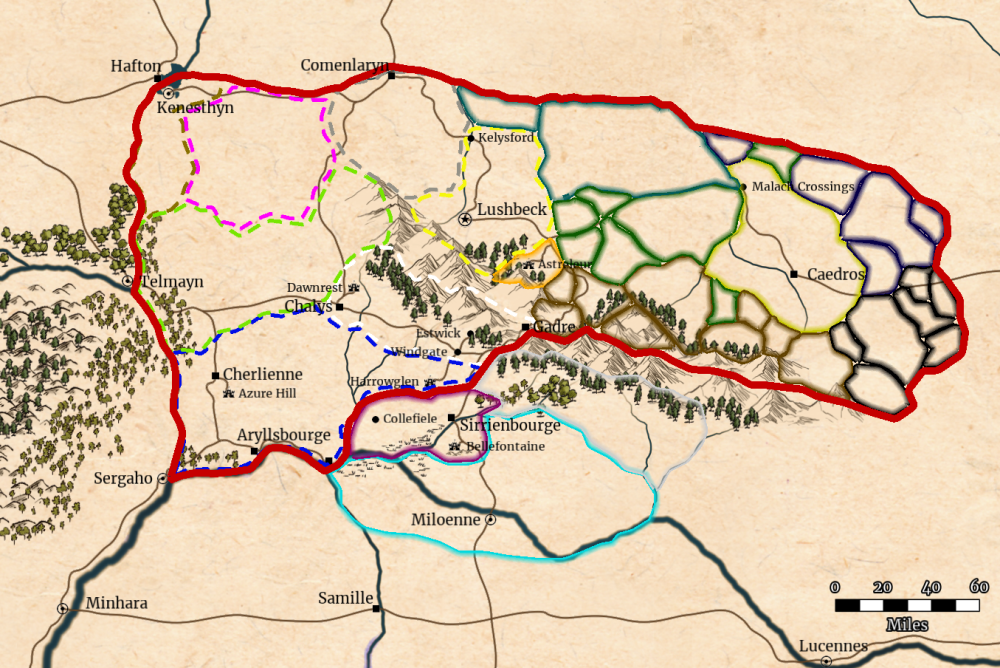
The Political Geography of the Kingdom of Gaelet - Part 3: The Fiefdoms of Gaelet Before the Imperial Conquests of the mid-1200s, the territory that would become the Kingdom of Gaelet was ruled by five different noble houses, as well as some western territory ruled by the Kaloneri Empire. The three houses south of the mountains were the House of Samane, which ruled the Duchy of Miloenne and its vassals, the House of Feravut, which ruled the Duchy of Pais-Fierre and its vassals, and the House of Du Brezhe, which ruled the Barony of Sirre. North of the mountains was ruled by the House of Verekai, which ruled the Duchy of Terrignon and its vassals, and the House of Wyst, which ruled the Duchy of Caedros and its vassals. The areas from Lushbeck and west to the river was still ruled by the Kaloneri Empire. However, after the war of independence, the kingdom held a large amount of land that either had never been ruled by a noble house, or had been ruled by noble lines that were entirely extinct from the war. The Eastern Fiefdoms Under the new kingdom, the eastern fiefdoms were ruled by seven noble houses. The houses of Wyst and Verekai retained their ducal titles, but their vassals were all elevated to their own noble houses. The heads of each of these noble houses were elevated to the rank of Earl, drawing on the experience of the king while in exile in the eastern fiefdoms. The king also created a new intermediate rank between Earl and Baron, in order to reward those nobles if the new houses who had distinguished themselves in the war. Several new families were elevated to baronies who owed fealty to these new houses. The eastern fiefdoms are represented on the map by solid colors. The House of Wyst The House of Wyst is represented on the map by a solid yellow outline. After the independence war, it controlled only the Duchy of Caedros. The House of Ester The house of Ester is represented on the map by a solid green outline. It holds several fiefdoms in the center of the kingdom, north of the mountains. The house seat is the Earldom of Harcourt. The fiefdoms listed in the spoiler tag are given from north to south, and then west to east. The House of Glenfax The house of Glenfax is represented on the map by a solid turquoise outline. It has two holdings along the northern border of the kingdom. The house seat is the Earldom of Whiteglen. The fiefdoms listed in the spoiler tag are given from west to east. The House of Cellidore The house of Cellidore is represented on the map by a solid blue outline. It has a number of holdings along the northern border of the kingdom. The house seat is the Earldom of Caister. The fiefdoms listed in the spoiler tag are given from north to south, and then west to east. The House of Ruitte The House of Ruitte is represented on the map with a solid black outline. It has a number of holdings along the eastern border of the kingdom. The house seat is the Earldom of Messine. The fiefdoms listed in the spoiler tag are given from north to south, and then west to east. The House of Montagnesse The House of Montagnesse is represented on the map with a solid brown outline. It has many holdings along the northern foothills of the Oaksridge mountains. The house seat is the Earldom of Altienne. The fiefdoms listed in the spoiler tag are given from west to east, and then north to south. The House of Verekai The House of Verekai is represented on the map with a solid orange outline. The House of Verekai has only limited holdings since the independence war, and now holds the Duchy of Terrignon, which itself has been greatly reduced from its former extent. The Western Counties The former Imperial lands in the west were organized into six counties who owed fealty directly to the king. Unlike the title of Count used among the southern nobility, these titles created ruling nobility and marked the creation of six new hereditary noble houses. The western counties are represented on the map with dashed outlines. The King's Lands The lands around Lushbeck are relegated to the support of the king. In 1309, the king is also the high lord of the House of Wyst, but the king's lands were explicitly kept separate from the holdings of the house of Wyst, likely as an attempt for the king to build up a power base of his own that isn't beholden to his house. The King's Lands are represented on the map by a dashed yellow outline. The House of Devrashal The house of Devrashal is represented on the map by a dashed grey outline. It holds the county of Comenlaryn, north of Lushbeck. The House of Burnist The house of Burnist is represented on the map by a dashed pink outline. It holds the county of Marcester, in the northwest of the kingdom. The House of Surrestor The house of Surrestor is represented on the map by a dashed brown outline. It holds the county of Kenesthyn, on the northwestern border. The House of Calliester The house of Calliester is represented on the map by a dashed green outline. It holds the county of Arcady, west of the mountains. The House of Lasofer The house of Lasofer is represented on the map by a dashed blue outline. It holds the county of Cherlienne, on the southern border. The House of Seonid The house of Seonid is represented on the map by a dashed white outline. It holds the county of Chalys, in the southern foothills of the Oaksridge mountains.
-
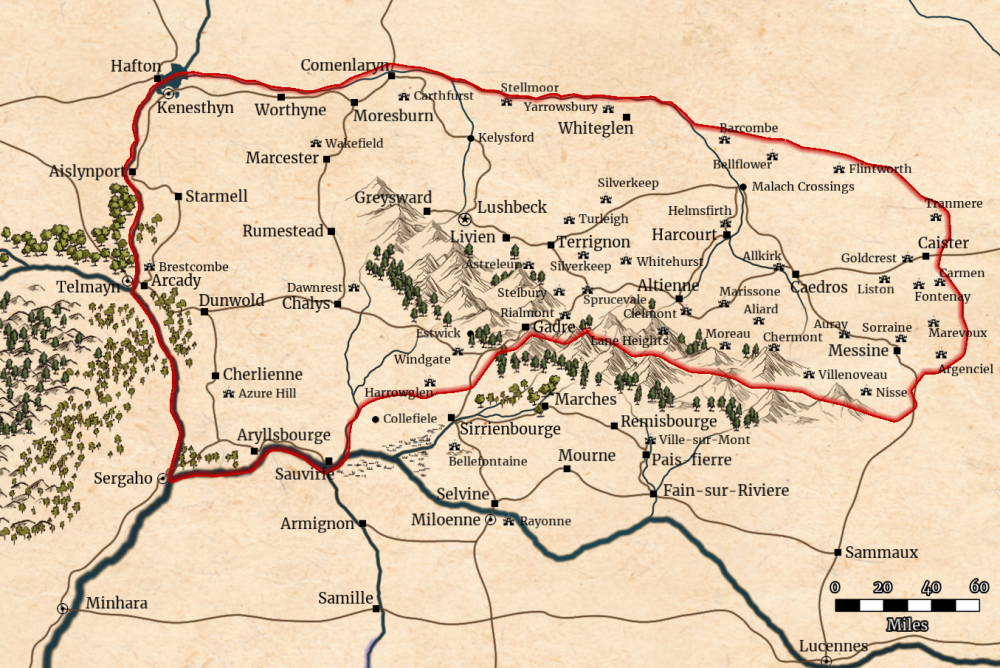
The Political Geography of the Kingdom of Gaelet - Part 2: Gaeletii Fiefdoms and Population Density And here is Part 2 of yesterday's post! As promised, we are going to do a comprehensive look at the fiefdoms that comprise the Kingdom of Gaelet. And (finally!) do the population density estimates. Population Density in Medieval Europe First, we're going to talk about population density in a medieval world and what assumptions I've been making as I put this country together. And it might surprise you to find out that these assumptions have changed even in the last couple of days as I've learned more. So the fundamental question of population density is "How many humans can live in a given area?" Now, I'm sure that if I really wanted to, I could get into estimates of calories from farming and raising livestock, plus calories from sustainable (or unsustainable) foraging, and end up with a rough number of the maximum number of people the land can support. But I don't have time for that. I don't think anyone has time for that. So instead, I'm going to draw on historical sources, largely focused on medieval Europe, since it is a rough analogue for the cultures of the Edassan midlands. And just starting by looking at medieval Europe, we are going to end up with an incredible distribution of population densities. First off, we have to define a time frame for "medieval Europe." After all, the medieval period lasted for centuries, and what the population and culture of France looked like in 1000 C.E. was nothing like what it looked like in 1330, or in 1450 (which is towards the end of the medieval period). As an arbitrary number, we are going to pick one of the local high-water marks for European population - 1300 or so. This is shortly before the Black Death hit Europe (generally considered to be 1347), which caused a massive drop (estimates roughly around 31%!) in population that didn't recover until after the medieval period. So, in or around 1300, France had a population density of between 90-100 people per square mile. Germany and Italy were a little lower than France, since the French land was a little more fertile - perhaps around 80-90 people per square mile. The British Isles had a density of around 40 people per square mile, though this was heavily impacted by Scotland's extremely low density (4-5 people per square mile); England proper having between 75-90 people per square mile. Spain and Portugal sat somewhere around 25-40 people per square mile. Sweden and Norway had a much lower population density, at 2-3 people per square mile. So we have a very wide range of possibilities here, but the variation is very much tied to local fertility levels/how much arable land is available. So now we have to talk about the land of the Kingdom of Gaelet. Population Density and Gaeletii Ecological Regions Most of the Kingdom of Gaelet is in a semi-arid region. This means that, in most areas, farming cannot be sustained by rainfall alone - irrigation from rivers and local streams must be employed to make land arable. This also means that the region is highly sensitive to drought. As a result, we are not going to be able to reach the population density of highly productive regions like France and the Low Countries without some sort of external factor. That factor is available to us, though. The continent of Edassa was settled by colonists from Earth in the 2500's or so (making up a number right now, please don't hold me to it lol). And, completely discounting any technological advancements, there is a huge difference for the people living on Edassa: their grain. In the ancient and medieval world, the efficiency of a crop was generally measured by its seed-to-yield ratio. This measures how many seeds you could reasonable expect to get out of a single plant, and is expressed as an average across a field or a region. This was variable, depending on local conditions - wheat grown in a marginal hillside farm could not be expected to produce as much as wheat grown in a lush riverside flood plain like the Nile valley. Even more impactful than local conditions, however, were seasonal considerations - a bad year could tank your production, while a good year could see a massive impact, even on poor land. On average, for decent farmland (not amazing, but not marginal), you could expect to see a seed-to-yield ratio between 4:1 and 8:1, depending mostly on how the weather was that year and other seasonal factors. In contrast, modern wheat farms can get yields in excess of 30:1. That is a massive difference in how much food a farm can produce - and therefore a huge difference in how many people an area can support. This difference comes from two major sources - modern improvements in farming methods and technology, and selective breeding to increase wheat yields over the centuries between 1300 and now. The first source - improvements in methods and technology - is going to be nearly impossible for our peasants to replicate, since the industrial base and scientific/technological know-how that supported that type of mass farming was destroyed by the comet impact that doomed the initial colony. But even without those methods, our farmers are growing wheat that is much more productive than the cultivars grown by their medieval ancestors. So with that out of the way, let's look at 5 different regions within the kingdom. The Northern Highlands The northern highlands are in the rainshadow of the mountains, and are fairly rugged terrain regardless, so farming is difficult there. I have divided the region into more fertile areas - near rivers or very close to the mountains where they can still likely take advantage of runoff from the summer rains (winter is the dry season in most of the Edassan midlands) - and less fertile areas (everywhere else). The more fertile areas I've assigned a population density of 30 people per square mile, and the less fertile areas get 15. My justification for this is that we aren't far enough north to have farming problems like Sweden and Norway, or even Scotland, but we do not have great land to grow on in most places. So the more fertile riverbeds can support small farming communities, but the more arid highlands are mostly semi-nomadic herdsmen or ranchers. Then I scaled them up by a little bit to account for the more productive grain. The Oaksridge Foothills The foothills of the Oaksridge Mountains are well-watered and fertile. More so on the south side than the north, but even the north is still getting watered by the rain dropped on the mountains during the wet season and the foothills get the runoff in streams and rivers. The terrain is hilly, and that places limitations on farmland, but on the whole it is still a better place to farm than the highlands. I've given this region a population density of roughly 40 people per square mile, on the high end of the range gathered from the Iberian peninsula, which was a fairly hilly/intense region. Compared to Iberia, the land is probably less easy to farm in the Oaksridge foothills, but the better grain evens it out. The Oaksridge Mountains There are some small homesteads and trapping communities in the mountains themselves. The much more vertical terrain has a lot fewer opportunities for farming, especially since the low population density means that there isn't enough labor to artificially terrace hills and mountainsides. I have arbitrarily set the population density for this region at 10 people per square mile, but I have also noted large swathes of the mountains as effectively uninhabited. So if you average it out, you probably end up with much less than 10 people - maybe even down to 1-2 people per square mile. Given the terrain, I don't feel that that is unreasonable at all. The Western Plains The western plains are still semi-arid, but without the rainshadow of the mountains they are much more fertile. And the grain is much better, so I've assigned this region a population density of about 50 people per square mile, increasing to 60 around major rivers. This puts this area in population densities close to the fertile areas of medieval Europe, despite its semi-arid nature. I feel like this is justified by the higher-producing grain and the large rivers going through the region. The Southern Riverlands The Southern Riverlands get enough rainfall to not even be considered semi-arid anymore, although they aren't the most fertile areas of the continent by any means. They are very well-watered, but a little more hilly than the flat western plains. I have assigned them a population density of 75 - well within the norm for medieval Europe. I see the climate as still more forbidding than France or even Germany, and without modern grain they might be much closer to the most fertile parts of Spain or Portugal, but the modern grain puts them well over that edge. Population Centers of the Kingdom of Gaelet With that done, we can now turn our attention to the fiefdoms within the kingdom. First, here's a map showing all the population centers within the kingdom: every city with a population higher than 2,000 people isa shown by a black square; with major metropolitan areas of 20,000 or more with a circled dot. Black dots indicate towns of less than 2,000 people that have historical or plot significance; Kelysford and Malach Crossings in the north were the sites of major battles during the war of independence, while Collefiele in the south is the hometown of one of the main characters, and the mining town of Estwick is part of another main character's estates. It also shows the capital estates of each of the kingdom's fiefdoms - marked with a castle. This should also show that the kingdom does not have a very heavily urbanized population, unlike the Kaloneri Empire to the west or the River Kingdoms in the south. This post is already getting long, and I have to go to church soon, so I'll post the fiefdom-by-fiefdom breakdown in the next post after I get back from church sometime. Or tomorrow, possibly.
-
Welcome and solidarity! And oh that's rough. I don't have autism personally, but I do have depression and anxiety, and that got my writing hard this week too. And my daughter has autism, and watching her get frustrated at herself because she is struggling with something that comes easily to the people around her is really hard. So I guess what I'm saying is two things: first, that your feelings are valid and you should never feel bad for feeling them. And we are here for you for all of the virtual hugs you need, and all the support and encouragement you want (and only previously as much as you want, as long as you let us know if we are going overboard lol). But second, I recommend giving yourself some grace. It's ok to feel bad about not writing. But it's also ok to look at your achievements and be proud of doing some hard stuff, even if your writing slipped. Yeah, you might not be measuring up to this perfect image of what you wish you were like and how you wish you handled the situation. But you're already pretty darn awesome. And here's a bonus third thing, straight from my therapist! (Important disclaimer - I am not a therapist, and I don't even play one on tv.) I heard the word "should." That's a weird that creates unhealthy expectations and the wrong kind of guilt. You are not somehow lesser just because your mental health impacted your writing this week. You are not flawed because you didn't handle a situation exactly the way you wished to. You are good enough (and not only good enough, but pretty darn cool) without being perfect. Or, I suppose, to put it in a shorter, pithier way: your worth is not connected to your writing output.
-
Saturday worldbuilding post! The Political Geography of the Kingdom of Gaelet - Part 1: Social Classes and Noble Ranks This week, we are going to start with a detour into the political systems of the Avran peoples. The post is going to be split into two parts, but I'm not going to make you all wait a week for the second part - that will come sometime in the near future. That part will be a deep dive into the fiefdoms and regions that comprise the Kingdom of Gaelet - including a complete list of every noble fiefdom, its population, and the ruling estate, along with which noble house it owes fealty to. We'll also have a conversation about population density, medieval lifestyles, and what the inhabited countryside would look like. Today, we are going to lay the foundation for all of that by talking about the languages, social classes/organization, and noble ranks of the Avran people (which is the broader culture group that includes the Kingdom of Gaelet). Next Saturday, we'll have the third and final part in the series, in which we take a look at how the political geography of the Kingdom of Gaelet emerged, and maybe even look at some of the important people. A Note on Language Several languages are in use among the Avrans. The most common language is Commonspeak - this is the local term for the Imperial Kaloneri language. Due to their long political domination over much of the region, their language has become the de facto language even far beyond their nominal borders. All but the most isolated rural villages speak Commonspeak. The other two commonly used languages are native; scholars call them Low Avran and High Avran, but the local terms (in Commonspeak - which should demonstrate just how far usage of the Imperial dialect has penetrated) are Highspeak and Godspeak. Godspeak is an ancient, nearly dead language, used primarily in religious rituals of the region and among the priestly and scholarly classes. The Highspeak language is most accurately described as a descendant of Godspeak. It has been centuries at least since the two languages were mutually comprehensible, so fluency in one does not grant fluency in the other. Among the southern Avrans, the use of Highspeak is a point of cultural superiority - a linguistic demonstration of their independence (even if most of them still speak Commonspeak). Most Avran regions that were not under direct Imperial rule see some level of usage of this language, and often speakers will switch back and forth between Commonspeak and Highspeak in a single sentence. Peasant Classes The Avrans operate a very entrenched manorial system, where the land is divided up into various manors. Each manor is a self-sufficient (or mostly self-sufficient) estate ruled over by some lord or lady, who holds rights of rulership and taxation over their lands. Each lord is at the very least the largest landowner in their estate; many of them own more land than the rest of the landowners under them altogether. However, almost no manors are completely owned by their noble ruler; the vast majority have a fairly large population of "freeholders" - peasants who own their own land, although they are still responsible to pay taxes to their lord. Those peasants who do not own their own land are tenants or serfs, depending on the estate. Tenants own their own home and a small parcel of land on which is stands, but do not own any crop- or pastureland. Instead, they enter contracts with either the lord of the manor or with other freeholders to rent out a portion of their farmland and work it, in exchange for a portion of the crops. Serfs, on the other hand, own no land, even their houses. They live on the lord's land and work the field. Instead of paying taxes, the entire output of their labor is owned by the lord, but the serfs are provided with enough foodstuffs to take care of their needs. Unlike freeholders or even tenants, serfs are considered to belong to the land, and have fewer rights compared to the rest of the peasantry - most notably, they do not have the right to leave the lord's lands without permission. However, they are not considered slaves - the lord may own the crops grown on the lands, but they do not own the person of the serf, and the serf owns personal property (other than land) and can work some occupation in their down time to earn their own money. The Avrans are more-or-less opposed to slavery, and so the final class of peasantry is the hired hands. Where a freeholder owns land and a tenant has a contract to work another families lands, hired help is generally considered part of the household for whom they work. In other cultures, the niches filled by these people might be filled by slaves instead, but the Avran cultures frown on direct owning of people (although indentured servitude is known). Hired help lives in the homestead with the peasant or even the lord - the manor's servants are of this class, and so on. In addition to the peasantry and the landowning lords, there does exist a sort of middle class. These are shopowners and tradespeople who don't rely on farming for their support. Blacksmiths, horse traders, bowyers, carpenters, and other artisans generally fall under this class. However, most of the villages are too small to support more than one or two of these roles; and even then, many of them are still part-time peasant farmers (or at least tenant farmers, on top of the trade they run when there's enough work). Some lords provide patronage to skilled artisans on their estate, bringing them into their household and providing their support in exchange for getting the first pick of their output. In the midsize and larger cities, of course, the artisan class is much larger, and includes a much wider variety of workers, including merchants, jewelers, chandlers, scribes, accountants, lawyers, and other tradesfolk. The Nobility Among the nobility, there are two broad groups: the ruling nobility and the lords of the land (in Highspeak, they are called the noblesse de droit and the noblesse petit). The ruling nobility own hereditary titles. These titles grant rulership to the holder and their descendants over a specific land known as a fief. This generally includes multiple manors and many towns and villages, and the largest fiefs can be truly massive. To be a ruling noble is to be the sovereign over your domain; while you may owe fealty as a vassal to a higher-ranking noble, you still have the unquestioned right to do as you please in your own lands. In contrast, the lords of the land rule a single manor in service to one of the ruling nobles. Thus, a single baron might have a dozen lords of the land managing manors in their barony, and the baron has the right to override the decisions of any of their lords of the land. Lords of the land come from three groups - the first and largest is the non-inheriting children of the ruling nobility. The third son of a duke is not likely to inherit the dukedom, and the duke is unlikely to diminish their estate by dividing it between their heirs. Instead, the non-inheriting children are given lord of the land status over prominent estates within the dukedom, and their children will likewise be given estates. The second are those who are given an estate by the ruling noble as a reward for their actions. Often, these are soldiers who are knighted during or after a battle, or other wealthy landowners who have done a great service to the ruler. The third group are those who have bought a patent of nobility. Not all regions permit this, but some cash-strapped noble regions have sold off titles to estates. These last two types of nobility are generally non-inheritable; the children of the ennobled person do not become noble themselves, and the ownership of the manor reverts to the ruling noble upon the death of the lord of the land. Noble Ranks The ruling nobility is distinguished by ranks; higher ranks generally correspond to owning more land and having more power and influence, but a title-holder who falls on hard times doesn't generally lose their rank. In addition to the ranks of nobility, the head of a noble house (generally but not always the highest ranking member of that house) holds the title of High Lord/Lady. The definition of "head of a house" is of a noble who owes fealty to no other person. Therefore, some technically low-ranking barons can still be a High Lord/Lady if they do not owe fealty to a higher-ranking noble. High Lords/Ladies are independent; while a High Lord who holds a barony might still owe social deference to a duke or prince, they are considered to deserve their own respect and recognition, even by the highest ranking nobles. There are a number of regional variations in titles - the most important ones are given here: Southern Fiefs Among the southern fiefs, and into the Godlands proper, there are three titles of ruling nobility: Prince/Princess, Duc/Duchessa (Duke/Duchess), and Baron/Baronne (Baron/Baroness). The lords of the land are Baronet/Baronette ("little baron/baronesse," titles given to the non-inheriting children of ruling nobles), Chevalier (Knight) (a minor noble raised due to their deeds in battle or other great service to the ruling noble), and Ecuyer (Esquire) (a minor noble who had bought a patent of nobility). There are also two non-ruling titles of nobility in common use that do not appear in other regions: Comte/Comtesse (Count/Countess) and Vicomte/Vicomtesse (Viscount/Viscountess). These are administrative titles held under Princes or Dukes - a Princedom or Dukedom is often divided into counties which are rules by Counts, and particularly large ones are further divided into viscounties ruled by Viscounts. These titles take the form of a governorship under a ruling noble; though they are often hereditary, and many Counts and Viscounts are even more powerful and influential than ruling Barons. Eastern Fiefs In the east, the title of Prince had not been used for centuries - though as parts of the north organized themselves into kingdoms under stronger centralized rulers, it was resurrected as a term for the children of the royal family. Instead, the titles of ruling nobility included Duke/Duchess, Earl/Arless, and Baron/Baroness. Unlike the duchies of the south, the eastern fiefs had become much more fragmented - splitting up among multiple heirs, etc. The elaborate system of Counts and Viscounts of the south found little purchase in the east, although many higher ranking nobility - dukes and earls, mostly - did divide their lands into small administrative districts called shires. These were administered (but not generally governed) by Sheriffs who acted as the ruling noble's representative and worked with local knights to keep order. Non-ruling nobility in the east are generally called Lords/Ladies, if they are a relative of a ruling noble, or Knights/Dames, if they are not - regardless of whether they were awarded the title or purchased it. Northwestern Fiefs In the northwest, the proximity to the Dahlevolk culture and influence of the Kaloneri Empire has created a highly non-standard list of noble titles, many of which retained their designation in the Markatic language of the Dahl. The highest ranking title is Altduke/Altducine (High Duke, High Duchess), followed by Mittelgrave/Mittelgravine (Lord/Lady Agent) (a title derived from positions granted by the Imperial throne, even after the Empire no longer ruled the region) and then Landgrave/Landgravine, while Baron/Baronine (Baron/Baroness) occupies the lowest rank of ruling nobles, in the same way that rank does among the other fiefdoms. However, there are variations on the intermediate rank - Feldgrave/Feldgravine (Lord of the fields), Margrave/Margravine (Marquess/Marchioness) (Lord of the borders), Wildgrave/Wildgravine (Lord of the forests), Burgrave/Burgravine (Lord of the fortress), and Altgrave/Altgravine (Old lord or high lord - not considered to be the same as the head of a house) are all represented in the northwest - sometimes only in a single family or fiefdom. The non-ruling nobility also have a wide array of titles - Baronet/Baronetess, Castellan, Knecht/Knechtin (Knight/Dame), Provost, Juncherre/Juncherrine, Ritter/Ritterin (Rider), Squire, and others are in use, and only the nobility of the northeast can confidently identify the distinctions between them.
-
So, we'll be having our conversation on the political geography of the Kingdom of Gaelet this coming Saturday. That will be where I talk about the assumptions I made about population densities in different regions, how they all worked out, and what the end result looks like. For those who are obsessive over details, I'll also post a list of every noble holding in the kingdom, its population, the most prominent manor/estate/castle in it (basically, where the ruling noble rules from), and so on. I've also got an essay about the noble houses, where they came from, and so on and so forth. If it gets to be too long for a single week, we'll split it up over 2 weeks. In other news, I've got a rough draft of the opening scene ready for your reading enjoyment! I'd really like to hear feedback on it - what you think works, what you think could be better, what confuses you, etc. Thanks in advance!
-
That's amazing! Wins deserve to be celebrated.
-
Lol. It's a fine commentary in moderation. As long as it's not used to dismiss the feelings. There's a difference between "here's a comforting thought" and "you're feelings don't match reality, you shouldn't have them." Like, that's literally what the definition of anxiety is. I am scared and overwhelmed by things that don't deserve that kind of response. My brain's threat-o-meter still thinks I'm one of my ancestors on the African savannah, and it's going "Aaaahhhhh! I saw the grass move!!!! It's a lion!!!! Run!!!!" Because apparently it's a survival advantage if you run at everything. Because if you're wrong you only look stupid. But if you're right, you didn't get eaten.
-
It'll be good to get a reminder of what it's like before my kids get into their teens lol. Also, today was a bit rough. Can't home from work early to help a bit at home (sick kid, tired wife) and ended up so wired with anxiety I was stuck doing sudoku for an hour or two just to try and calm down. The story has a good ending - my wife was able to help me get started on making dinner, and once I got started it was much easier to finish. Like always lol. It's never as bad/hard as my anxiety makes it out to be. But try telling that to my brain when it's overheating.
-
Weekly writing accountability post for week ending 09/14/25 Total words written: ~26,000 Ran into some roadblocks with the scene I have been focusing on - beginnings seem to be hard for me, making sure that I'm introducing the right themes early enough. But I finally had a breakthrough, and progress is coming again. And, while I was stymied on that, I did manage to get a much better sense of the political situation in the kingdom, which changed some of the backstory and brought other pieces into much clearer relief. So all in all, I'd call it a successful week. Goal for next week: 30,000 words
-
Oh this is me. It took 20 years from the time I first thought up characters and the world they lived in before I started writing a book...the worldbuilder's disease is real. By which I mean I am formally applying for membership in the guild. Wouldn't want to be producing non-guild-licensed products after all . Before my retirement from the Shard, I did a lot of worldbuilding stuff in the Creator's Corner - I can link to some of my old posts, if anyone is interested. My current project is linked in my sig. You are more than welcome to slip on over to the Creator's Corner and share your world with us! And this goes for anyone and everyone. Depends on whether or not your goal is to write a book... If not - worldbuilding can be a delightful and fulfilling hobby all on its own! If so, then...well, you have to learn when the world is built enough to actually start writing the story. But only you can determine which of these applies!
-
Updated my signature and about me section. It's been 6 years since I even showed up here, and 10 since I created my account. Feeling a little bit old.
-
I love that this thread exists. I could really have used something like this five years ago. I finally got myself to go to therapy and get on some medications and I'm in a much better space now. But I'm glad that it exists. And, belatedly, I'd like to apply for membership. I've got ADHD, depression, and generalized anxiety disorder, and I'm a proud (but sometimes struggling) dad of an autistic daughter.

